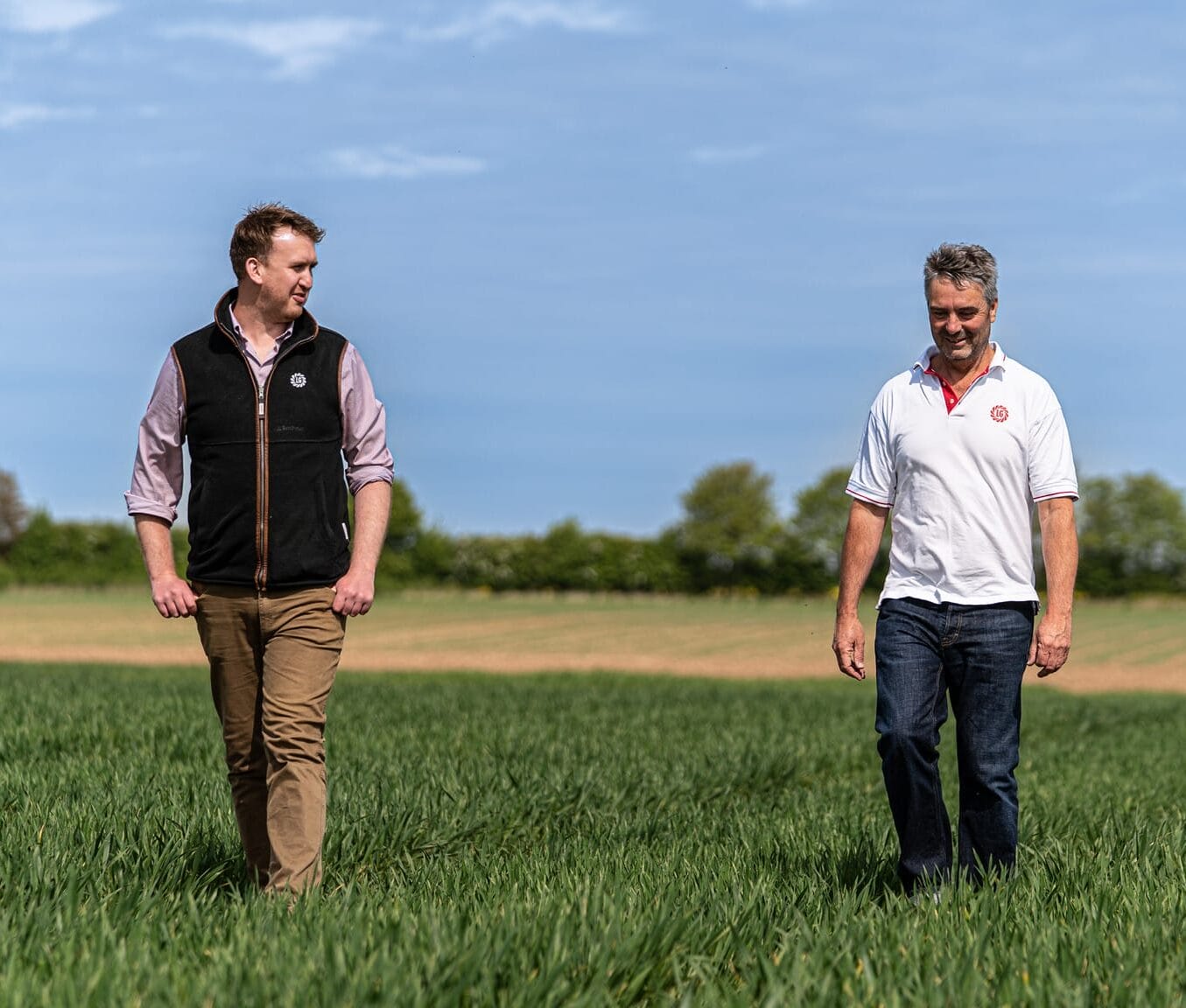
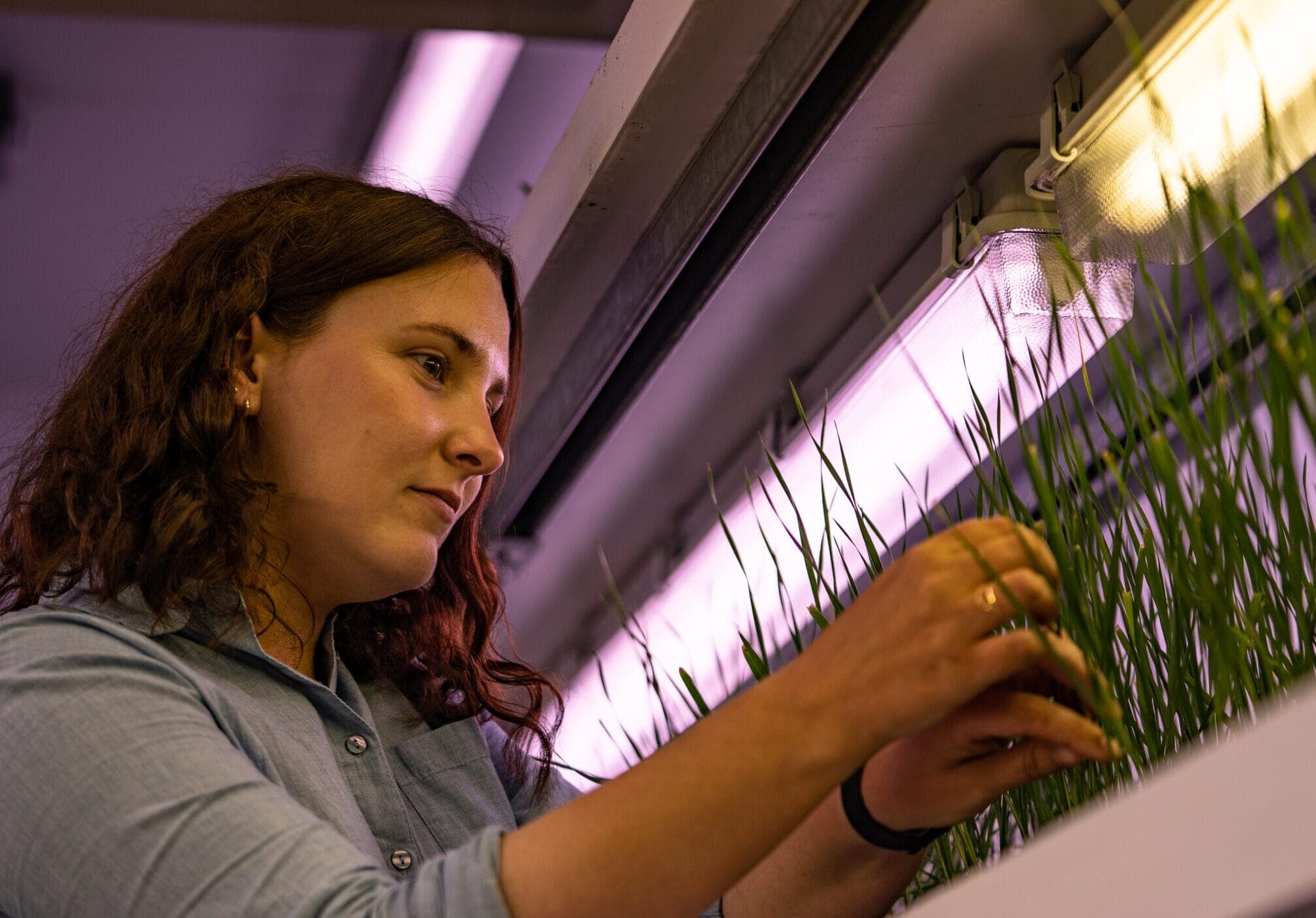
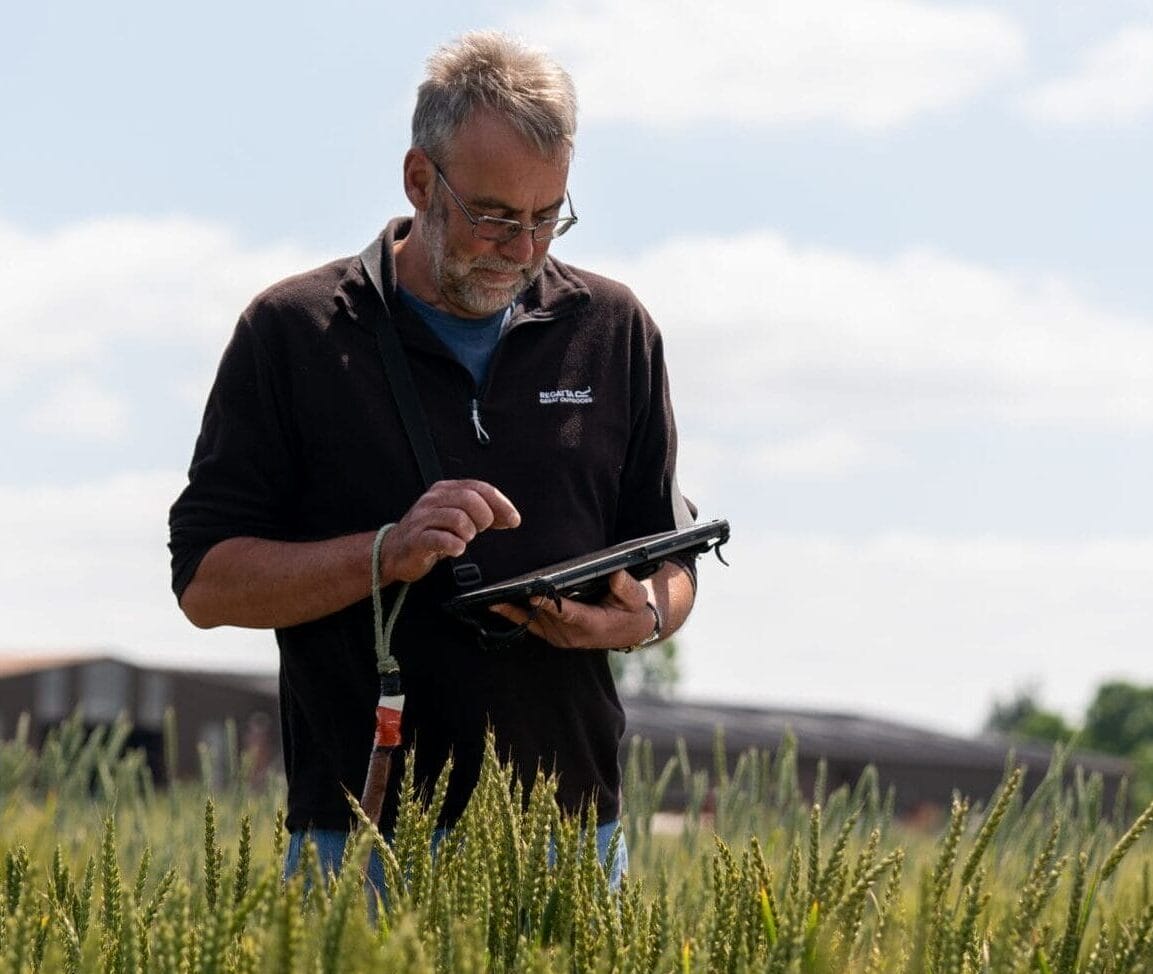
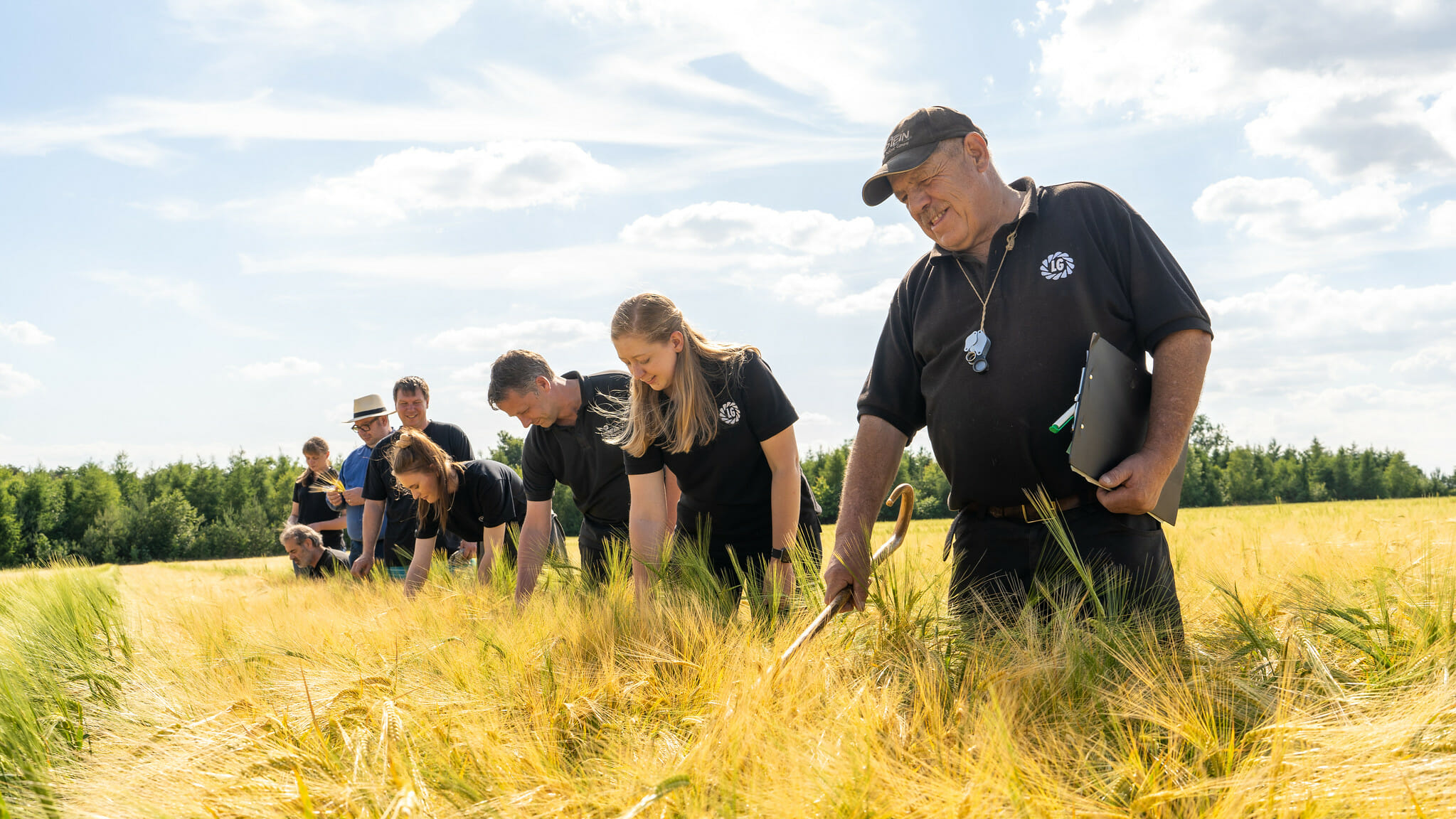
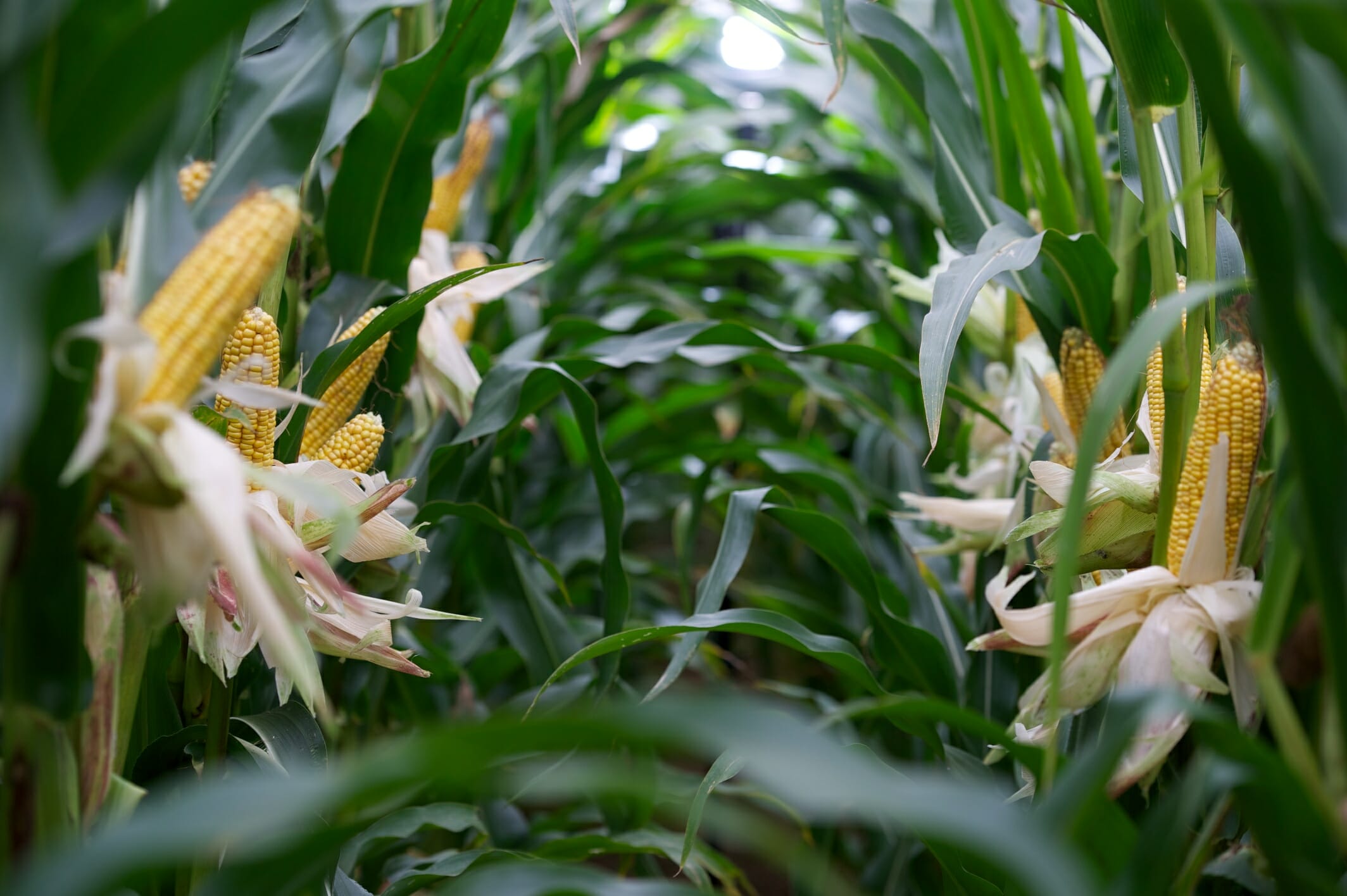
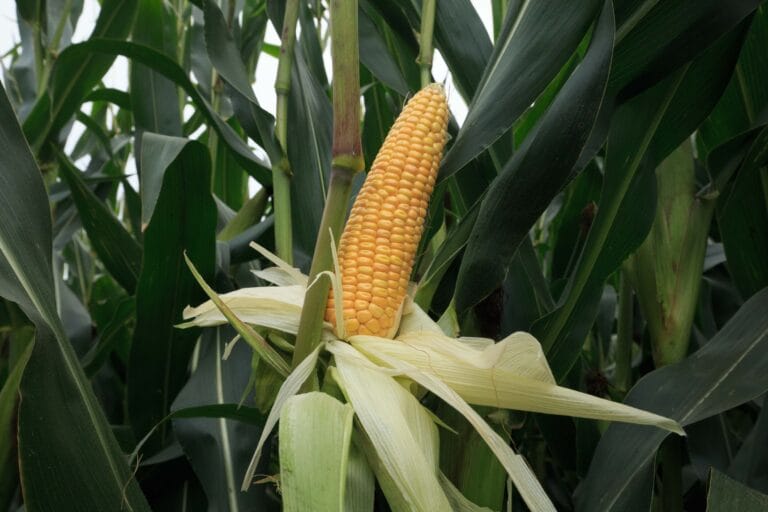
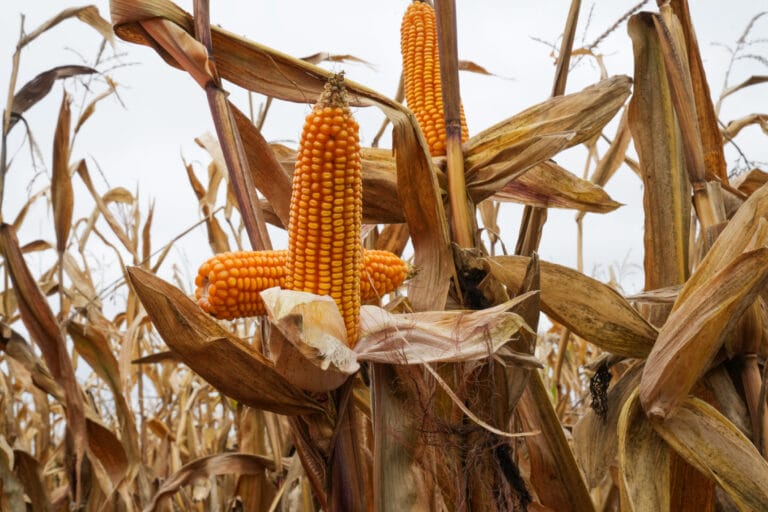



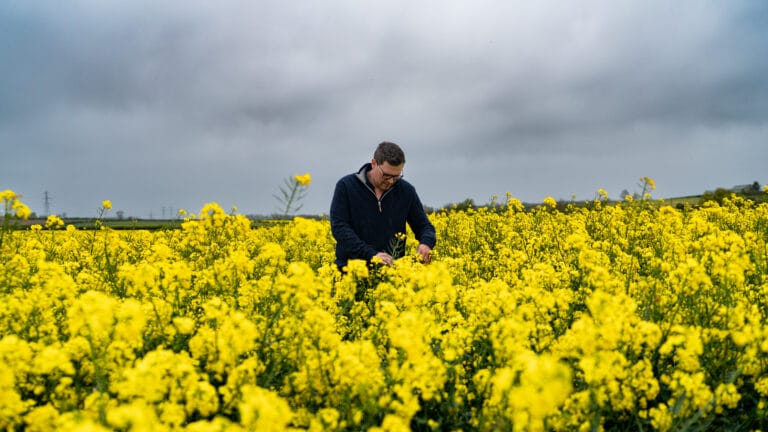
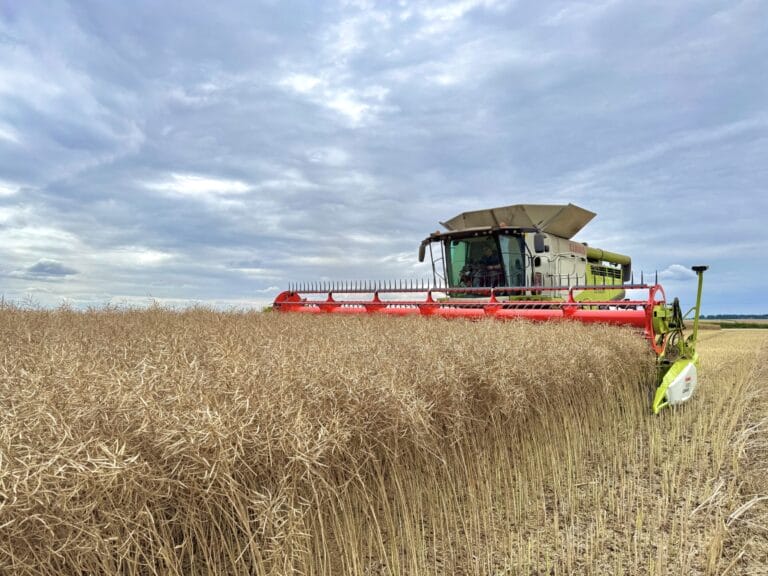


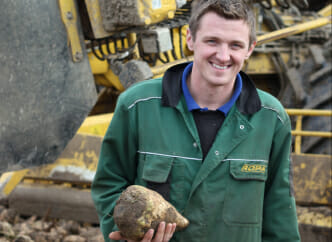
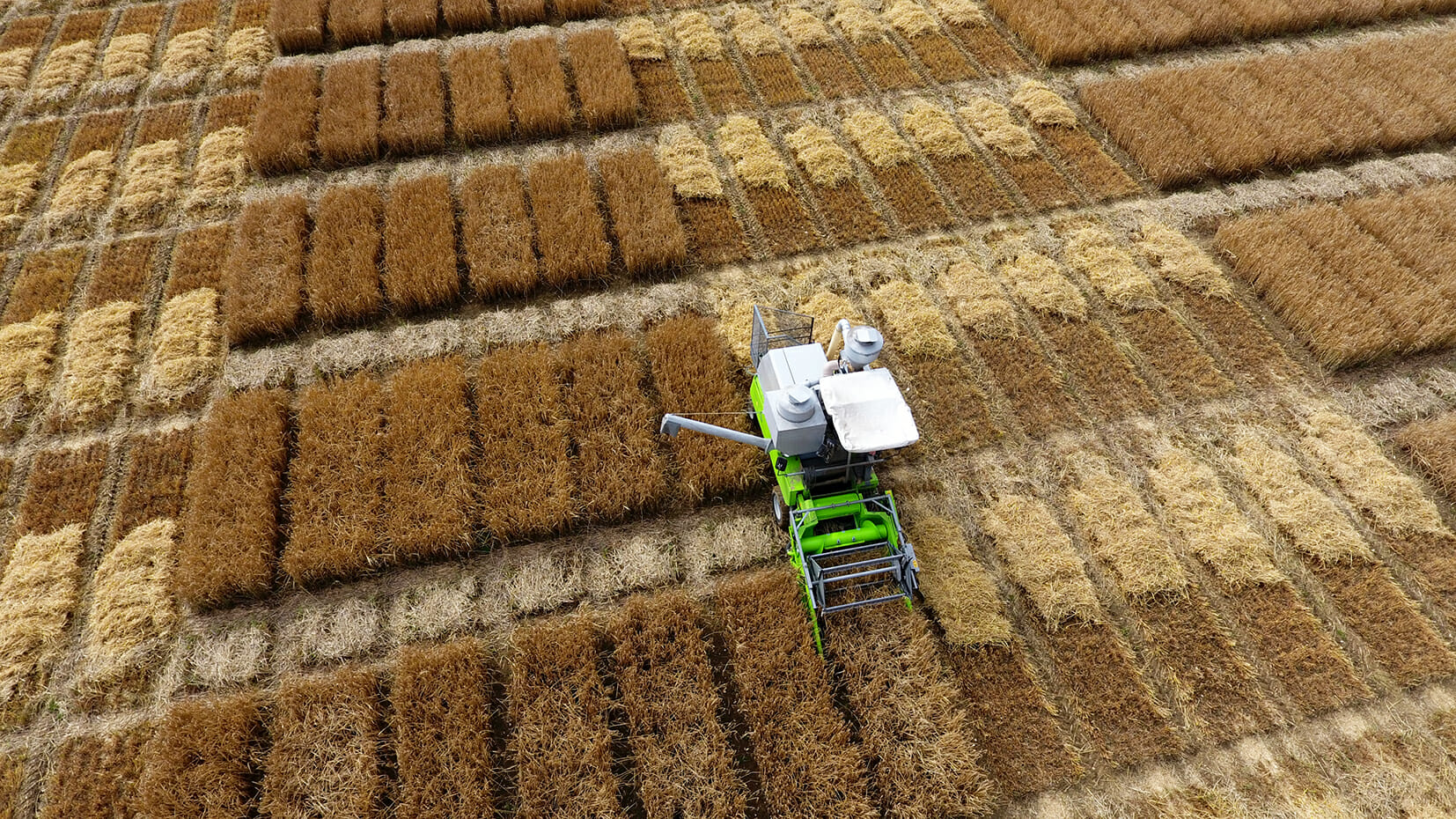

Located just outside Uttoxeter in Staffordshire, Rob Atkin manages a 1,000-acre farm with a focus on arable cropping and grass -fed, home-reared cattle. As a third-generation farmer, he works alongside his father Peter, combining experience with a practical, forward-thinking approach to land management.
The farm operates across a wide range of soil types, from organic-rich alluvial soils to heavier, more challenging clays; Mixed – light alluvial (9–12% OM) to heavy clay (3–4% OM).
To maintain soil structure and workability, Rob has used a shallow tillage system since 2003, working to a depth of 10–15 cm, but remains flexible — what he refers to as “thoughtful farming” — adjusting his methods according to seasonal and soil conditions.
The cropping strategy is designed around maximising first wheat performance while maintaining oilseed rape (OSR) as a break crop just once every five years. The rotation includes wheat, barley (winter and spring), oats, beans, maize, and OSR. Cattle are fed using home-grown rations based on forage maize and beans, contributing to a fully integrated farm system.
How many different varieties are grown and how long is a variety grown for?
Wheat: LG Beowulf, LG Rebellion, Oxford, Bamford, LG Typhoon
Winter Barley: LG Caravelle
Spring Barley: LG Diablo, Planet, Skyway
Oats: Ascani
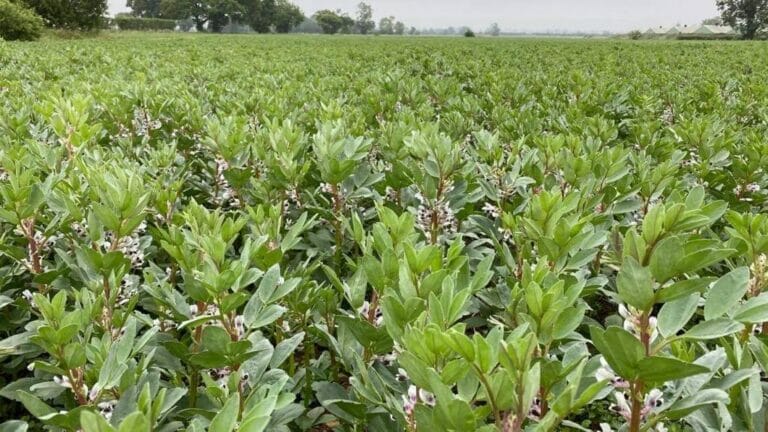
Beans: LG Raptor (spring), Tundra (winter)
Maize: KWS Leto, LG Gema
Rob grows a wide range of varieties tailored to different roles in the rotation.
His current wheat portfolio includes LG Beowulf, LG Rebellion, Oxford, Bamford, and LG Typhoon, grown for feed and marketed through Openfield and ADM. He aims for around 8.5t/ha.
“A variety is typically grown for two to three years to assess performance across different seasons. If it continues to deliver strong results, it remains in the programme until yield performance begins to decline,” he explains.
Barley plays a smaller role in the rotation, with 13–14 ha of winter barley (currently LG Caravelle) and around 80 ha of spring barley split between LG Diablo, Planet, and Skyway.
OSR remains an important break crop, typically covering 50–60 ha. While the farm has long favoured Dekalb hybrids, this season Rob is trialling LG Armada and LG Avenger to evaluate their performance.
Rob prefers to use local trials when looking at new varieties to grow. “ We are an Agrii iFarm and host trials for then, so that gives us an invaluable insight to how varieties will grow on our farm, I also judge for the Staffordshire Agricultural Society so get to visit farms in the region and look at a range of different varieties that way.”
What characteristics are most important to you when choosing a variety?
For Rob, yield remains a key priority — but not at any cost. He looks for varieties that offer good performance without needing excessive inputs.
“Yield is always important,” he says, “but I want that to come without ridiculously high inputs— we are not interested in a variety that requires high spend to push for yields.”
High disease resistance is just as critical. “That’s really linked to yield and just as important,” he adds.
Crop vigour is another major consideration, both in autumn and spring. “I’d much rather be managing a forward crop in March than trying to catch one up.”
Early drilling suitability rounds out the main criteria, as drilling around the third week of September is standard practice on the farm. “Any later than this and crops just don’t have the time to get the tillers on before the winter.”
1. Yield
2. Disease resistance
3. Vigour
4. Early driller
Have these characteristics, or weight of importance, changed over recent years?
No! Rob believes his priorities in variety selection have remained consistent. While environmental and regulatory pressures may be evolving, the fundamental traits he values have stayed the same.
“It’s always been about finding the right balance between yield and reliable agronomics,” he says.
Why LG varieties?
LG varieties feature strongly in Rob’s rotation because they offer a practical combination of yield and agronomic strength.
“In my view, LG produces farmer-friendly varieties,” he explains. “They’re high yielding, but they’re also clean, vigorous, and manageable. That gives us a kind of yield security — and that’s worth a lot.”
He also values how clearly LG varieties are positioned in terms of agronomy and management. “Take LG Typhoon — it’s well suited to early drilling, and it’s a very clean variety. You know where it fits and how to get the best out of it.”
How have the varieties performed this season?
Crops are performing well so far, with low disease pressure across all varieties. Rob reports that the season has allowed for a reduction in fungicide inputs, helping to control costs without compromising crop health.
“Disease levels have been low this year, so we dropped the T0 spray. We’ll go in with a T2 as the flag leaf pulls away from the ear — what I call a ‘head & shoulders’ spray.”
To compensate for the lighter fungicide programme, Rob has focused on supporting plant health through nutrition:
• Nitrogen: All wheat crops receive around 200 kg/ha in three splits, with early applications of sulphur
• Micronutrients: Particular attention is paid to managing trace elements, especially on the alluvial soils where nutrient availability can be more variable
• Spring applications: Crops received boron, sulphur, magnesium, and manganese to support key growth stages
“On the light soils, trace elements like magnesium and manganese are critical. If they’re not available when the plant needs them, it shows.”
“Among the wheats LG Beowulf and LG Rebellion are looking very clean this spring, and in the dry conditions appear to be holding on better than other varieties.”
OSR crops are also showing promise, supported by slurry applications pre-drilling and targeted spring nutrition.
“LG Armada has held onto its petals just that little but longer than other varieties, so hopefully this will play out in numbers of pods.”
• Early slurry helps establish strong root systems
• Spring sulphur is applied to maintain growth and yield potential
• A cost-effective fungicide approach is used — selecting varieties with good phoma and sclerotinia resistance is essential
“We don’t overspend on fungicides for OSR — that’s why varietal resistance is a key factor for us.”
Introducing LG Legends grower, Ryan McCormackRyan McCormack is the Farm Manager at Dennington Hall Farms based in Suffolk. Dennington Hall Farms is a 1,600ha combinable crops and sugar beet operation.
Since joining the business in May 2022, Ryan has developed a diverse cropping rotation, set a new machinery strategy to suit a regenerative approach and is creating a forward-thinking team culture.
With a key focus on soil, air and water health, Ryan now operates a 12-year cropping rotation, integrating grazing livestock across arable land, moving to variable rate liquid fertiliser, reduced tillage and a block of Wildfarmed Bi-cropping.
Ryan is BASIS and FACTS qualified and has a continued passion for data, innovation and technology. He achieved silver in the British Farming Awards, ‘Arable Innovation’ award in 2019 and is a member of the 68th Worshipful Company of Farmers. Ryan completed his Advanced Business Management Course in 2018.
Introduction
Dennington Hall Farms is a family-run 1,600-ha heavy land farm in east Suffolk, that has recently transitioned to a regenerative farming system as part of its ongoing commitment to sustainability and responsible land stewardship.
There is a particular focus on building the health of the predominantly heavy clay soils, promoting biodiversity, and sequestering carbon, through a range of techniques, including; reduced tillage, cover and catch crops, a diverse 12-year rotation, and managed grazing.
Cropping includes; winter wheat (mainly Group 4s for local feed markets), oats, spring barley, winter barley, sugar beet, vining peas, beans, mustard, oilseed rape, plus Wildfarmed bi-crops, cover and catch crops. Livestock – sheep from a neighbouring farm – are also integrated to graze cover crops.
How many different varieties are grown and how long would you grow a variety for?
This season, the farm is growing around 15 different varieties across all crops, plus several blends. Varieties include:
- Wheat: LG Typhoon, LG Redwald, LG Beowulf, Champion, KWS Extase, KWS Dawsum
- Winter barley: KWS Tardis, LG Caravelle
- Spring barley: LG Aquarius
- OSR: Campus
- Spring oats: WPB Isabel
- Three-way wheat blend trial of LG Redwald, Champion, and KWS Dawsum
- Wildfarmed blend of spring wheat, and Laureate spring barley
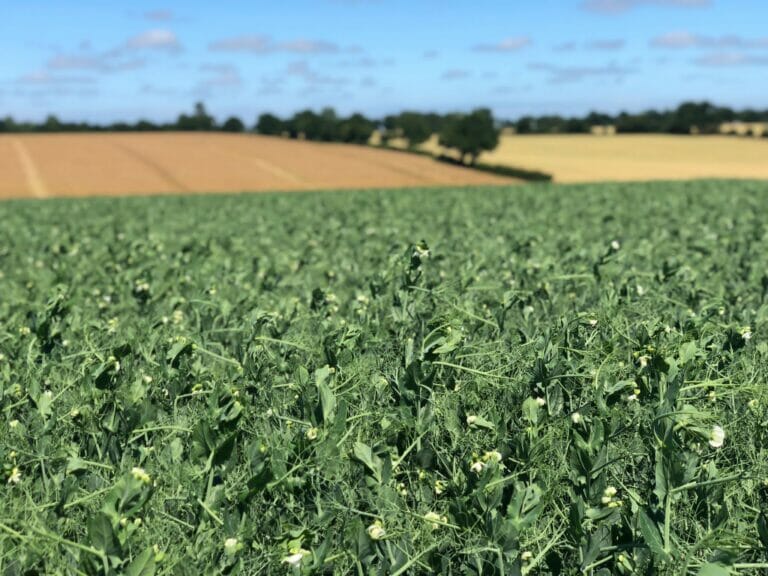
- One variety each of beans, mustard and vining peas
Farm manager Ryan McCormack says a variety is usually grown for three or four years (assuming no disasters in year one), before deciding whether to replace it with something else.
“That decision depends how strongly it has performed; there’s no real timescale for how long we’ll keep any variety for. Generally, we’ve got four or five mainstream varieties, and every year we look at what’s new, what’s going to work for us, and then replace the weakest of those main varieties.”
Sometimes a new variety may be trialled on a small 30-40ha area first if there are potential question marks over how it might perform, but he may also commit a whole 100ha block if confident in its potential – as was the case with LG Beowulf and LG Typhoon this season.
What characteristics are most important to you when choosing a variety?
While yield is important, Mr McCormack’s aim is to select varieties that also have good agronomics and characteristics to suit the specific requirements of different parts of the varied rotation.
“After sugar beet, for example, we’re looking for something that gets up and away quickly, and has high vigour, even if sown late into sub-optimal conditions, which is where LG Redwald fits in.
“On other parts of the rotation, we’re looking at lowering our inputs and reducing cultivations, so that’s why LG Typhoon was chosen, as it can be direct drilled, knowing that we’ll get a good plant stand – it has that agronomic advantage over some other varieties.”
Have these characteristics, or weight of importance, changed over recent years?
The farm’s approach to variety selection has evolved with the move to regenerative farming, Mr McCormack says, with greater focus now given to finding the agronomic characteristics that suit specific situations, to improve yield security.
“Traditionally the farm would have been more intensively cultivated, drilled early, looking primarily for high yields, and not necessarily focused on agronomics, gross margin, or soil health when looking at varieties.
“But in recent years, we’ve been focusing much more on gross margin and the other aspects that varieties can bring to the party, not necessarily just looking for ‘barn fillers’. Yield is still important, but it’s about finding varieties that also have good agronomics that suit our soils and the situations we’re putting them in.”
Why have you chosen LG varieties?
This season, Dennington Hall Farms is growing 100ha blocks of three Limagrain varieties, LG Typhoon, LG Beowulf, and LG Redwald.
LG Typhoon was chosen primarily for its suitability to wider-row regen-type systems, says Mr McCormack. “We wanted a variety we could scratch in, or direct drill after legumes, and LG Typhoon seems to be the choice for regenerative farming, given it can go into a very min-till, or direct-drill situation and produce a good plant stand. Agronomically it’s very pleasing and has good yield potential.
“It has definitely got different characteristics to other varieties; it spreads and stays quite flat to the ground over winter, which is good for wider rows, or direct drilling scenarios, where you want a developed canopy to smother any grassweeds before stems start extending.”
He also values LG Typhoon’s suitability for earlier drilling. “We’re not drilling really early, but typically look to start in the first week of October with LG Typhoon, and aim to finish by the end of October.”
LG Redwald, grown for the first time in 2023/24, was chosen for its vigour when being sown later in the autumn after sugar beet. “LG Redwald is known for being very vigorous, and might seem a risky choice for highly fertile, heavy soils, but if it’s being drilled late into a sub-standard seedbed after sugar beet, you want that extra vigour to grow away and still yield well.”
Another new addition this season is LG Beowulf, grown as a first-wheat after oilseed rape. “I saw it twice in trials last year and for me, it was the stand-out variety for its agronomics, yield potential, and vigour,” says Mr McCormack. “I’d describe it as the ‘heavy land LG Redwald’.
“LG Beowulf is clean, high yielding, and has good vigour, but suits our fertile, heavy soils. It’s everything we want from a variety right now.”
LG Redwald also features in a three-way blend alongside Champion and Dawsum, which is being trialled to see if mixing genetics and agronomics can help reduce disease pressure, improve plant stand, and maximise yield.
The farm is heavily into conservation, so avoids using insecticides wherever possible, therefore having Orange Wheat Blossom Midge resistance in all three Limagrain varieties helps in that respect, Mr McCormack notes.
How are the varieties performing to date and have you managed them differently this season?
At the time of writing, approaching the T2 timing in mid-May, Mr McCormack says the 100-ha of LG Beowulf after oilseed rape looks the strongest of the wheats.
“It looked well all winter and early spring, although the lack of rain is a concern for all crops. Coming into spring, it looked like a 12 t/ha crop of wheat, but if I had to put a figure on yield now, I’d say it’d be nearer 11 t/ha, which is still very good. That might reduce to 10 t/ha if we don’t get any rain in the next three weeks though.”
Mr McCormack says a different establishment approach was tried on some fields of LG Beowulf this season, whereby a summer catch crop went in after the OSR harvest, which was mob grazed with a neighbour’s sheep, before direct drilling LG Beowulf on 27/28 October. “That’s later than most people would drill first-wheat after oilseed rape, but it was a good opportunity to bring a catch crop and livestock into the rotation. It also improved soil resilience to a spell of heavy rain in mid-October.”
Given the dry spring, the LG Beowulf has only received liquid fertiliser, while other varieties have had a 50:50 split of granular and liquid fertiliser.
Disease pressure has been relatively low across all varieties, with no real issues seen thus far, other than odd incidences of rust and Septoria, Mr McCormack says. As a result, he has been able to reduce fungicide spending at the T0 and T1 timings, adjusting both product choices and rates to risk and yield potential.
The later-sown LG Redwald has so far received the lowest fungicide input, reflecting the fact that yield potential has been compromised by an estimated 1-1.5 t/ha due to late sowing after beet, and a very dry spring, he says. The more open canopy also means ground has dried out slightly more than in the other LG wheats where larger canopies have provided more of a shading effect, he notes.
While fungicide inputs have been reduced overall, this has been supported with additional micronutrients, such as manganese and magnesium, to build plant health and natural disease resilience.
Mr McCormack says LG Typhoon has stayed true to its characteristics, remaining close to the ground in early spring, before a dramatic change in late April/early May as growth started to extend upwards.
“Now it’s looking good, and more vigorous. If I had to put a yield on it at this stage, I’d say it’s on the ‘good’ spectrum, at around 10 t/ha, providing we get some much-needed rain in the next few weeks.”
The blend trial looks well, although he admits the dry conditions have not really tested the aims of the trial. “We haven’t had the disease pressure, nor have we been increasing fertiliser due to massive yield potential, so it’s hard to judge performance. Crops look well from the field edge, but once you get into them, you often find they haven’t put huge amounts of biomass on.”
Finally, if a breeder gave you three wishes for varietal traits what would they be?
One key trait would be to have mainstream wheat varieties with resistance to barley/cereal yellow dwarf viruses (BYDV), to remove the need for using any insecticides in the autumn, says Mr McCormack.
Ergot is another issue that can be “a bit hit and miss”, so removing that through varietal breeding would be beneficial, he says. Another is gout fly resistance, as that seems to be becoming an increasing issue, he adds.
“Finally, if I were to fast forward 20 years, we’d be looking to grow varieties that allow us to be fully self-sufficient, so we’re not having to buy in lots of fertiliser and we can supply the nutrients required.”
Growing Crops for Seed ProductionIndependent crop consultant Pat Thornton, farms 150ha’s of arable land at Low Melwood Farm, Owston Ferry, North Lincolnshire, and has grown cereal and pulse seed crops for Limagrain for the last six years.
We asked him about the pros and cons of growing crops for seed.
What are the main benefits of growing crops for seed?
Growing crops for seed adds value to what I already grow across the rotation. It gives me a premium on top of a standard feed crop. One of the most exciting aspects is seeing new genetics in action before they become widely available. It’s great to be part of that development process and see how these new crops perform in real farm conditions. I have direct access to the breeder, which is invaluable for understanding the crop and getting expert advice. Seed crops are also collected relatively quickly at harvest, helping to move crops on faster; and this helps with cash flow.
Are there any challenges associated with growing crops for seed?
Yes, growing seed crops requires stricter quality control and attention to detail. There are specific requirements for purity and disease management, which means I must follow precise guidelines to meet standards. We have to be extra vigilant about weeds like wild oats, which can be an issue, and blackgrass, which is a particular challenge on my heavier soils. To manage this, I tend to grow seed crops on my cleaner fields.
Is storage capability an issue?
Storage is an important consideration because seed crops need to be kept separately to maintain purity. This means having dedicated storage space and ensuring it is well-managed to meet seed quality standards.

Pat Thornton of Low Melwood Farm.
This year Pat is growing LG Beowulf and Tundra winter beans. Pat has grown Tundra for a few years now and is looking forward to seeing the new genetics coming out of the LG pulses breeding programme.
Find out how becoming an LG seed contract grower can benefit you. Contact Victoria Smith on:
T: +44(0)1472 370159
E: victoria.smith@limagrain.co.uk
This article is featured in the June 2025 edition of GatePost. Click here to read the full edition.
The Benefits of Winter Barley in a UK Crop RotationThe inclusion of winter barley can significantly enhance productivity, as well as economic and environmental sustainability on farm. Unfortunately, in recent years, there has been a decline in the winter barley area planted, similar to oilseed rape, likely due to depressed commodity prices.
The versatility of winter barley, particularly in combination with oilseed rape, should not be overlooked. This is especially relevant with the launch of Limagrain’s Cabbage Stem Flea Beetle resilience oilseed varieties this Autumn.
Improved Soil Health
Winter barley has a positive impact on soil health. It acts as a cover crop, protecting the soil from erosion and nutrient leaching during the winter months. Its root system improves
soil structure, increases organic matter, and enhances water infiltration, all of which contribute to long-term soil fertility.
Weed Suppression
Winter barley is effective at suppressing weeds. Its rapid establishment and dense canopy outcompete many weed species, reducing the weed seed bank and minimising
herbicide use. This lowers production costs and promotes sustainable farming by reducing inputs.
Flexibility, Pest & Disease Management
Incorporating winter barley into the rotation can break the cycle of pests and diseases. For example, it reduces the incidence of take-all and eyespot. Staffordshire farmer Rob Atkin mentions that “being able to drill varieties with high yield potential, like LG Caravelle, means we can drill early. Early September drilling helps take the pressure off, and we’ve grazed forward winter barley crops with sheep for extra feed into winter.”
Limagrain’s Cereals & Pulses Product Manager emphasises that winter barley requires earlier foliar applications than winter wheat. This consolidation of workload allows for more effective attention to crop needs.
Newly Recommended variety LG Carpenter and RL Candidate LG Catapult are both BYDV tolerant. BYDV in severe cases can lead to significant crop losses, up to 50% in severe cases, reduced tillering, yellowing and stunted growth, and delayed maturity. LG Catapult is a competitive two-row feed variety, with short straw, good standing, a robust disease package, and high yield potential; a clear step forward in winter barley breeding.
Yield Stability and Early Harvest
Winter barley is less affected by adverse weather compared to spring-sown crops, ensuring reliable yields even in challenging growing seasons. Additionally, it matures earlier, allowing for an earlier harvest, which frees up time and resources on farm. Helping to spread workloads and save costs. Varieties like LG Capitol, which performed well on Luke Palmer’s farm, near Cambridge, yielded 9.5t/ha in 2024. The years of breeding, attention to detail, and collaboration between farmers and breeders, are showcasing excellent results.
Economic Benefits
Due to adverse weather in Autumn 2023, many farmers planted spring barley in 2024, leading to depressed prices. Over the last decade, winter barley has been a profitable addition for farmers. Its early harvest provides early cash flow, and the straw offers an additional income stream. The reduced need for inputs also lowers production costs.
Environmental Benefits
Winter barley plays an essential role in reducing soil erosion, improving soil health, and lowering input needs, making it a key part of a sustainable farming system.
Conclusion
Winter barley offers numerous benefits, including improved soil health, weed suppression, pest and ” disease management, yield stability, and economic and environmental advantages. For these reasons, it should remain a valuable addition to any crop rotation.
This article is featured in the June 2025 edition of GatePost. Click here to read the full edition.
Wise Variety Choice Builds Yield SecurityFrom unpredictable weather, to evolving disease threats, there are numerous risks to crop profitability; some of which can be managed,
or at least mitigated, with careful variety selection, says our arable technical manager, Ron Granger.
Yield remains a top priority when choosing what to grow, but the key is selecting proven varieties that deliver “yield security” across multiple, often very different seasons, by combining yield potential with agronomics and disease resistance, suited to specific situations.
Yield security is something Limagrain is providing, with a range of exciting hard wheat varieties, including LG Typhoon, LG Beowulf, LG Rebellion, and two new Candidates for 2025, LG Challenger and LG Defiance.
LG Typhoon has been on the RL for three years, and has proven popular with many agronomists and farmers, especially those drilling early and with wider-row
regen-type systems. It has an excellent disease resistance profile, especially for yellow rust (9) and Septoria tritici (7.2). This, combined with orange wheat blossom midge (OWBM) resistance, good specific weight and agronomic characteristics of a slow, prostrate, growth habit, and high tillering ability, all suit such situations.
These characteristics make LG Typhoon a great all-round package, but it should not just be considered as an early drilling variety. It has proven to be a great all-rounder, showing good results when drilled later, affording extra flexibility should the weather disrupt plans.
LG Beowulf takes genetic gains further, building on its strong Costello x Gleam parentage. It offers robust disease resistance, rated 9 for yellow rust, and 6.6 for Septoria tritici, stiff straw, strong tillering, OWBM resistance and excellent grain quality, particularly specific weight. LG Beowulf has all the key agronomic attributes for securing yield potential, with proven performance across different situations, soil types, drilling dates, and regions. It is a variety that offers great all-round flexibility, suiting most on-farm situations, and is certainly one for consideration this Autumn. It also has faster Spring growth than LG Typhoon, which could make it a better option for those concerned about black-grass and wanting to maximise crop competition. Another variety with variety with growth is LG Rebellion. Although not on the RL, it has performed consistently well over the past three years in official trials and Limagrain remains fully committed to it for the coming Autumn, confident that it offers a differential package to many other hard feed wheats. LG Rebellion capitalises on its KWS Extase parentage, offering more rapid Spring growth, high untreated yield potential, and good grain characteristics, with the bonus of Pch1 eyespot resistance.
Early maturity is a particularly valuable asset for spreading harvest date and the potential for land preparation or an early entry into oilseed rape.
LG Rebellion is more suited to the main and late drilling window, performing well on all soil types, but probably warrants special consideration for more testing, lighter and medium-bodied soils where varieties with faster growth, earlier maturity, and good specific weight are considered beneficial. It also suits growers wanting to sow a hard wheat after late-lifted root crops, veg,
and maize. Yellow rust is something to watch out for on-farm, but recent seasons show all varieties – even those with the highest resistance ratings – should be monitored, given the pathogens constantly evolving nature.
Raising the Bar
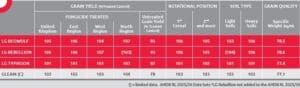
The two exciting new Candidate varieties, LG Challenger and LG Defiance, promise to raise the yield potential bar further, backed up by high untreated yields. They mark the latest results of ongoing Limagrain breeding development, bringing new hard wheats to the UK market.
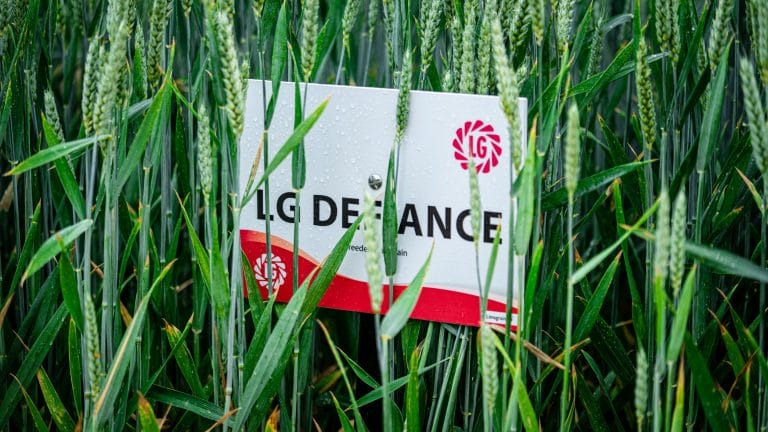
LG Defiance builds on its Gleam x KWS Extase parentage, offering the second-highest treated yield of all Candidate varieties (111); slightly ahead of three-way cross, LG Challenger (108). LG Defiance is more of a KWS Extase-plant type, but with a slower Spring growth, suiting the mainstream to late drilling window.
LG Challenger, in contrast, sits tighter to the ground and tillers better, which is likely to make it a more suited option for earlier drilling and Northern regions, based on limited data.
Both have OWBM resistance and good grain quality, although LG Challenger has a slight edge on specific weight and Hagberg.
With hard feed wheats accounting for around half the UK wheat market and likely to feature heavily again this Autumn, selecting a variety that fits your situation and offers yield security is key to maximising returns, whatever next season throws at us!
This article is featured in the June 2025 edition of GatePost. Click here to read the full edition.
Applying regen practice to commercial farmingRegenerative farming has become a bit of a polarising subject amongst growers in recent years. There are those who reject the term completely and others who have embraced it in its entirety. Generally, growers are adapting Regen ideas and practices in a way that fits their existing system, with a watchful eye on yields and overall profitability. Equally, breeders and machinery manufacturers alike are paying attention to this trend and innovating accordingly.
“The question we often get asked is whether we are creating the right varieties for regenerative farming systems,” says Ron Granger, arable technical manager at Limagrain.
Though untreated yield figures and disease resistance ratings are useful, there’s no data on varieties grown in wide rows and established by direct-drilling, both of which are typical of the approach. Similarly, the use of inter-row cultivations or companion cropping with wheat may require plants with a specific growth habit and speed of development.
Ron remarked, “What was interesting was the finding that 43% of growers we surveyed in a recent re-gen poll said the RL data isn’t extensive enough for selecting varieties for these systems. It was a real ‘could do better’ moment.”
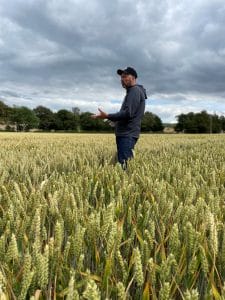
Factors like consistency, yield and disease resistance have always been integral to the development of new varieties. These are even more important when you consider a variety suitable for regen. Ron also lists attributes such as tillering ability and plant growth habit as well as rooting and grain quality as key considerations.
Cultivation is a basic tenant of regen practice and increasingly farmers are looking for varieties that work with their latest machinery purchase and suit the no or minimal tillage approach.
“From HORSCH’s perspective, it is encouraging to see seed breeders developing and trialling new seed varieties specifically designed for direct drilling and minimum tillage practices. While HORSCH offers a comprehensive range of seeding and tillage equipment, recent trends have shown a shift towards low-disturbance and direct drilling methods. As a result, the outcomes we have observed with LG Typhoon are particularly promising.“
Limagrain have been proactive in testing varieties on farm in a Regen situation. This has resulted in internal endorsements for LG Typhoon and LG Redwald, with the newer varieties LG Beowulf and LG Rebellion also under testing and in the running for consideration for the future.
Join The RebellionThe AHDB Recommended List has traditionally served as a catalogue for wheat growers when it comes to selecting varieties for the coming season. Breeder’s compete for the top rankings in this publication each year. With increasingly tough growing conditions, ever tighter margins on farm and stricter legislation on nutrition and chemical inputs. Some farmers take a more granular approach when it comes to varietal selection, 43% of growers in a survey conducted by Limagrain said the RL data isn’t extensive enough for selecting varieties.
“Whilst recommended varieties are often suitable for the more conventional farming systems, there’s a case to be made for selecting varieties tailored towards less orthodox systems” suggests Ron Granger, LG’s arable technical manager.
As a plant breeder at the forefront of food production, we believe good genetics are the backbone of our agricultural economy in the UK, and it appears farmers agree! We received 900 responses to our survey of wheat growers, with further thoughts and ideas gathered during focus groups and stakeholder interviews it was made abundantly clear that disease and pest resistance is key when selecting a variety. Other agronomic features such as good grain quality and high, stable yields were also highlighted.

Ron Granger – Arable Technical Manager
Senior wheat breeder, Phil Tailby confirms, “this is very much aligned with the strategy and key objectives of the Limagrain breeding programme in the development of new varieties.
LG Rebellion, despite its unlisted status has demonstrated a very consistent high treated yield over both seasons and regions (UK 106%) This is backed up by an impressive untreated yield (93%), performing consistently across three contrasting high pressure disease years. Although the variety has a good disease resistance profile and has shown very high untreated yield, Yellow Rust was seen in some regions on the variety in 2024 and Limagrain’s technical team suggest that this should be monitored, and if present, treated accordingly to maintain high yield potential on farm.
LG Rebellion has the desirable attribute of early maturity, breaking the trend for later maturing varieties delivering the highest yields. With increasingly unpredictable weather patterns, and the shift in climactic conditions over the past few harvests, this has proved a great attribute on farm. The opportunity to spread both harvest period and workload, offers growers increased flexibility when it comes to things like land preparation and future cropping opportunities.
LG Rebellion has many of the desirable attributes of key consideration to growers. A high yielding feed wheat that demonstrates strong and consistent performance on farm, backed up by an earlier maturity and with excellent grain quality characteristics of a high hagberg and specific weight. On top of this, the variety has a wide drilling window and shows good results from October sowing onwards through to December, giving growers flexibility for sowing after root crops and maize
Limagrain considers this variety worthy of its place both on farm and in the market
#JOINTHEREBELLION
Reflections on the arable market going into 2025 – Dominic Spurrier – Commercial ManagerFollowing the extremely difficult autumn of 2023, we had hoped for a better 24, unfortunately it was not to be. British farmers are practiced at preparing for all eventualities, which is handy when the only consistent currently is change! Who knows what autumn 2025 will hold? In terms of crop choice, I am confident that the Limagrain portfolio has varieties to stand up to it!
On the back of an 11.1 million tonne wheat crop last harvest, this year’s AHDB Early Bird Survey surprisingly came in at only 1.6 million hectares, in recent times the average has been closer to 1.8. The Early Bird Survey shows further declination in winter barley, from the very small crop area planted in 2023. The decline in oil seed rape hectarage is marked, in terms of both production and area we are approaching a fifty-year low.
We know spring cropping can be seen as a get out of jail card for arable farmers, but is there a mindset change happening? Will this impact cropping choices and varietal selection next autumn?
Last year’s growing season did not offer a very clear picture on performance of individual cereal varieties. Disease was prevalent, crops went in late and were stressed from the go. The story is clearer when comparing varieties across consecutive growing seasons.
The varieties that have demonstrated consistent resilience both in trial and on farm across the previous 3 to 4 years are the ones that I would be choosing to drill again this Autumn. Consider LG Beowulf or LG Typhoon if you are looking for wheat, with LG Caravelle and LG Capitol great contenders for barley.
With oilseed rape the story is slightly different, though weather has of course played a significant part, it is the flea beetle that is having the greatest impact. Limagrain has listened to the concerns of growers, and through our skilled UK based breeding programme, we are actively selecting varieties that show a resilience to flea beetle, that alongside solid IPM strategy will work to mitigate the devastating crop loss experienced in previous years.
Barley Yield is all about Tiller RetentionSpring barley was a get-out-of-jail card for some growers last season, after wet weather prevented autumn drilling, yet many crops went on to deliver above average yields.
Why they performed so well owes much to the age-old issue of tiller retention, Ron Granger says.
Maximising spring barley yield is all about retaining maximum tillers through to harvest. In some seasons, prolonged dry periods can cause crops to drop tillers and reduce this potential, yet last year, plentiful moisture availability throughout the growing season benefitted many spring crops, especially on lighter land. We cannot control the weather, but there are five actions that will help barley produce and retain as many tillers as possible this spring. Such foundation work is essential, whatever the weather.
1. Select The Right Variety
Choosing a variety with greater tillering ability drives yield, and having more tillers helps crops compensate for tiller loss, should stressful conditions arise.
2. Wait For Optimal Conditions
While earlier drilling can increase yield potential, this may only be possible on lighter, free-draining land that dries and warms faster than heavier soil. Barley must go into a
good seedbed with warming soils and temperatures to germinate and establish quickly, so be patient.
3. Optimise Seed Rate
For high yield potential, aim for a final tiller count of 775-800/m², and work back from this to calculate seed rate, varying according to soil type, drilling date, seedbed conditions and weather. LG trials indicate 350 seeds/m2 is optimal for more vigorous, higher tillering varieties drilled in ideal conditions around mid-March, although 300-325 seeds/m2 might suffice if drilling
into an “onion bed”. Later drilling dates reduce tillering potential, so once into April, closer to 400 seeds/m2 may be more appropriate. Higher seed rates should also be considered for black-grass control.
4. Tailor Nutrition
Balanced macro and micro nutrition improves rooting and canopy development, which benefits tiller survival. Apply most nutrition early, to the seedbed or soon after drilling. Don’t be afraid to push new, higher tillering varieties with more nitrogen. In continued LG trials, an extra 30 kg N/ha applied in the second split generated 0.5-1 t/ha extra yield in some varieties, with crops still achieving low grain N.
5. Minimise Weed Competition
Weeds compromise crop establishment and tillering capacity, so drill into good condition and control early weed growth with effective chemistry sets that do not “knock” early plant development.
For more information, watch our spring barley agronomy series.
Join the RebellionGrowers looking for a strong-performing winter wheat that they can sow late this autumn and harvest early next year, should consider the hard Group 4 variety, LG Rebellion, from Limagrain Field Seeds UK.
The variety builds on many of the agronomic strengths that made KWS Extase such a popular choice on farms, but brings with it higher yield potential and even earlier maturity.
“It’s a high yielding hard feed wheat and has shown very consistent high yield potential across testing seasons and regions, with additional desirable agronomic characteristics,” says Limagrain Field Seeds arable technical manager, Ron Granger.
Early maturity is a particularly valuable characteristic of LG Rebellion, offering growers in many parts of the country, north and south, a way to spread harvest workloads or provide an early entry for following crops, such as oilseed rape, he says.
LG Rebellion has strong tillering ability and good spring vigour, and suits drilling around the traditional October window. However, it can also perform well when sown later, into November, providing conditions allow, therefore could make a good choice for growers looking to sow wheat after later harvested potatoes, sugar beet, or maize, Mr Granger says.
“While LG Beowulf remains the highest yielding variety in late drilling situations on the present AHDB Recommended List, there is also a good opportunity for extended drilling dates with LG Rebellion, because it’s so quick out of the blocks regarding its vigour in the spring. It produces strong tillers and responds very well to PGR programmes.”
Another key strength of LG Rebellion is its consistently high untreated yield. The 2024 AHDB provisional harvest results (published 26 September) show that LG Rebellion delivered the second highest mean untreated yield over the four years to this harvest (2020-2024), at 117% of control.
This is partly due to an excellent disease resistance profile, especially for Brown Rust and Septoria, plus the variety also offers Pch1 eyespot resistance, which will be particularly important for growers looking to grow it in a second wheat situation, says Mr Granger. Indeed, LG Rebellion has performed well in second wheat situations, he notes.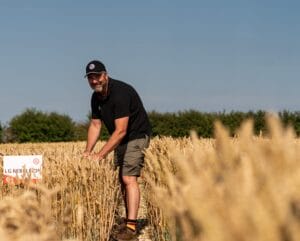
Grain quality is excellent, offering a high Hagberg and specific weight, although he reminds growers that it is a hard Group 4 feed wheat with ukp export potential, rather than a Group 2 quality wheat like its parent.
“It’s a KWS Extase derivative with 4% higher yield, offering yields comparable with the best hard feed wheats commercially available.
“But choosing a variety should never be just about yield,” he adds. “While yield is important, it’s also important to consider all of the other attributes that a variety offers growers on farm, whether that’s variety positioning, early maturity, disease resistance, or grain quality.”
LG Rebellion spreads workloads on Cambs farm
Cambridgeshire farmer Michael Brown grew 20 ha of LG Rebellion for the first time last season, utilising its early maturity to help spread harvest workloads on the 600 ha farm.
The variety was one of the last to be drilled before the weather broke in the middle of October last year, but despite that, it was easily the first to reach harvest, which this summer was on 30 July.
“The LG Rebellion established well last autumn, but it was in the spring that it grew away really quickly,” he remarks. “Throughout the spring, the variety was easily the most forward of all the wheats I grew.”
Mr Brown’s LG Rebellion also went on to produce the farm’s joint highest winter wheat yield last season, averaging 10.5 t/ha, with a specific weight of 78 kg/hl.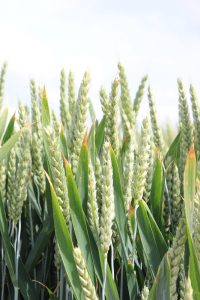
On the back of that strong performance, he is increasing the area of LG Rebellion for this season, with 30 ha being grown for seed, and another 30 ha as a commercial crop.
Alongside LG Rebellion‘s early maturity, Mr Brown also values its strong disease profile, as reflected by the high untreated yield.
“We grow a lot of crops for seed, so generally like to maintain a robust fungicide programme, but it’s good to have the varietal resistance as an insurance policy in the event that the weather prevents us getting on with sprays at the optimum time. There may be scope to reduce inputs slightly on the cleaner varieties, such as LG Rebellion, in the future, so that’s something we may look at doing.”
LG Rebellion
- –> Hard Group 4 feed wheat with consistent high yield potential
- –> Consistent yield performance over multiple seasons and across regions
- –> Very high untreated yield
- –> Good disease resistance profile, including Pch1 eyespot resistance
- –> Strong tillering with good spring vigour
- –> Very early maturity
- –> Suitable for drilling from early October onwards
- –> Excellent grain quality – ukp export potential
- –> A true replacement for growers of KWS Extase and its agronomic type
- –> Has shown good black-grass competition in external trials
The sisters LG Capitol and LG Caravelle are definitely doing it for themselves, and proving to be a force within the winter barley sector.
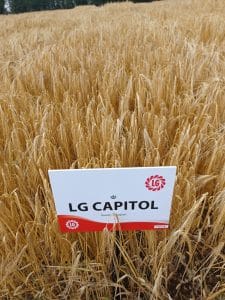
Winter barley sister varieties LG Capitol & LG Caravelle, continue to show a high consistency of yield performance in what is considered to have been one of the most testing seasons for winter cereals, ever!
Both varieties retain their positions as high yielding fully recommended 2-row feed varieties on the AHDB Recommended List harvest results mean 2024 (provisional results 28th August), with LG Capitol achieving 105.4% and LG Caravelle 105.2% of controls, for treated grain yield. Both varieties show a yield increase over KWS Tardis.
Ron Granger, Limagrain Field Seeds arable technical manager, shares his views on why both varieties have a place on farm this coming season.
LG Capitol has been the highest yielding 2-row feed variety for the last two seasons – just beating its sister LG Caravelle, by less than a decimal point!
He believes their excellent consistency of performance over some very difficult seasons is a headline note, with both varieties demonstrating this consistency of yield performance over not just seasons – but also across regions – as confirmed by AHDB RL harvest results for the mean of four years, from 2020–2024, which shows both varieties continue to sit at 106%.
He says the high yield potential of both varieties comes down to their increased tillering ability and this in turn also delivers valuable straw yields.
This excellent tillering ability of both LG Capitol and LG Caravelle, allows for as good black-grass competition as that offered by hybrid barley. In particular, LG Capitol’s performance on heavy soils which, generally favour black-grass populations, is the best of any of the winter barley varieties available, hybrids included.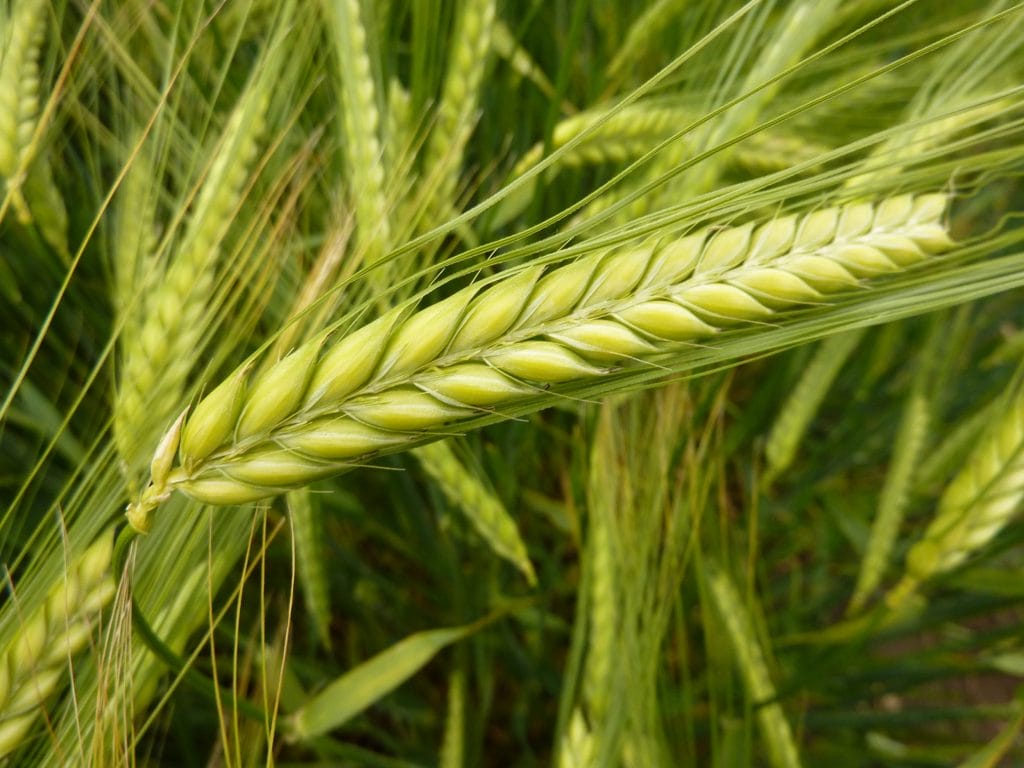
On farm characteristics
Mr Granger notes, agronomically, there are such subtle differences between the two sister lines but both varieties can be treated the same with regards to agronomic inputs and timings, as shown by results from Limagrain in-house agronomy trials over the last 2 seasons.
LG Typhoon is top performer in Leicestershire“It’s worth noting, LG Caravelle and LG Capitol winter barleys can offer a higher yield potential with better agronomics and specific weights compared to a second or third winter wheat, along with a reduced fungicide spend and an earlier harvest opportunity, if oilseed rape is back on the agenda.”
The first year of growing LG Typhoon proved to be a resounding success for Leicestershire farm and contracting business, F J Garner & Sons.
The variety out-yielded other wheats on the farm by around 25%, and produced a good grain sample, with big, bold grains, despite very challenging growing conditions throughout much of the year.
Extending to 420 ha of land, plus another 120 ha of contracting for neighbours, across a mixture of soil types, the farm tried 9.3 ha of LG Typhoon last year on the recommendation of seed merchant, Saxon Agriculture, explains Peter Garner.
“We like to stay one step ahead of the curve by growing new varieties, otherwise there is a risk you get left behind. It was only one field last year, so wasn’t a particularly big gamble.”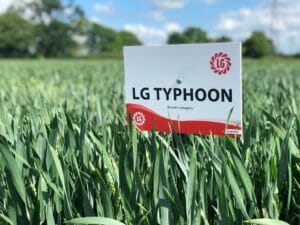
But it was a decision that paid off, after the crop, which followed oilseed rape and received biosolids prior to being direct drilled on 20 September, yielded an average of 11.4 t/ha, well above all other varieties grown last season.
“The crop was initially a bit slow to get going last autumn, but once it did, it started to look good, then very good in the spring.
“By harvest, the LG Typhoon yielded really well. I did see 16 t/ha at one point on the combine yield monitor, and certainly many parts of the field were typically doing 11-14 t/ha. Inevitably, the headlands did pull down the overall average slightly.
“It’s not the highest yield we’ve ever had, but in a year where everything else was yielding nearer 7-9.2 t/ha, it was head and shoulders above the rest.”
The crop produced a good grain sample too, with a thousand grain weight of 53 g; the highest of all wheat varieties grown last season, Mr Garner adds.
Disease-wise, it stayed clean throughout the growing season and looked a good colour in the spring, he notes.
Following the strong performance in 2023/24, the farm is growing LG Typhoon again for the coming season and plans to sow another 20 ha this autumn, which will be direct drilled around the third week of September, weather permitting.