






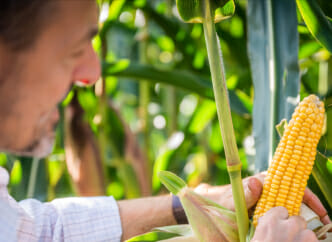
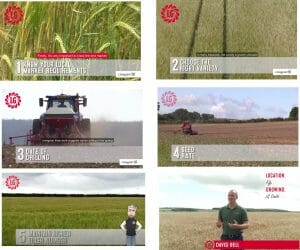
Introducing our Spring Barley AgRONomy video series, with commentary and technical advice from Limagrain UK Arable Technical Manager, Ron Granger.
The videos take you through how to identify the local market requirements, to variety choice, drilling dates and seed rates, with the 5th video providing tips on how to maintain a higher tiller number.
The final video is an interview with Spring Barley grower, David Bell of Fife, Scotland as he chats with LG about his YEN (Yield Enhancement Network) award winning spring barley crop, LG Diablo. David reveals the secret to his success with YEN over the years and how in 2020 he won the spring barley YEN with LG Diablo with an eye-watering yield of 13.4 tonnes a hectare. He discusses how he is using direct drilling and reduced tillage within his rotation, along with a plough-based system for his potatoes and break crops. The grower also shares how it’s important to be open to learning and engaging with the experts at Limagrain, alongside understanding your own soils and your own fields.
You can view the entire series here.
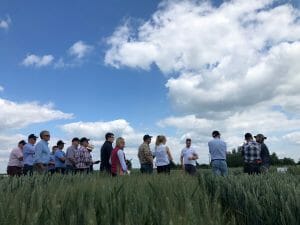
With a tightly packed schedule of events to attend, our small but perfectly formed team of experts spend much of June and July travelling the length and breadth of the UK, bringing our learning, expertise and innovation to you, the grower.
Ron Granger and Liam Wilkinson come with a combined half century of experience in agriculture, unparalleled knowledge and practical experience of cultivating LG’s formidable cereals and oilseeds portfolio, alongside notoriously unbiased opinions.
If you have a burning question about future variety selection, nutrition or establishment, no doubt you will run into one or both if you are attending any of the diverse range of agricultural events that punctuate the busy summer months.
If you are growing or thinking about growing an LG variety and are looking to achieve a deeper understanding of where they sit in the current market, or indeed fit with your own very particular conditions, I would urge you to register for one of our summer demo days.
Alongside the usual trials tours and opportunity to catch up and exchange ideas with colleagues and other industry professionals, we will be running a programme of talks and seminars, with the prospect to hear from the breeders as well as brand partners.
Dates for 2023 are:
- Woolpit – 20th June
- Newbury – 21st June
- Maldon – 23rd June
- Rothwell – 4th July
- Perth – 26th July
You can register for the events here.
A move to direct drilling LG Diablo spring barley has proven successful for Berwickshire grower Neil White, as yields and quality impressed in a challenging season.
Mr White has been direct drilling crops for the past seven years at the 260 ha (650-acre) Greenknowe Farm near Duns, but until this season, had not established spring barley this way.

“Barley has been the last crop I’ve gone over to direct drilling with, but we successfully tried it on two-thirds of our area last spring, sowing directly into overwintered stubble. We will direct drill all of our barley again this spring, either into overwintered stubble or after a cover crop.
“It’s really pleasing for me to see that LG Diablo works in that direct drilled scenario, and still produces a good yield and grain quality. I’m very happy with it.”
The farm’s target spring barley yield is usually around 7.4-8.6 t/ha (3-3.5 t/acre), and this year’s 35 ha of LG Diablo was at the top end of that range, despite some very dry conditions during the growing season.
Quality was good too, with nitrogen coming in at 1.52%, and specific weight at 67.4 kg/hl, allowing everything to meet the malting specification required by grain buyer, Simpsons Malt.
“It produced a nice bold grain, despite the very dry spell. Everything hit the spec for malting, which is spot-on.”
Mr White acknowledges there were a few light grains this season, which he attributes to the lack of rain, preventing some grain from maturing and filling fully. “We certainly haven’t seen any issues with screenings before, so I’m sure it’s due to the year, not the variety.”
Maximising establishment
Mr White recognises that his Mzuri drill does move more soil than other direct drills, but believes this benefits barley establishment in the spring, as it helps aerate the soil, warm it up and mineralise some nitrogen.
Switching from a combination drill to the Mzuri has also allowed him to sow spring barley at variable seed rates to account for establishment differences on varied soil types, and put fertiliser ‘down the spout’ with seed, to get crops off to a good start.
Seed rates last season typically ranged from 380-440 seeds/m2 on the variable soils, with crops sown on 33cm rows. That is a much wider spacing than spring barley is conventionally sown at, but he believes LG Diablo’s vigour enables it to fill the gaps between rows nicely.
“Also, it doesn’t brackle, which is something that is always a threat if weather turns catchy at harvest, especially on wider rows.”
Wider benefits of direct drilling
Soil carries machinery better when it is not ploughed.
Moving less soil reduces total fuel consumption which saves money and improves the carbon credentials of direct-drilled malting barley.
In demand from distillers
LG Diablo’s consistency is valued by end users too, says Mike Dagg, senior grain trader at Simpsons Malt, who expects it to remain one of the top two varieties grown in Scotland for distilling over coming years.
“We’ve had the variety for five or six years now, and we know it goes through the malting process very well. If it performs well going through the malting process, then there’s every chance the malt product will also do well going through distilling too.”
Indeed, over the past few years, LG Diablo has shown consistently good performance in distilleries, both in terms of spirit yields and processability, which ultimately leads to good efficiency and maintains demand for the variety, he says.
“LG Diablo is now pretty universally accepted by the majority of the Scottish distilling industry, and I don’t really see that changing anytime soon.
“Because LG Diablo is so consistent, and benefits from dual use approval for brewing and distilling, it’s got the ability to compete with, and hold its ground against, any new varieties coming along.
“I don’t see anything coming through breeding programmes currently that suggests LG Diablo and Laureate will lose their dominance in the Scottish distilling market.”
In search of marginal gainsIn my development work with the Limagrain UK oilseed rape portfolio, I’ve progressively seen marginal gains every year. Advances in trait stacking genetics have provided much greater yield stability, allowing us to get the best on farm performance out of our OSR varieties.
Micronutrition is one of the areas in which marginal gains are still possible. In varieties with higher yield potential and security, a focus on micronutrition can offer a good return on investment.
I have rarely walked an OSR crop not showing some level of boron deficiency.
Boron is one of the most crucial micronutrients in OSR plant growth, yet is one that is the hardest to test for, with soil testing being one of the most inaccurate that can be carried out. Typical symptoms are cracked, hollow stems, uneven flowering, and reduced pod set.
Boron uptake is poor in low soil temperatures, and it is prone to leaching following high winter rainfall. This means that it is not often readily available to the crop in early spring, especially to crops with underdeveloped root systems.
As an industry, we are seeing a trend towards varieties that have better spring vigour, can put down bigger roots before any spring droughts, and grow away from pigeon or cabbage stem flea beetle (CSFB) larvae damage.
This means varieties such as LG Aviron and LG Scorpion are starting stem extension much earlier than traditional varieties, whilst soils are still cold, and crucially, elements like boron are not as available to the crop.
Foliar boron should be considered as a staple inclusion in all OSR nutrition plans. With late autumn (propyzamide timing), early spring and flowering being the key inclusion timings for foliar boron. This will help with cell wall development at a time when the crop is growing rapidly, leading to a more even flowering and pod set.

Liam Wilkinson
With this topic of micronutrition in mind, we have partnered with YARA on a joint OSR nutrition event near our head office in North Lincolnshire on the 8th March 2023. We will be running an online webinar on 8th February 2023 to further discuss the topics of how to get the best out of our genetics.
You can register for the events here.
Clovers – reducing fertiliser useThe agricultural press has been full of articles covering the impact of fertiliser price rises over the last year, with headlines being focussed predominantly on methods of reducing Nitrogen application rates.
What is less well reported is that growers have actually been reducing their use of inorganic fertilisers since the early 1980’s and this change has contributed to the reduction in estimated greenhouse gas emissions from UK agriculture over the last two decades.
The biggest reductions in N use have been seen on grassland farms where fertiliser use has halved. Whilst potentially good news for the environment, this reduction may be limiting profitability as even at the current fertiliser price levels, the cost of Nitrogen applications to grassland can be justified by increased forage yields.
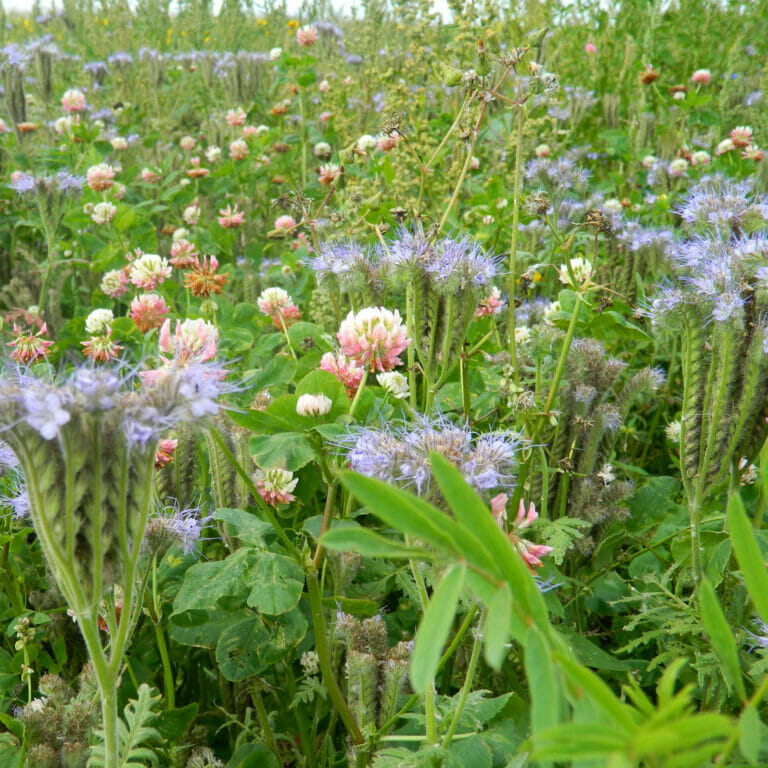
One way of maintaining grassland yields with lower inputs is to ensure that leys include a good proportion of clover.
But DEFRA reports that only 13% of livestock farmers include clovers in all their leys, with 25% not including any clover at all. This seems like a huge, missed opportunity.
A grass sward with a good white clover content can produce as much forage as one receiving 180kg N/Ha. On a 100Ha grassland farm, this is equivalent of 52 tonnes of ammonium nitrate fertiliser. Red clover has even more impressive figures and can fix as much as 250kg N/Ha.
Making sure a newly reseeded ley includes clover is more important than ever. Where clover isn’t present, it can be successfully oversown into an existing sward using pelleted Cloverplus. The pellet enables more accurate sowing and most importantly improves establishment.
The advantages for livestock farmers are clear, but clovers (and grass/clover leys) can also improve soil organic matter, earthworm populations and soil structure in arable rotations whilst also leaving residual N for the following crop.
Arable farmers struggling to find a market for a crop of clover (or grass and clover) may be able to take advantage of ELMS/CSS options such as AB15 Two-year legume fallow. Mixtures such as Legume 2, bring all the benefits of clovers whilst also being eligible for CSS payments.
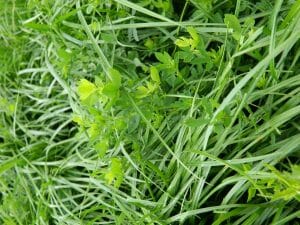
It is clear that improvements have been made across the industry to reduce reliance on inorganic fertilisers but continued environmental legislation and financial pressure mean the subject is unlikely to fall out of the spotlight any time soon.
Dominating the 2023/24 AHDB Recommended ListClovers can play an important part on any farm looking to optimise nutrient inputs.
It’s a grand slam as Limagrain UK’s exciting new wheat, winter barley and oilseed rape varieties, take leading positions across the 2023/24 AHDB Recommended List.
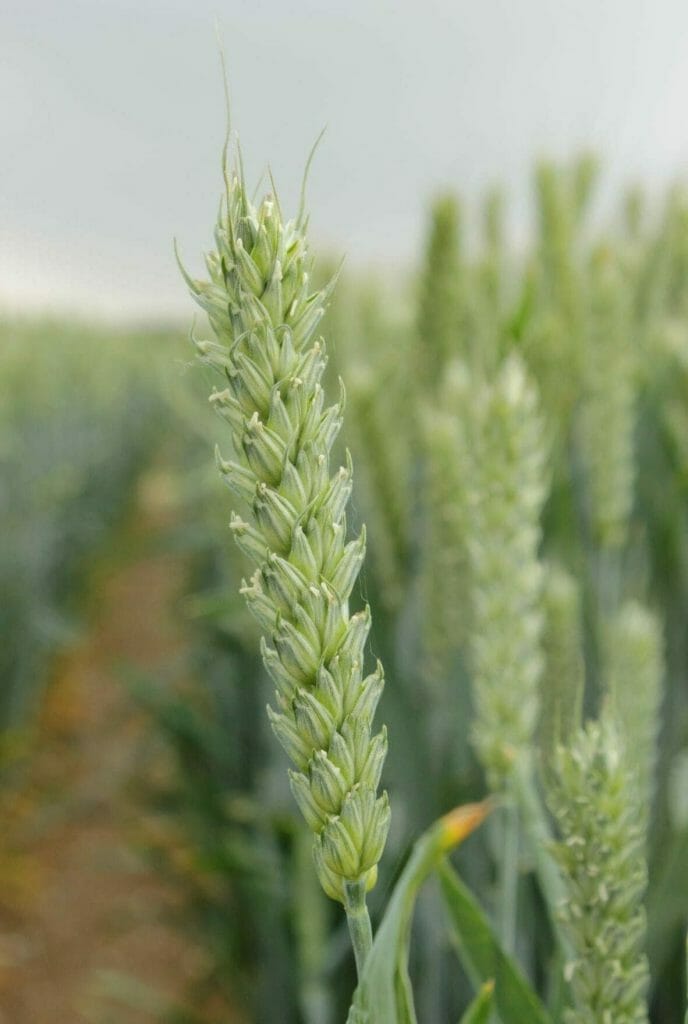
LG Redwald secures poll position as the highest yielding winter wheat.
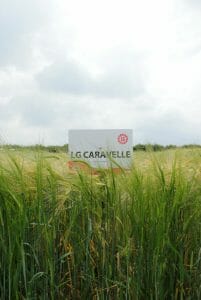
LG Caravelle is the highest yielding two row winter barley.
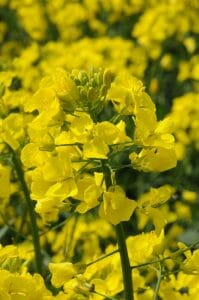
Attica joins as the highest yielding oilseed rape variety, with the essential turnip yellows (TuYV) and pod shatter resistance traits.
LG Wagner is the highest yielding addition to the northern OSR Recommended List.
LG Redwald sets a new standard for high yielding wheats, yielding 107% in the UK, (107% in the east and 109% in the west). As a soft wheat, the variety also offers potential for distilling.
These high yields have been consistently proven across National List trials, over seasons, drilling date and soil type, particularly in the second wheat and later drilling situations.
LG Redwald has an excellent disease resistance profile, with very good Septoria resistance as well as orange wheat blossom midge (OWBM) resistance.
LG Redwald
“It is an exciting variety that should deliver for growers in 2023/24, if supported with good agronomic practise to ensure it meets its full potential on farm, and comes at a time when growers are looking more than ever to maximise output in order to maintain profit in times of increasing costs.”
– says Ron Granger, arable technical manager.
LG Caravelle is the highest yielding two row winter barley to join the 2023/24 Recommended List.
LG Caravelle dispels any misconception that two row barleys are lower yielding than hybrids.
LG Caravelle
It offers UK yields of 106.3% – which is as good as the top yielding hybrid barley variety – and yields 2% above hybrids in the east.
These high yields are backed up by an excellent disease profile, reflected in LG Caravelle’s high untreated yields. LG Caravelle also offers an exceptionally high specific weight for a winter barley, of 71.8 kg/hl.
It is an early maturing variety with stiff straw; both important characteristics for a winter barley.
Attica is a newly recommended fully loaded hybrid with full UK recommendation. It joins the Recommended List as the highest yielding variety to combine stable high yields with the genetic security of TuYV and pod shatter resistance traits.
Attica has a strong autumn growth habit, offering growers a wide drilling window and a very good disease resistance package.
Attica
LG Wagner joins the north Recommended List as the highest yielding variety (108.1%). In 2022, it was the highest yielding variety, also offering the security of pod shatter and TuYV resistance. It is a shorter hybrid with stiff stems, combined with solid light leaf spot resistance and good stem health.
“This is a tremendous achievement and is the first time that any breeder has achieved this level of success across all of the cropping sectors in the last decade, if not longer.”
– says William Charlton, marketing manager for arable seeds.
“We believe this success is built on our unique UK focussed breeding approach, which means we are able to select for the UK’s maritime climate from day one in the breeding programme. This allows us to look for consistently high yielding varieties from the very start of our programme, to suit UK growers and end user requirements.”
YEN Innovation Award winnerThis year, to mark 10 years of the Yield Enhancement Network (YEN), a new Innovation Award has been commissioned which was presented at the YEN conference on 24th January. The award is for an outstanding contribution to on-farm innovation and has been sponsored by Limagrain.
“Limagrain has been an active supporter of YEN since its inception so it seems only fitting that we sponsored the Innovation Award for the 10th anniversary conference,” says Limagrain’s Arable Marketing Manager, Will Charlton.
“As a company that invests in UK based breeding activities for all major arable crops, innovation is a core value of our business. Alongside bringing new varieties to market, we invest a considerable amount of time and money in examining how our varieties perform in different farming systems. Over the years YEN has been invaluable in helping us facilitate this work by providing a structure and detailed analysis to aid Limagrain’s collaborations with innovative farmers across the country.”
The standard of nominations was exceptionally high with all the farmers demonstrating a passion for progress, learning and collaboration. However, there could only be one winner. The award was presented by Limagrain’s Arable Technical Specialist, Liam Wilkinson.
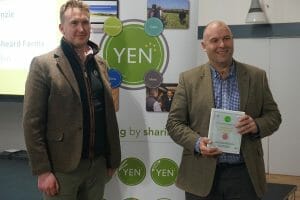
Liam Wilkinson and Russ McKenzie
“I’m delighted to announce that Russ McKenzie, farm manager of DJ Tebbit and John Sheard Farms, has won the YEN innovation Award. Russ has demonstrated his commitment to YEN by being one of the few farmers to provide an entry every year since YEN began.
In particular, the judges were impressed by his recent on farm trials work which has sought to investigate fungicide, nutrition and variety interactions under his own establishment system, utilising the latest digital and molecular diagnostics, alongside a trials plot combine to analyse the results. The complexity of his trials required dedication and a significant time commitment throughout a busy growing season. The data generated has provided valuable insights into how different inputs interact and influence a farming system.”
‘Phenomenal’ yields make LG Diablo top choice next springThe third year of growing LG Diablo was certainly one to remember for Yorkshire farmer Paul Rogers, after the variety revealed its true yield potential on his 182 ha (450-acre) farm near Ripon.
Some 25 ha (60 acres) averaged 10 t/ha (4 t/acre) sold weight at 15.5% moisture, with one field hitting an impressive 10.6 t/ha (4.3 t/acre). Furthermore, all crops achieved the full malting specification required by grain buyer Saxon Agriculture, coming in at 1.51% nitrogen and an average specific weight of 68 kg/hl.
“I’ve never seen anything like it. The barley was rolling off the combine like a crop of first wheat. It was phenomenal!”
Mr Rogers acknowledges the highest yields did come from the farm’s best “good bodied” land, that did not drought off in the dry season, but even so, he would have still only expected yields of nearer 7.5 t/ha (3 t/acre).
“Even another 25-acre block of drought-hit sandy land still managed to do 7.2 t/ha (2.9 t/acre), which was tremendous for a field that droughted-off.
“I don’t know exactly where the big yield came from, because we didn’t do a lot different to the year before, apart from getting crops in earlier, around mid-March instead of early April. It was just an earlier spring; the soil conditions were correct for drilling.”
The LG Diablo established quickly, resulting in a dense plant stand that “looked like a carpet”, he notes. “The key was to keep it standing, which meant we did put on an extra growth regulator, in addition to Terpal (ethephon + mepiquat).”
Mr Rogers admits that while he may not be able to guarantee hitting such impressive yields every year, LG Diablo‘s performance in 2022 at least demonstrates what the variety is capable of on his farm and soil types, and he plans to put all of his spring barley area (around 30 ha) into LG Diablo again next spring.

Paul Rogers
Black-grass benefit
A key reason for growing spring barley on the farm is for its role in controlling black-grass and ryegrass, Mr Rogers says. “Both are becoming more of a problem, but I’ve found that if I can get thick coverage of spring barley, it does a tremendous job of smothering the black-grass, which we did see last season.”
He adopts a very traditional approach to establishing spring barley. Preceding stubbles are left to green-up after harvest, before land is ploughed in November, allowing bare soil to weather and breakdown naturally over winter. He then goes in with a power-harrow/ box drill combination, once ground is dry and warm enough in the spring, usually around early April.
“It normally doesn’t worry me drilling spring barley towards the middle of April, if that’s when conditions are right, so long as I can make sure it goes into moisture, and I can conserve that moisture in the seedbed.
“The important thing is to drill when conditions are right, not on a particular date. Last year [2022 harvest], we didn’t do a lot different to normal, apart from getting crops drilled slightly earlier because soil conditions allowed.”
Ploughing in November allows time to achieve a good flush of weeds in the autumn, which means no pre-emergence spray is needed in spring. “I don’t want anything knocking the crop, and pre-ems can sometimes hold barley back a bit. I prefer to wait until weeds have emerged after drilling, and then tackle what’s there. The spring barley itself is our grassweed control, so we only really need broadleaf chemistry.”
Granular phosphate and potassium fertiliser (0-20-30) is typically applied once the tramlines have been established, as is the nitrogen, with crops getting around 135 kg N/ha in total.
Manganese is a key nutrient for spring barley, and Mr Rogers generally includes it with both of the main fungicide applications, as well as sowing manganese-dressed seed. Last year’s fungicides were based on benzovindiflupyr applied in May, and fluxapyroxad + Mefentrifluconazole in June.
“LG Diablo is certainly a good variety that has performed well for us in all three years we’ve grown it, so I’ve no plans to grow anything else next year,” he concludes. “LG Diablo is ticking all the boxes for me at the moment.”
Dominating the 2023/24 AHDB Recommended ListIt’s a grand slam for breeders Limagrain UK as their wheat, winter barley and oilseed rape varieties take leading positions across the 2023/24 AHDB Recommended List.
LG Redwald secures poll position as the highest yielding winter wheat. LG Caravelle is the highest yielding two row winter barley.
Attica joins as the highest yielding oilseed rape variety, with the essential turnip yellows (TuYV) and pod shatter resistance traits.
LG Wagner is the highest yielding addition to the northern OSR Recommended List.
LG Redwald sets a new standard for high yielding wheats, yielding 107% in the UK, 107% in the east and 109% in the west. As a soft wheat, the variety also offers potential for distilling.
These high yields have been consistently proven across National List trials over seasons, drilling date and soil type, particularly in the second wheat and later drilling situations.
LG Redwald has an excellent disease resistance profile, with very good septoria resistance as well as orange wheat blossom midge (OWBM) resistance.
“It is an exciting variety that should deliver for growers in 2023/24, if supported with good agronomic practise to ensure it meets its full potential on farm, and comes at a time when growers are looking more than ever to maximise output in order to maintain profit in times of increasing costs,” says Ron Granger, Limagrain’s arable technical manager.
LG Caravelle is the highest yielding two row winter barley to join the 2023 Recommended List. LG Caravelle dispels any misconception that two row barleys are lower yielding than hybrids.
Offering UK yields of 106.3% – which is as good as the top yielding hybrid barley variety and yielding 2% above hybrids in the east.
These high yields are backed up by an excellent disease profile, reflected in LG Caravelle’s high untreated yields. LG Caravelle also offers an exceptionally high specific weight for a winter barley, of 71.8 kg/hl.
It is an early maturing variety with stiff straw; both important characteristics for a winter barley.
Attica is a newly recommended fully loaded hybrid with full UK Recommendation. It joins the Recommended List as the highest yielding variety to combine stable high yields with the genetic security of TuYV and pod shatter resistance traits.
Attica has a strong autumn growth habit, offering growers a wide drilling window and a very good disease resistance package.
LG Wagner joins the north Recommended List as the highest yielding variety (108.1%). In 2022 it was the highest yielding variety also offering the security of pod shatter and TuYV resistance. It is a shorter hybrid with stiff stems, combined with good light leaf spot resistance and good stem health.
“This is a tremendous achievement and is the first time that any breeder has achieved this level of success across all of the cropping sectors in the last decade, if not longer,” says William Charlton, Limagrain’s UK marketing manager for arable seeds.
“We believe this success is built on our unique UK focussed breeding approach, which means we are able to select for the UK’s maritime climate from day one in the breeding programme. This allows us to look for consistently high yielding varieties from the very start of our programme, to suit UK growers and end user requirements.”
LG Diablo is a perfect fit for mixed farmThe combination of LG Diablo’s high yield potential and consistent grain quality has made it a firm favourite within the rotation for East Fife farmer David Bell.
The mixed arable and suckler beef farm near St Andrews extends across three holdings, centering its varied rotation around potatoes, winter wheat, winter and spring barley, vining peas, 5-8-year grass leys, permanent pasture, and Agri-Environmental Climate Scheme options.
The farm has been growing LG Diablo since before it joined the Recommended List, and in 2020, won the Yield Enhancement Network (YEN) Gold award with the variety, achieving the highest spring barley yield of 11.3 t/ha.
“There’s no hiding the fact that LG Diablo is a great yielder; it rivals any feed spring barley,” Mr Bell says.
“Our yield in the 2020 YEN competition was phenomenal, and it all made sub-1.65% nitrogen malting spec. Mother Nature was very favourable towards us that year, and we were really able to maximise the potential of the variety. The crop didn’t get any special treatment, we were just attentive to timings and it really delivered for us.
“Having grown LG Diablo for eight years, our understanding of how to manage the variety to get the best out of it has grown as well, and we’ve had some amazing yields. It has also shown consistency for hitting low nitrogen malting spec.”
Flexible approach
Building and maintaining soil health is fundamental to the farm business, and underpins the success of any crop, including spring barley, Mr Bell says.
“We really see our soils as the foundation, and everything else grows on top of that, literally and metaphorically.”
Cover crops, organic manures, and a varied rotation that can be adapted to the season and market fundamentals, are central to this focus, as is a flexible cultivations policy that includes direct drilling, minimal tillage, and deeper cultivations where needed.
“I’m very fortunate to have a choice of establishment methods, whether a zero-till drill or a one-pass drill. It’s a real luxury to be able to choose the right tool for the job, crop and conditions.”
Traditionally, spring barley has been established after ploughing overwintered stubbles in the spring, but for the first time in 2022, Mr Bell tried direct drilling all of his spring barley into a grass and clover cover crop. It is a method he has successfully adopted in winter cereals, but for spring barley, he acknowledges it has been a learning curve.
Cover was sprayed off with glyphosate in early spring once conditions started to warm up, then drilled when it started to die back, using variable seed rates from a base of 425 seeds/m2.
“But, my seed rate was too low for the ability of spring barley in that situation. This was true of all three barley varieties we grew, as spring barley is less vigourous than winter wheat and, in my opinion, it needs some tilth to develop effectively.”
Crops therefore fell short of his target plant population, resulting in yields below par across all spring barley varieties last harvest, averaging just shy of his expected 7-8 t/ha.
“I relied too much on the root mass [of the cover crop] to do the tillage for me, but have learnt from that. We didn’t have a viable enough establishment area for the seed, so next spring I shall again be direct drilling into fields with green cover on them, but will do a shallow 25mm cultivation pre-drilling to create a tilth to help barley establish. We will also look at a more diverse cover crop in the future.”
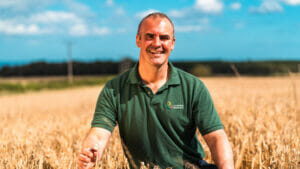
David Bell
Fitting into the rotation
LG Diablo will again be Mr Bell’s main spring barley variety grown for harvest 2023.
“One of the huge benefits of LG Diablo, especially in a mixed farming situation, is that it’s a high yielding spring barley variety, and if we do get it wrong in terms of nitrogen being too high for distilling or brewing, we still have a good feed crop. It’s dual purpose in that respect too, creating a circular economy within our own farm.
“Every farm and field is different though, and it’s up to us as growers to select the right tool for the right job, or the right variety for the right market or ground conditions.
“We have to look at our market, select our crop and variety against what our ground is capable of delivering, and LG Diablo fits that bill for me.”
Direct drilled LG Diablo performs in one of the driest seasons on recordA move to direct drilling LG Diablo spring barley has proven successful for Berwickshire grower Neil White, as yields and quality impressed in a challenging season.
Mr White has been direct drilling crops for the past seven years at the 260 ha (650-acre) Greenknowe Farm near Duns, but until this season, had not established spring barley this way.
Traditionally, he favoured ploughing and power-harrowing spring barley ground, before sowing with a combination drill once soil was dry and warm enough, or sometimes drilling directly into the plough with his 3-metre Mzuri Pro Til 3T. He says ploughing reduces the risk of wheat volunteers emerging in the barley crop, and generally creates a good seedbed for barley to establish quickly.
“Barley has been the last crop I’ve gone over to direct drilling with, but we successfully tried it on two-thirds of our area this spring [2022], sowing directly into overwintered stubble. The plan is to try and direct drill all of our barley again next spring, either into overwintered stubble or after a cover crop.
“It’s really pleasing for me to see that LG Diablo works in that direct drilled scenario, and still produce a good yield and grain quality. I’m very happy with it.”
The farm’s target spring barley yield is usually around 7.4-8.6 t/ha (3-3.5 t/acre), and this year’s 35 ha of LG Diablo was at the top end of that range, despite some very dry conditions during the growing season.
Quality was good too, with nitrogen coming in at 1.52%, and specific weight at 67.4 kg/hl, allowing everything to meet the malting specification required by grain buyer, Simpsons Malt.
“It produced a nice bold grain, despite the very dry spell. Everything hit the spec for malting, which is spot-on.”
Mr White acknowledges there were a few light grains this season, which he attributes to the lack of rain, preventing some grain from maturing and filling fully. “We certainly haven’t seen any issues with screenings before, so I’m sure it’s due to the year, not the variety.”
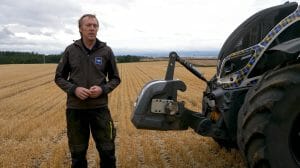
Neil White
Maximising establishment
Mr White recognises that his Mzuri drill does move more soil than other direct drills, but believes this benefits barley establishment in the spring, as it helps aerate the soil, warm it up and mineralise some nitrogen.
Switching from a combination drill to the Mzuri has also allowed him to sow spring barley at variable seed rates to account for establishment differences on varied soil types, and put fertiliser ‘down the spout’ with seed, to get crops off to a good start.
Last year he applied a 10-26-26 N, P, K fertiliser, with some sulphur, at drilling, but next spring plans to reduce the total amount of phosphate and potassium applied due to high prices, instead opting for a 16-15-15 product.
Seed rates last season typically ranged from 380-440 seeds/m2 on the variable soils, with crops sown on 33cm rows. That is a much wider spacing than spring barley is conventionally sown at, but he believes LG Diablo’s vigour enables it to fill the gaps between rows nicely.
“Also, it doesn’t brackle, which is something that is always a threat if weather turns catchy at harvest, especially on wider rows.”
Mr White says LG Diablo has been pretty straightforward to manage, and has even allowed a slight reduction in spray costs.
“Previously, we used to apply a low rate of growth regulator to Concerto to encourage it to root and tiller, but we haven’t needed to do this with LG Diablo, which possibly reflects its strong vigour. I haven’t found it expensive to grow, especially as we just do a two-spray programme.”
Crops usually receive two fungicides; one with trace elements at Growth Stage 23 and a second at GS 39 with manganese.
Wider benefits of direct drilling
There are broader benefits from the full conversion to direct drilling too, not least in the fact that soil carries machinery a lot better when it is not ploughed, Mr White says. “That’s particularly noticeable at harvest.”
Moving less soil reduces total fuel consumption too, which saves money and improves the carbon credentials of direct-drilled malting barley, he adds. This could become more significant in the future as the UK continues its drive towards net zero and grain buyers look to secure supplies with a lower carbon footprint.
“I’ve often said that I should be receiving a small premium for low carbon barley, and LG Diablo ticks the box for that.”
In demand from distillers
LG Diablo’s consistency is valued by end users too, says Mike Dagg, senior grain trader at Simpsons Malt, who expects it to remain one of the top two varieties grown in Scotland for distilling over coming years.
“We’ve had the variety for five or six years now, and we know it goes through the malting process very well, from steeping the barley, to germinating and kilning, so that means we’re not losing time having to give it an extra day or two at any stage.
“If it performs well going through the malting process, then there’s every chance the malt product will also do well going through distilling too.”
Indeed, over the past few years, LG Diablo has shown consistently good performance in distilleries, both in terms of spirit yields and processability, which ultimately leads to good efficiency and maintains demand for the variety, he says.
“LG Diablo is now pretty universally accepted by the majority of the Scottish distilling industry, and I don’t really see that changing anytime soon.
“Because LG Diablo is so consistent, and benefits from dual use approval for brewing and distilling, it’s got the ability to compete with, and hold its ground against, any new varieties coming along. At the moment I don’t see anything coming through breeding programmes that suggests LG Diablo and Laureate will lose their dominance in the Scottish distilling market.”
Why Crusoe is top milling wheat for Northants farmer – again and againJoe Adams farms over 800 hectares of wheat just outside Daventry in Northamptonshire. A decision to move to continuous wheat five years ago was made in response to struggling to establish oilseed rape.
“We could no longer rely on oilseed rape as it had just become too much of a liability to establish with the loss of the neonicotinoids, so we had to look at what else we could do to maintain our rotational profitability”.
“We have always grown milling wheat which we sell onto various local and national grain merchants, and that has worked well for us so we decided to look at growing continuous wheat.”
“We used to grow Cordiale but moved over to Crusoe about nine years ago and now it is the only variety we grow across the farm. Crusoe has performed very well for us, and whilst the variety doesn’t have the highest yields of the Group 1’s, we can rely on it to consistently produce the protein spec of 13% that we are looking for.”
When moving over to continuous wheat, Mr Adams moved to slightly later drilling, around the first week of October, as this helped to manage take-all. However, he is now finding that the take-all pressure is abating so drilling has come back to about the third week of September.
Having moved over to a regen system last year, the wheat crop at Thrupp Farms is direct drilled within a CTF system. “All of our machinery works to a 12m tram line. It generally takes two weeks to get the whole farm drilled which in turn gives us a spread of harvest.”
“We don’t have a big black-grass problem, but any that does come up is sprayed-off or hand rogued. A robust fungicide programme supports the brown rust weakness of Crusoe, and we have never had any issues with it to date”.
Last year Mr Adams cut back on nitrogen from 250 kg/ha to 200kg/ha and still hit spec weight. This year he is looking at cutting that back even further to 180kg/ha and that will go on as liquid in a 4 way split and is applied variably.
.