
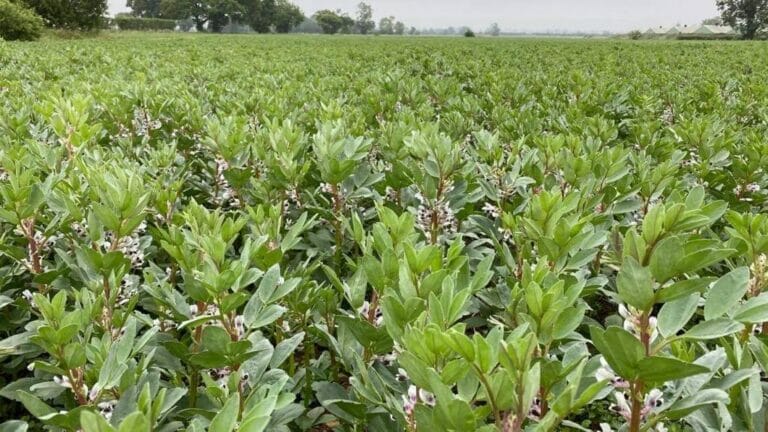



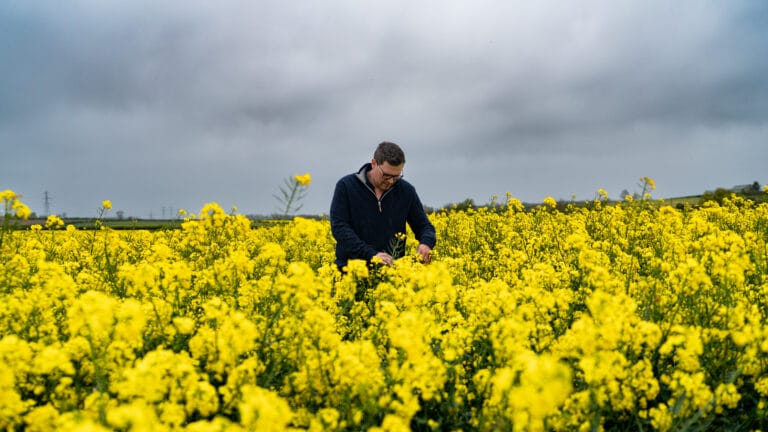




Liam Wilkinson introduces Limagrain’s newest genetic trait, Sclero-flex, into its OSR breeding lines.
Sclerotinia stem rot is a significant disease of oilseed rape in the UK; and in some circumstances, can reduce yields by 50% or result in complete loss through plant death.
In spring, when soils are moist and warm (10oC+), sclerotia in the soil germinate, releasing airborne ascospores which land on OSR petals. Sclerotinia then develops as the petals fall and stick to the leaves or stems, assisted by further moisture.
The disease is fed by nutrition from the rotting petals and pollen, allowing penetration of the leaf cuticle, resulting in lesions. Then, stem lesions occur as the pathogen spreads, which reduces food and water supply to the canopy, induces premature ripening, and weakens stems to cause lodging.
Effective control of the disease relies largely on protectant fungicides that should be applied during mid-flowering before there is any significant petal fall. However, the fungicides only have a protectant role and have to be applied ahead of infection taking place.

Coretta Kloeppel – OSR Hybrid Breeder
Sclerotinia sprays can coincide when on-farm activity is high and there’s greater pressure on sprayer hours. This makes it difficult to hit those optimum timings.
Sclerotinia is the reason given for almost 30% of total fungicide use in the crop. Against this background, the weather has become less predictable.
In recognition of this increasing threat, a new breeding tool has been identified by Limagrain to help combat the disease. Known as Sclero-flex, this exciting quantitative tolerance to Sclerotinia completes the Sclerotinia control triangle, joining cultural methods and fungicidal chemistry.
Limagrain OSR varieties with the new technology, have shown an average reduction in Sclerotinia incidence of 57%, and a reduction in severity of 44%.
How does Sclero-flex work?
It’s based on tolerance rather than resistance. Sclero-flex is the collective result of many smaller genes which all demonstrate tolerance. This ensures a variety will be durable and sustainable and less likely to break down in the future.
The focus on developing new traits beyond existing scope has been coined as Limagrain’s seventh generation of hybrids – bringing varieties to the market which offer a stacked portfolio for stem health, alongside the standard pod shatter, TuYV and RLM7 resistance traits, which growers have come to expect.
LG Armada is the first seventh generation hybrid to be released, boasting the new Sclero-flex technology. It’s also the highest yielding OSR variety on the AHDB Recommended List.
Integrated Pest Management Foundations
Plant breeding remains the foundation of integrated pest management (IPM).
LG champions a ‘control triangle’ where effective disease management lies in a careful balance between cultural practices, responsible fungicide use, and refined plant genetics. This includes when combatting Sclerotinia.
Cultural control practices rely on widening the cropping rotation – so, only growing OSR once every five years, whilst being mindful of where other Sclerotinia hosts fit into the rotation. Effective weed management is also important.
As for responsible fungicide use, action starts by using relevant Sclerotinia alert tools such as that hosted by the AHDB. It’s then a case of understanding the crop’s growth cycle and not using fungicides curatively, due to them having no activity once infection has taken hold.
Breeders Perspective Q&A
Maeve O’Rourke – Junior OSR Breeder
Q. What diseases do you see as being the biggest threat to UK OSR crops in the coming seasons?
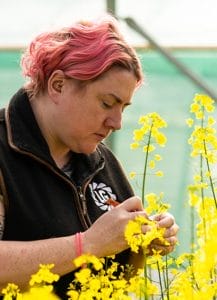
Maeve O’Rourke – Junior OSR Breeder
A. I think it’s still going to be cabbage stem flea beetle that will be our biggest challenge rather than disease.
LG has a huge selection of different varieties with robust resistance against common UK diseases, with dozens of strong varieties in the immediate pipeline, and international research behind upcoming challenges. However, fighting CSFB is a unique and hard challenge for breeders and farmers alike.
Q. How important is the UK to the European breeding programme?
A. The UK is extremely important.
Almost every parent line in the last two decades has begun at our head office in Rothwell, Lincolnshire and our trials network is so varied (from Aberdeen to Dorset and everywhere in between) that we have a great chance of spotting any future issues for disease and any stand-out varieties, not just for the UK but all of Europe.

Q. As a breeder, what is your focus for the future?
A. Focusing on different sources of resistance.
As breeders, we know we have a limited lifespan for all resistances because diseases are constantly evolving, and the changing long-term climate conditions will affect where in the UK these diseases start to occur. We are always looking to find new and novel types of resistance, even if they aren’t useful in 2024, they might be crucial in 2034.
Winter Barley Success with Sister VarietiesLimagrain sister varieties; LG Caravelle & LG Capitol, dominate the 2-row feed winter barley AHDB 2024/25 Recommended List.
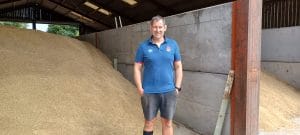
Mark Ullyott
LG Caravelle performed very well last harvest on the Yorkshire Wolds, for Mark Ullyott of Langtoft Grange Farm near Driffield, and he was extremely pleased with yields between 8.5-9.5 t/ha.
“We have grown seed crops of barley for over 10 years, and LG Caravelle must be the best we have seen,” he says.
“It is always interesting growing a new variety for the first time to see how it performs, and we are very pleased with LG Caravelle and will grow it again. If we could, we would put all of our acreage down to the variety,” says Mark.
Ron comments ‘LG Capitol Backs up Successful Genetics’
“LG Capitol backs up the successful genetics of LG Caravelle, in that it is a sister line selected from the same initial cross.
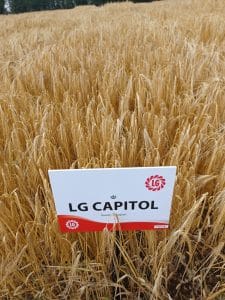
LG Capitol has shown similar very high yield potential, sitting on 106% for the UK and 107% in the east, and importantly, it has shown this high consistency of performance over regions and seasons.
This trait, combined with the desirable agronomic attributes of good standing, a good disease resistance profile and good grain quality, makes it a great addition to the new RL and it will be of interest to all barley growers.”
Perfect Fit for Regen SystemA large estate in the northeast of England, has turned to wheat variety LG Typhoon as part of its drive to build a more sustainable regenerative cropping system.
The in-house farming operation of County Durham-based Raby Estates, began conversion to direct drilling in 2018 and is striving to reduce the use of artificial inputs where possible, without compromising on the quality and quantity of crops produced.
“We’re trying to move away from growing high input varieties, so are primarily looking for those that offer a robust disease package, good standing power and suitability for our direct drilling system,” according to farm manager Philip Vickers.
“Direct drilling in northern England is not something you want to be doing into November, so I also look for varieties that suit the early drilling slot. From what we’ve seen so far, LG Typhoon seems to fit our requirements well.”
Strong performance
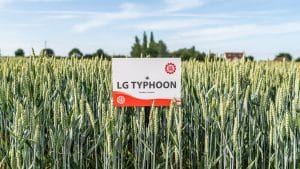
In 2022, the farm grew around 32 ha (80 acres) of LG Typhoon, alongside several other varieties, but Mr Vickers has been so impressed with its agronomics, ease of management and yield performance, that he has increased this to 100 ha for 2023/24.
The LG Typhoon averaged an excellent 9.4-9.6 t/ha.
“Agronomy-wise, LG Typhoon was problem-free. It established quickly in the autumn, got away well in the spring, and was relatively early to harvest, tight behind Graham.”
Robust disease profile
Strong Septoria resistance is a must-have for all winter wheat varieties grown on the farm, as the disease remains the number one yield-robber in high pressure seasons.
With a Septoria rating of 7.2, backed up by a combination of genetics that are different to those in other RL varieties, LG Typhoon has a distinct advantage over others.
Perfect fit for regen systems
LG Typhoon offers attributes that make it ideally suited to strip tillage/ direct drilling, regenerative crop establishment systems, that often feature wider rows.
- –> High yielding, consistent & resilient variety, that delivers across seasons & rotations
–> A prostrate growth habit with a slower plant development through the autumn & winter months
–> High tillering variety that utilises the space from wider rows often associated with direct-drilling
–> Very good disease resistance profile reflected in its high untreated yield
–> Exceptional disease ratings for yellow rust (9) & Septoria (7.2)
–> Good standing
–> OWBM resistance
–> Excellent performance as a second wheat -
-
LG Typhoon is a high yielding, consistent & resilient variety, that delivers across seasons & rotations!
From early to late drilling, ploughed land to min-tilled, and high to low soil fertility, Fife farmer & contractor, Zander Hughes, faces almost every possible cropping scenario across the 320 ha (800 acres) he farms for a range of clients.

Zander Hughes
Such variability represents a stern test for any variety, but for Mr Hughes, LG Skyscraper continues to be the stand-out performer in terms of its consistent yield and quality across multiple seasons, and flexibility to go into a range of drilling situations.
Having grown LG Skyscraper since its launch five years ago, the variety once again accounts for his entire winter wheat area, with around 130 ha in the ground for harvest 2024, up from 81 ha last season, due to rotational shifts and a slight reduction in spring barley area. Most is sown as a first wheat after potatoes, vegetables, grass, or spring barley.
“We’ve never had any problems with LG Skyscraper; we really like it as a variety. To this day, LG Skyscraper remains the variety that produced the biggest yield I’ve ever grown, at 14.5 t/ha in the year we first tried it.”
Although last year’s crop did not quite reach that level, he says it still performed really well, averaging 10.5-10.75 t/ha across the whole wheat area, with big, bold grains, good quality, and plenty of straw that stood well.
That performance came despite relatively high disease pressure last season, and challenging conditions that meant the first T0 fungicide, plus growth regulator, could not be applied, he notes.
“That did put slightly more pressure on the T1 and T2 growth regulators in high fertility situations, but despite this, crops generally still stood really well.”
Looking good in a tough year
As for this year’s crop, Mr Hughes says the vast majority was drilled into good conditions, despite tricky autumn weather that stretched the drilling window from 1 September to mid-November. Some fields were ploughed, while others were min-tilled, although decisions are very much taken on a field-by-field basis, depending on soil conditions and previous cropping, he notes.
LG Skyscraper has a fairly vigorous growth habit once it germinates, so Mr Hughes has no fear of sowing it later, as he might with some other varieties.
As always, seed rates were adjusted according to drilling date and conditions, ranging from 375 seeds/m2 at the lowest, up to 525 seeds/m2 in the most challenging situations last autumn.
“At the moment, there aren’t really any obvious differences between the early and late-sown crops. We’ve found that standing water on some fields – which is a new thing for us this year – has had more of an effect than drilling date.”
With most crops around growth stage 31 (T1) at the time of writing, Mr Hughes says generally the LG Skyscraper all looks well, with no obvious issues, despite ideal conditions for Septoria and yellow rust development over much of the season so far.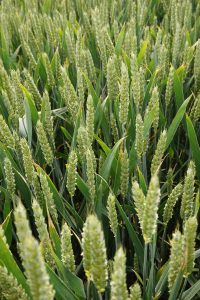
Given higher disease risk, robust SDHI and triazole-based T1 and T2 fungicides will be used to protect the important yield-building leaves through the remainder of the growing season, and maximise crop potential. This will build on the prothioconazole-based T0 applied earlier this spring, accompanied by trinexapac-ethyl and chlormequat growth regulators, and trace elements.
“Growth stages are slightly all over the place at the moment, even within the same field, so we’re hoping the T0 growth regulator will reduce the apical dominance of the main stems a bit, as they’re a lot further on than the tillers at this stage. We’ll also apply another growth regulator at T1, although decisions are taken on a field-by-field basis.”
Nitrogen is usually applied in three doses, but this year Mr Hughes has favoured more of a “little and often” approach, based on four applications of granular fertiliser, roughly in a 30-40-20-10% split, to reduce any potential risks of field losses due to the weather. Total application generally averages around 210 kg/ha, although this ranges from 180 kg/ha to 240 kg/ha depending on soil levels and crop potential.
Sticking with LG Skyscraper
Looking ahead to next season, Mr Hughes plans to continue growing LG Skyscraper, although is also going to try Limagrain UK’s new hard Group 4 variety, LG Beowulf, which joined the AHDB Recommended List this year as the highest yielding winter wheat.
LG Skyscraper is just one of 16 varieties featuring in a Limagrain UK variety demonstration that Mr Hughes is hosting for the first time this season.
“The demonstration is being held on one of our contract farms that hasn’t grown wheat for around 15 years. My initial plan was to go with LG Skyscraper on this farm, because it’s one we like and has done well for us, but there was some debate as to what variety would best suit the farm, hence hosting the trial here.”
As well as a range of Limagrain UK and competitor varieties, the demonstration is also looking at the impact of different seed rates on four Limagrain wheats, sown at half, three-quarters, 100%, and 125% of the standard seed rate.
LG Skyscraper
–> Soft Group 4 wheat
–> First listed on the RL in 2019
–> OWBM resistance
–> Good yellow rust resistance (7)/ Septoria requires monitoring
–> Consistent yield and quality performance over multiple years
–> Flexibility for a range of rotational positions (1st or 2nd wheat), sowing dates, and soil types
–> Good grain quality – specific weight (77.1 kg/hl)
–> End market flexibility – feed/ distilling/ biscuit grists
LG’s Summer Demo DaysLG has a range of summer open days across the UK, to present their demo trials, alongside Limagrain’s technical experts who will be providing all the latest information on new & existing varieties.
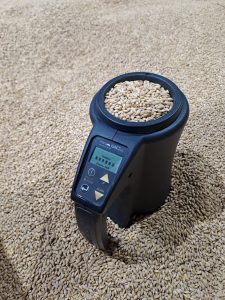
As well as the LG experts, each event will feature industry experts from within the agricultural sector, providing technical information on an array of topics such as fertiliser & micronutrients, agrochemicals, SFI’s and more. On top of this, we will again be running the Moisture Meter Clinic, which has been a farmer favourite in past years.
LG’s Summer Demos will have a wide assortment of winter wheat varieties to show, including Limagrain’s No.1 highest yielding variety; LG Beowulf, and a taste of Limagrain’s up and coming RL Candidates and NL2 offerings.
Alongside this, they will also be displaying commercial competitor varieties, with both untreated and treated plots.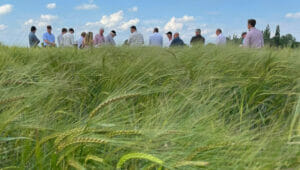
Rothwell and Woolpit will be showing all varieties in the Limagrain winter barley portfolio, including the 2 highest yielding; LG Caravelle & LG Capitol, plus exciting new BYDV tolerant RL Candidate, LG Carpenter.
Register now…
—-> Tues 9th July – Rothwell, Lincolnshire
—-> Weds 17th July – Perth, Perthshire
BASIS/NRoSO points will be available for each Demo Day.
If you are thinking of growing an LG variety, have an interest in learning more, or have any questions for our experts, Register Now for one of our Demo Days.
Limagrain Upgrades Malting Barley Laboratory at UK Head QuartersOur malting barley laboratory at Rothwell in Lincolnshire has been upgraded to increase testing capability for the early screening of new varieties, from 1000 to 4000 samples a year, for both the UK and European markets.
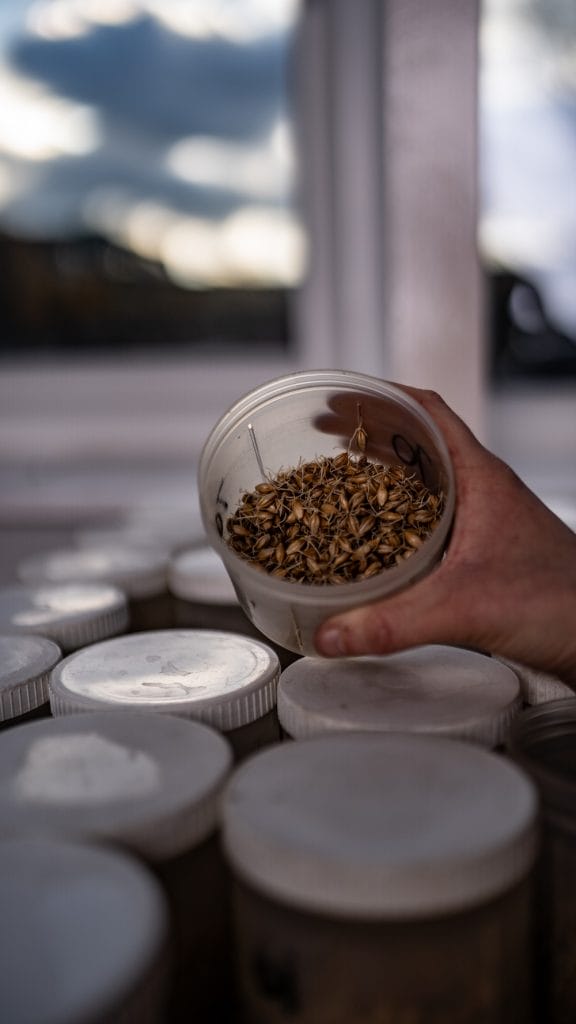
“This will allow us to use the data generated more efficiently to enable more accurate genomic selection, to better predict the malting potential and quality of the next generation of malting barleys,” says Sophie Buon, barley breeder.
“This new approach will test varieties under different micro-malting regimes, that require less water and less steeping – and in response to end user requirements, do this in the most carbon neutral way possible.”
“We hope that the new facility will encourage end-users to visit and see for themselves, the extensive work that we are doing to breed new and exciting malting barley varieties, that meet all of today and tomorrows market requirements.”

Three new forage maize varieties from Limagrain have been added to the 2023-24 BSPB/NIAB Descriptive List, with two very early maturing varieties sitting atop the new list of first choice varieties for favourable sites, and the third, a later maturing option, topping the list for very favourable sites.
Skipper and Foxtrot are ranked numbers one and two respectively as first choice varieties for starch yield on favourable sites, while LG31.207 tops the chart for ME yield for varieties suited to very favourable sites.
“With an early FAO of 160, an ME yield of 221,175 MJ/ha and the highest starch yield (6.74 t/ha) on this year’s favourable site list, Skipper is ideal for farmers who want to fill their clamps with a very early maturing crop of exceptionally energy-rich and starch-filled maize,” explains Tim Richmond, Maize Manager for Limagrain in the UK and Ireland.
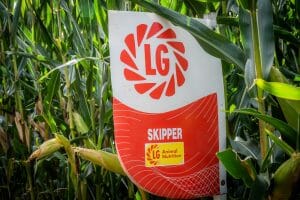
“Skipper also performs well on marginal sites, where its good early vigour (6.9), excellent standing power (7.6) and early ripening cobs deliver an easy to harvest crop that gives exceptional dry matter and energy yields.”
Foxtrot is also classified as a very early maturing variety (FAO 170) and is second only to Skipper in terms of starch yield (6.54 t/ha). Foxtrot also sits towards the top of the rankings for ME yield (222,363 MJ/ha) and DM yield (18.7 t/ha) and also shows good early vigour (7.2). “And with a Cell Wall Digestibility of 59.4%, Foxtrot is ideal for dairy and beef farmers who are looking for a bulky and very early maturing variety that will improve the feed conversion efficiency of their herd’s ration,” Mr Richmond adds.
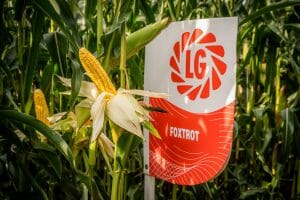
The third new Limagrain variety to be added to this year’s Descriptive List is LG31.207: with an FAO of 210, this intermediate to late-maturing variety is one of the best options for very favourable sites.
“LG31.207 is impressive on paper and in the field, and is the perfect choice for those growers looking to maximise their return on investment with a variety that poses minimal risk,” Mr Richmond describes.
“LG31.207 tops the Descriptive List for very favourable sites with an ME yield of 217,115 MJ/ha and dry matter yield of 18.7 t/ha ,” Mr Richmond continues. “And with excellent agronomic traits that include good standing power (8.0) , excellent early vigour (8.2) and an eyespot resistance rating of 7.5, LG31.207 is a really safe choice for growers looking for an energy-rich, easy to grow variety for AD purposes.”
|
VARIETY |
DM content (%) |
DM yield (t/ha) |
ME content (MJ/kg DM) |
ME yield (MJ/ha) |
Starch content (%) |
Starch yield (t/ha) |
Cell Wall Digestibility (%) |
Early vigour (1-9) |
Standing power (1-9) |
Leaf senescence (1-9) |
FAO |
|
CONTROLS: Favourable |
34.1 |
18.2 |
11.7 |
213,241 |
35.1 |
6.2 |
59.0 |
7.0 |
7.6 |
6.9 |
– |
|
SKIPPER |
35.9 |
18.8 |
11.8 |
221,175 |
35.9 |
6.74 |
58.8 |
7.2 |
7.8 |
7.3 |
160* |
|
FOXTROT |
35.3 |
18.7 |
11.9 |
222,526 |
35.3 |
6.54 |
59.4 |
7.2 |
6.7 |
7.3 |
170* |
|
CONTROLS: Very favourable |
34.5 |
18.1 |
11.5 |
207,131 |
32.0 |
5.8 |
57.0 |
7.3 |
7.5 |
5.6 |
– |
|
LG31.207 |
35.3 |
18.7 |
11.6 |
217,115 |
31.6 |
5.9 |
58.5 |
8.2 |
8.0 |
6.1 |
210* |
Source: BSPB/NIAB Forage Maize Descriptive List 2023-24.
Orange highlight: favourable sites. Blue highlight: very favourable sites.
* Limagrain estimate.
The 2024 Maize Variety Selection Guide is available now, it includes all the BSPB/NIAB data for Favourable, Less Favourable and Very Favourable sites, as well as additional LG data, giving you stacks of information to get stuck into, making your buying decision easier than ever before.
To download, click here!

How Later Drilling OSR can be successful
The oilseed rape drilling window is far wider than often thought. Although most crops are drilled in the first two weeks of August, it is possible to drill into September and still get a good crop established, says leading plant breeders Limagrain UK.
“With this year’s later harvest comes the reminder that there is no need to panic and rush to get the rape crop in before mid-August. Many farms now have drills that cover large areas quickly, so it is possible to get drilling done in a shorter time frame than may have been the case several years ago,” says Liam Wilkinson, Limagrain’s oilseed rape product manager.
“The last few years we have seen milder autumns so soils are warmer, and as long as there is sufficient moisture, we have seen crops do well on farm when drilled at this later period.”
“Most breeder and Recommended List trials are drilled later than they would ‘on-farm’ -which could be anytime from the August bank holiday – as the seed becomes available. What we see the following year in trials plots, are often slightly later drilled crops.”
Mr Wilkinsons refers to work done by Dr Sacha White at ADAS where later drilled crops tend to be at less risk from CSFB larvae as there is less time for the adults to lay their eggs in the autumn crop.
“So if you can get the crop up and away from the adults as quickly as possible, the crop has a fighting chance against the pest.”
“Drilling later can also help with black-grass control as it gives you enough time to create a stale seed bed.”
“We find ourselves now in a position where there are fewer active ingredients to control the most difficult weeds in the whole rotation, particularly this year with the loss of Carbetamide.”
He adds: “The pressure on these herbicides increases further considering the growing number of early drilled crops (if soil moisture allows), which can mean potentially bigger weeds under the canopy, as they’ll have more time to grow before being sprayed.”
“By drilling later, the smaller crop can also make better use of autumn nitrogen, as opposed to a plant established in mid-August that is much larger and has to spread the nitrogen out.”
“For those in Clubroot infected areas, delayed drilling also reduces the risk of infection.”
Neil Watson, Hutchinsons southern technical manager agrees by drilling oilseed rape later it is possible to avoid the peak migration of the adult CSFB, and there reduce subsequent impact from larvae.
“The French drill later than we do and still manage to get to 8 leaves before the cessation of autumn growth,” he says.
He also recognises however that there is risk involved with drilling later and that yield potential may be compromised should the plant not reach the critical 8 leaf stage – hence the value of picking a vigorous variety that will grow away quickly enough to be well established before the winter closes in- and this is critical.
“A backward crop coming into the spring has insufficient leaves and branching sites to fulfil yield potential. It also leaves little time for leaf area expansion before initiating floral development from the vegetative stage leaving a suboptimal canopy size to intercept light.”
He refers to data which suggests needing a 400-600 day degree (80dd per leaf) from emergence to get to this magical 8 leaf stage. “A vigorous crop emerging end of August through to mid-September has a good chance of achieving this, assuming sowing date being 2 weeks earlier roughly. Beyond this drilling window, however you are compromising yield.”
Mr Wilkinson adds for success when drilling in this later slot, it is key to choose a variety with rapid autumn dynamic growth and the traits needed to establish and grow away quickly into the autumn – so a vigorous, trait-loaded hybrid fits the situation well.

Liam Wilkinson
So what is vigour and how can it be measured?
“Industry wide there is much debate about the value of vigour in oilseed rape varieties. But with no standardised measurement for vigour, it’s very subjective,” says Liam Wilkinson.
“Vigour is not a point in time measurement, it is a reflection of the plant’s dynamic growth through the autumn and reflects the speed of growth and ability of the plant to accumulate biomass.”
“Understanding how a particular variety develops and being able to create vigour values related to these, means that as breeders we are very well informed to provide advice on where a variety should be drilled,” he says.
“The very high yielding hybrid LG Aviron is one of one of the most vigorous varieties, it establishes speedily in the autumn and puts on biomass very quickly, even under testing or challenging situations, and copes well with being drilled later. Ambassador also performs well in this drilling slot, as do our national listed candidates Armada and Academic.”
However he points out, if the decision to drill later or circumstances push into a later drilling than normal, it is key to commit to the crop fully to give it as much chance to succeed.
“There’s no point in putting the crop in the ground and then hanging back on nitrogen or weed control. The crop will need all the help it can get so it’s up and away as quickly as possible.”
Drilling oilseed rape in mid-September is nothing new for Northumberland grower, Richard Brewis of Woodhouse Farm, who has been drilling rape in September for the last twenty years and does not believe this impacts yields.
“OSR is an integral part of our rotation, and we would normally have around 60ha’s in the ground. We had always done what everyone else did and drilled oilseed rape after winter barley, so mid-August.”
“However, our heavy wet soils didn’t suit winter barley, so about twenty years ago, we made the decision drop the barley and drill oilseed rape after wheat which would obviously mean drilling later, and we have never looked back,” he says.
“Now we aim to start drilling the rape by the 6/7th September and just keep going until it is all in.”
He points out this is of course weather dependent, and he must work around that. “But even when a crop was drilled as late as the 20th September it was still decent, although this is slightly later than we would choose to go, but it does show that yield is affected by other factors other than just drilling date.”
Growing hybrids is essential for our approach, he says. “We have grown Limagrain’s hybrid Aurelia for the last three years and have been very pleased with that, it copes well with this drilling slot, producing an even crop and very pleasing yields. Last year we also trialled some LG Wagner and plan to have a mix of each variety in the ground this year.
Rape at Woodhouse Farm is established using a Simba subsoiler followed with a power harrow drill and Cambridge roll, if weather conditions allow.
“We aim for a rosette pan structure of about 7-8 leaves rather than height, going into the winter, although we have had fewer leaves and still managed to keep the crop.”
Generally CSFB is not an issue, and Mr Brewis puts this down to the later drilling window. “Last year’s early harvest meant that we drilled our rape slightly earlier than normal, in the third week of August and lo and behold, we found patches of damage that we had not seen before.”
He believes there is a zone when adults CSFB inflight is reducing in his area – and this is the second and third weeks of September and by catching this, risk is much reduced for adult infection which then relates to very little spring larval damage.
“We do get some winter rape weevil, and treat this, so perhaps that also has an effect on the CSFB,” he suggests.
“Our main challenge is keeping pigeons off the crop, particularly as the crop is smaller, for which we use a range of methods from gas guns and visual deterrents to calcium chloride to make the crop more bitter. We must also take great care with slugs.”
However, some damage is inevitable, but Mr Brewis does not give up on poorer or damaged areas, and whilst they may never be as good as the rest of the crop, he says they will reach about 75% of the full potential.
He recognises there are pressure points in crop management when choosing to drill in September, and that it is not suitable for everyone. “As we don’t have issues with black-grass, we can start drilling wheat in the second week of September, so that can clash with drilling rape. We also have less time to get the wheat straw off.”
“Yes, there are risks to our approach – we only get one shot at getting the crop into the ground but so far there has been only one year back in 2012 when it rained continuously after harvest when we didn’t get the crop that we wanted.”
Thriving in Ireland – How OSR has found its place in the Irish rotationOSR hasn’t always been the break crop of choice in Ireland, but it’s gained popularity as a replacement for sugar beet since 2006, says farmer John Dunne and Goldcrop, arable trials & agronomy manager.
“Growers quickly realised how good a break crop it is and how both wheat and barley got a kick when grown after it, the kick in spring barley being seen for a few years after OSR.
“The planted area grew until 2012, when we had a bad harvest, and then faltered after a few varieties let growers down.”
But the trade continued to push the crop and Harvest 21 saw 10,000ha harvested. “This grew to 14,000ha for Harvest 22 and is expected to be 19,000ha this year,” he explains.
One reason for the increasing area has been down to better yields, says John.
“We’ve seen a 30% increase in yields over the past six years. Whereas growers would previously have achieved 3.95t/ha to 4.45t/ha, they’re now regularly getting 4.94t/ha to 5.43t/ha – so it’s a big increase.”
But getting the crop sown in time can be a challenge, he says. “Planting OSR behind winter barley is fine, but trying to get it in after winter wheat or spring barley can be tricky.
“In 2006, growers started out with conventional varieties but they’ve moved towards hybrids over time. We have to be careful that varieties aren’t too vigorous, but we’d rather be looking at the crop rather than looking for it.”
Having traits such as TuYV resistance in varieties is really important to Irish farmers because the climate is quite mild, according to John. “When we get a frost, it’s a notable topic of conversation here. And because it’s so mild, we’ve had issues with barley yellow dwarf virus, and this made me wonder if TuYV was also nipping at OSR yields.”
Working with breeders Limagrain UK who were the first to introduce the trait, Goldcrop took samples of varieties without TuYV resistance and found the virus to be consistently showing up. “Once you get your eye in for identifying the virus symptoms, you’ll see a reddening of leaves at the edges of the field and along tramlines and the disease can take up to a third of the yield.
“Last year we saw headline varieties without resistance falter in our official trials, whereas resistant varieties took this risk out of the equation.”
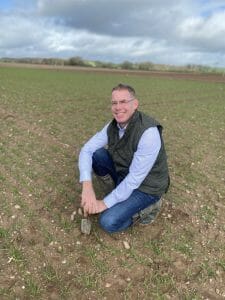
John Dunne
According to John, Irish growers have also had more trouble with light leaf spot than with phoma and so really value highly resistant varieties.
“LLS has always been the tougher beast to my mind and in some years the circumstances play into it with higher pressures, especially when there are nearby OSR stubbles. As the disease cycles so frequently and repeatedly, it can be hard to control and is the most damaging disease we have, so having genetic resistance is a huge help.”
He also feels that pod shatter resistance has to be standard in all varieties. “Our climate is tricky, so to have something that won’t shed is a big safety net. I can’t really believe that varieties still come to market without it.”
Irish farmers have become very fond of growing OSR, adds John. “It’s an essential part of the rotation for many, so having stacked traits to secure its future place here is important.”
Liam Wilkinson, product manager for OSR at Limagrain feels that the Irish OSR area has increased because of access to varieties with stacked traits. “If a disease is going to be found in any crop, the Irish will normally get it, but having new genetics in place has really helped secure OSR’s place in Ireland.”
Regen Farmer Looks to LG Typhoon for Low-Input ApproachRegenerative practices that are less reliant on artificial inputs require farmers to select varieties with attributes that can help them thrive in such conditions.
It is something East Yorkshire farmer, Jonathan Hodgson of I M Hodgson & son Ltd, recognises, after converting the 280 ha farm, to a reduced input, strip tillage system in 2019.
There is a diverse rotation on the medium to heavy clay farm, east of Hull, featuring winter wheat, oilseed rape, spring barley, spring oats, winter beans, vining peas, flax, and herbal leys. Cover crops are grown ahead of spring crops, while short-term catch crops are also included wherever possible, namely after vining peas, or oilseed rape, ahead of wheat.
“We’re trying to build diversity into the rotation, but our primary focus remains on first wheats; that’s what we’re always trying to get back to as quickly as we can,” says Mr Hodgson.
This season, he is growing a range of varieties, including 20 ha of the hard Group 4, LG Typhoon, alongside LG Astronomer for seed, trial areas of LG Aldaniti and LG Redwald, plus Costello, KWS Extase, Theodore, and a four-way blend trial.
It is the second year of growing LG Typhoon, after a successful 3 ha trial of the variety last year, on land previously in pasture.

Desirable traits for regen
Mr Hodgson’s decision to grow LG Typhoon followed a conversation with Limagrain UK’s arable technical manager, Ron Granger, who says the variety has certain attributes that suit strip tillage/ direct drilling, regenerative crop establishment systems.
Mr Granger says LG Typhoon had been on the farm in a Limagrain UK demo trial, alongside commercial and up-and-coming varieties, for a couple of seasons, and it was clear the variety offered better suitability for the direct drilling, wider row situation.
“It was a stand out variety,” says Mr Granger.
LG Typhoon’s growth habit, for example, means plants sit prostrate with slower growth through the winter into spring, which is ideal for those direct drilling earlier in the autumn and do not want a variety that will race off too quickly.
It is high tillering and has the capacity to utilise the space between the wider rows, often found with some direct drilling equipment. Indeed, Mr Hodgson’s Mzuri drill has a relatively wide row spacing of around 300 mm centres.
LG Typhoon’s strong standing power and disease resistance – reflected by its high untreated yield (92%) – further suits those looking for flexibility with crop protection inputs, Mr Granger says. Unlike some feed varieties, it also offers Orange Wheat Blossom Midge (OWBM) resistance, in addition to a six-rating for eyespot and Fusarium.
“It’s a high yielding, consistent and resilient variety, that delivers across seasons and rotations.”
For Mr Hodgson, the biggest draw is LG Typhoon’s robust disease package, particularly the Septoria rating of 7.3, and yellow rust rating of 9.
“That’s what I look for in a variety, probably more so than outright yield. What can it offer in terms of agronomy, and is it a good, stable, variety that will let me look after a crop how I want to, instead of relying on a can to keep it clean?”
Cutting inputs
Last year’s LG Typhoon lived up to promises, yielding 11 t/ha from limited inputs – about 10% up on the farm’s five-year average yield.
The crop received two fungicides – 0.5 L/ha Amistar (azoxystrobin), and 1 L/ha Verydor XE (fluxapyroxad + Mefentrifluconazole) – and a total of 160 kg N/ha.
“We have been trying for a number of years to reduce fungicide inputs, but last year was the first time we’ve done so on a farm-scale, albeit helped by relatively low disease pressure.”
Indeed, one variety on the farm did not receive any fungicide inputs in 2022, and still yielded over 10 t/ha. Other crops did receive fungicides at different stages of the season, reflecting Mr Hodgson’s desire to remain flexible and adapt to the conditions.
“We want to be flexible. If the plant looks healthy, I won’t put a product on, but if it needs one, we will still use a fungicide. Last year, some crops had a T1, others got a T2, and some first wheats had a T1.5 instead of a T1, as that’s when we decided to go on. We won’t rule out using fungicides, but it’s a measured approach, field-by-field and variety-by-variety.”
While looking to reduce reliance on fungicides, Mr Hodgson is keen to support plant health in other ways, notably through more targeted nutrition, utilising in-depth soil testing, and sap analysis, to determine requirements.
He is also changing the way nitrogen is applied, by moving to a “little and often” approach, rather than applying large amounts in one go, which can cause surges of weak growth fuelled by simple sugars, potentially making plants more prone to lodging, and attack by pests and disease.
This approach typically sees 160 kg N/ha applied in four liquid applications of 40 kg N/ha every 15-20 days, from early to mid-March onwards. A carbon source is included with each nitrogen application to improve uptake efficiency. Programmes are completed with a final foliar nitrogen application. “This only provides about 10 kg N/ha, but the nitrogen use efficiency is far greater than applying nitrogen to the soil,” notes Mr Hodgson.
“Our aim is to keep plants healthy and growing at a consistent, steady rate, instead of causing surges of growth that need to be managed with PGRs.”
Additional fertility comes from the 1,100 tonnes of pig manure produced on the farm each year, applied on a rotational basis.
Supporting establishment
Mr Hodgson acknowledges that in the first years of converting to strip tillage, establishment was lower than with conventional tillage, as soils took time to adjust.
Seed rates were therefore increased to compensate. This season’s 20 ha block of LG Typhoon, was sown at 400 seeds/m2 on 27 September, after oilseed rape, using home-saved seed, with no dressing (just cleaned in a mobile seed plant and tested for fusarium).
“However, we are now seeing an improvement in soils and drilling conditions, so I think we can start to reduce seed rates slightly. It’s been a steep learning curve.”
To support crop establishment and soil health, Mr Hodgson also includes two liquid products – fish hydrolysate and humic acid – in a band with seed at planting. “The hydrolysate is full of amino acids, so the idea is to prime the soil by helping the biology.”
No starter fertilisers are used, and he points out that no phosphate or potash has been applied for the past four to five years. “Most soils have tonnes of P and K; we just need to be better at getting plants to access it.”
Mr Hodgson says this year’s LG Typhoon established very well in a relatively kind autumn and winter, growing on well through spring. Disease-wise, it looks “pretty clean”, despite having not received any fungicide, or growth regulator, up until the time of writing (beginning of May).
“There is more disease pressure this year than last, so we’ll have to remain on the ball and keep checking crops.
“It generally takes two to three years to get to know a variety properly, so it is still early days, but so far, LG Typhoon seems to suit our system.”
LG Typhoon
High yielding, consistent Group 4 feed wheat
Strong disease resistance, particularly Septoria (7.3) and yellow rust (9) – 92% untreated yield
OWBM resistance, good standing ability
Adaptable drilling dates – suits early drilling, also excellent as a second wheat
High tillering capacity and a slower, prostrate growth habit through winter into spring, and the plant’s ability to fill space, suits wider row direct drilling re-gen systems.
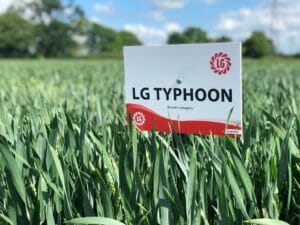
LG Typhoon
Meeting the challenges of growing oilseed rape has brought the value of both genetics and crop management practices into the limelight more than ever before. We look at how two growers on opposite sides of the country use these tools to tackle their challenges.
Despite the challenges of flea beetle, slugs and pigeons, oilseed rape is a good break crop for Emma Fletcher who farms 700 ha with her brother on the Leicestershire/Warwickshire border.
“It fits well in the rotation as a profitable break crop, going in after winter barley and before wheat”
The oilseed rape at Burton Fields Farming Ltd is was established via direct drilling with a 9 meter Dale direct drill. “The aim is to drill the crop in August, but the most important thing is to drill into moisture.”
“We have a tick list for the characteristics and traits a variety has to offer,” says Ms Fletcher. “Fundamentally we need it to be consistent, we don’t want a volatile crop that yields well one year and then lets us down the next.”

Emma Fletcher
“Aside from robust agronomics, we also need it to have really good autumn vigour, good disease resistance and we also look for a variety that offers pod shatter.”
“Aurelia ticks all of the boxes, and we were pleased with it in our first year of growing it in 2021 & 2022. We look for the rape to yield 4+t/ha.
“This year’s crop was drilled slightly later than we would have liked which meant it went in at the beginning of September rather than the last week of August, as we held off for a bit more moisture,” she explains.
“We had a few issues with CSFB in the spring. Despite drilling at low seed rates some areas have come through thicker than we would have liked, which we put down to volunteers, and the beetle seem to favour this thicker crop.”
Emma explains that having split hopper on the drill allows for companion crops to be sown at the same time. “Last year we established the OSR with buckwheat. Every other coulter was buckwheat or oilseed rape. We were really pleased with the results and the buckwheat then died off with the first frost.”
“However, this year the OSR has been drilled with a mix of buckwheat and berseem clover, so we shall see if that has made a difference.”
Nutrition at Burton Fields Farm is on a responsive approach with tissue tests being taken season-long and we prefer to respond to these results rather than simply going on with a blanket approach, points out Miss Fletcher.
“This season we have kept it fairly simple with the disease control and tried to utilise nutrition as best possible. In the autumn sewage sludge is put into the seedbed to enhance autumn vigour.”
“Slugs are often a problem in the autumn so traps are used to treat when the threshold is met. PGRs at this time are also very important; sheep have been considered instead of this but there are downsides to using them so we are holding back for now.”
Over in the north west of the country, Richard Reeves of Tattendale Farm has been growing OSR for 40 years.
“We are a fairly traditional arable rotation on a tenancy agreement with Tatton Park Estates, of which OSR is an integral part. We look for yields on average of 4.5t/ha and prefer varieties that we can rely on for a consistent yield.”
“On the advice of our rep, James Hood from United Oilseeds , we opted for Aurelia a couple of years ago and will stick with it again this coming season as it has delivered what we need. It comes though well in the autumn, its vigour is stand out and we haven’t had any issues with disease.”
Aurelia
“We tend to keep things fairly simple as this has always worked for us. The OSR follows barley or early wheat,” says Mr Reeves.
“Waiting for moisture to drill in the autumn is not so much of an issue where we are so we aim to drill in the last two weeks of August, any earlier and we find the crop gets too proud.”
“As we are not in a predominantly arable area, CSFB is not so much of an issue, pigeons are our challenge.”
Our soils take the plough well, so we plough and combo drill the rape straight after, which traps the moisture with the seed.”
Seed rates are around 3kgs/ha. We apply about 140-150kg/ha Nitrogen across two applications of granular product and then top up with liquid. This year we are looking at going on twice with a foliar application as we have found that this increases the oil content. We also apply Sulphur in an N:S mix.
“A single PGR is used in the autumn, and a fairly standard fungicide programme as we have so few disease issues with the Aurelia.“
“At the end of the day farmers want yields as this is what they get paid for, so growing a variety that the best chance of reaching its yield potential is key,” says Liam Wilkinson of breeders Limagrain UK.
“Growers can put in all the leg work, but are still being thwarted by elements beyond their control, which is where plant breeding steps in to protect yield by breeding stacked traits into varieties,”
Beckii Gibbs, seed manager with United Oilseeds, believes that Aurelia’s offering of fully loaded traits, excellent disease resistance, proven performance and good vigour makes it a firm favourite with farmers.
“Aurelia has been the number 1 variety on farm for a number of years now. The fact that it holds a 30% share of the UK certified hybrid seed market speaks volumes. From our farmers’ perspective, it’s a reliable and consistent variety and is likely to remain a popular choice particularly with the good yields Aurelia achieves year on year.”
LG GatePost Newsletter – June 2023The June 2023 issue of LG GatePost is now available to download.
This edition features articles about our newest wheat addition to the 2023-24 AHDB Recommended List, LG Redwald, as well as LG Caravelle, our excellent 2-row winter feed barley.
You can read about and view our Live Panel event which was a round table discussion on Varieties, Soils and Policy with industry experts.
We discuss the new Sustainable Farming Incentives and the new ‘actions’ involved, with an article about why to consider establishing a legume fallow.
There is also information about our upcoming Demo Days and a link to register.

LG GatePost – June 2023