‘Phenomenal’ yields make LG Diablo top choice next spring
The third year of growing LG Diablo was certainly one to remember for Yorkshire farmer Paul Rogers, after the variety revealed its true yield potential on his 182 ha (450-acre) farm near Ripon.
Some 25 ha (60 acres) averaged 10 t/ha (4 t/acre) sold weight at 15.5% moisture, with one field hitting an impressive 10.6 t/ha (4.3 t/acre). Furthermore, all crops achieved the full malting specification required by grain buyer Saxon Agriculture, coming in at 1.51% nitrogen and an average specific weight of 68 kg/hl.
“I’ve never seen anything like it. The barley was rolling off the combine like a crop of first wheat. It was phenomenal!”
Mr Rogers acknowledges the highest yields did come from the farm’s best “good bodied” land, that did not drought off in the dry season, but even so, he would have still only expected yields of nearer 7.5 t/ha (3 t/acre).
“Even another 25-acre block of drought-hit sandy land still managed to do 7.2 t/ha (2.9 t/acre), which was tremendous for a field that droughted-off.
“I don’t know exactly where the big yield came from, because we didn’t do a lot different to the year before, apart from getting crops in earlier, around mid-March instead of early April. It was just an earlier spring; the soil conditions were correct for drilling.”
The LG Diablo established quickly, resulting in a dense plant stand that “looked like a carpet”, he notes. “The key was to keep it standing, which meant we did put on an extra growth regulator, in addition to Terpal (ethephon + mepiquat).”
Mr Rogers admits that while he may not be able to guarantee hitting such impressive yields every year, LG Diablo‘s performance in 2022 at least demonstrates what the variety is capable of on his farm and soil types, and he plans to put all of his spring barley area (around 30 ha) into LG Diablo again next spring.
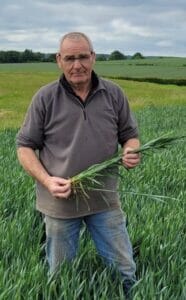
Paul Rogers
Black-grass benefit
A key reason for growing spring barley on the farm is for its role in controlling black-grass and ryegrass, Mr Rogers says. “Both are becoming more of a problem, but I’ve found that if I can get thick coverage of spring barley, it does a tremendous job of smothering the black-grass, which we did see last season.”
He adopts a very traditional approach to establishing spring barley. Preceding stubbles are left to green-up after harvest, before land is ploughed in November, allowing bare soil to weather and breakdown naturally over winter. He then goes in with a power-harrow/ box drill combination, once ground is dry and warm enough in the spring, usually around early April.
“It normally doesn’t worry me drilling spring barley towards the middle of April, if that’s when conditions are right, so long as I can make sure it goes into moisture, and I can conserve that moisture in the seedbed.
“The important thing is to drill when conditions are right, not on a particular date. Last year [2022 harvest], we didn’t do a lot different to normal, apart from getting crops drilled slightly earlier because soil conditions allowed.”
Ploughing in November allows time to achieve a good flush of weeds in the autumn, which means no pre-emergence spray is needed in spring. “I don’t want anything knocking the crop, and pre-ems can sometimes hold barley back a bit. I prefer to wait until weeds have emerged after drilling, and then tackle what’s there. The spring barley itself is our grassweed control, so we only really need broadleaf chemistry.”
Granular phosphate and potassium fertiliser (0-20-30) is typically applied once the tramlines have been established, as is the nitrogen, with crops getting around 135 kg N/ha in total.
Manganese is a key nutrient for spring barley, and Mr Rogers generally includes it with both of the main fungicide applications, as well as sowing manganese-dressed seed. Last year’s fungicides were based on benzovindiflupyr applied in May, and fluxapyroxad + Mefentrifluconazole in June.
“LG Diablo is certainly a good variety that has performed well for us in all three years we’ve grown it, so I’ve no plans to grow anything else next year,” he concludes. “LG Diablo is ticking all the boxes for me at the moment.”
Dominating the 2023/24 AHDB Recommended List
It’s a grand slam for breeders Limagrain UK as their wheat, winter barley and oilseed rape varieties take leading positions across the 2023/24 AHDB Recommended List.
LG Redwald secures poll position as the highest yielding winter wheat. LG Caravelle is the highest yielding two row winter barley.
Attica joins as the highest yielding oilseed rape variety, with the essential turnip yellows (TuYV) and pod shatter resistance traits.
LG Wagner is the highest yielding addition to the northern OSR Recommended List.
LG Redwald sets a new standard for high yielding wheats, yielding 107% in the UK, 107% in the east and 109% in the west. As a soft wheat, the variety also offers potential for distilling.
These high yields have been consistently proven across National List trials over seasons, drilling date and soil type, particularly in the second wheat and later drilling situations.
LG Redwald has an excellent disease resistance profile, with very good septoria resistance as well as orange wheat blossom midge (OWBM) resistance.
“It is an exciting variety that should deliver for growers in 2023/24, if supported with good agronomic practise to ensure it meets its full potential on farm, and comes at a time when growers are looking more than ever to maximise output in order to maintain profit in times of increasing costs,” says Ron Granger, Limagrain’s arable technical manager.
LG Caravelle is the highest yielding two row winter barley to join the 2023 Recommended List. LG Caravelle dispels any misconception that two row barleys are lower yielding than hybrids.
Offering UK yields of 106.3% – which is as good as the top yielding hybrid barley variety and yielding 2% above hybrids in the east.
These high yields are backed up by an excellent disease profile, reflected in LG Caravelle’s high untreated yields. LG Caravelle also offers an exceptionally high specific weight for a winter barley, of 71.8 kg/hl.
It is an early maturing variety with stiff straw; both important characteristics for a winter barley.
Attica is a newly recommended fully loaded hybrid with full UK Recommendation. It joins the Recommended List as the highest yielding variety to combine stable high yields with the genetic security of TuYV and pod shatter resistance traits.
Attica has a strong autumn growth habit, offering growers a wide drilling window and a very good disease resistance package.
LG Wagner joins the north Recommended List as the highest yielding variety (108.1%). In 2022 it was the highest yielding variety also offering the security of pod shatter and TuYV resistance. It is a shorter hybrid with stiff stems, combined with good light leaf spot resistance and good stem health.
“This is a tremendous achievement and is the first time that any breeder has achieved this level of success across all of the cropping sectors in the last decade, if not longer,” says William Charlton, Limagrain’s UK marketing manager for arable seeds.
“We believe this success is built on our unique UK focussed breeding approach, which means we are able to select for the UK’s maritime climate from day one in the breeding programme. This allows us to look for consistently high yielding varieties from the very start of our programme, to suit UK growers and end user requirements.”
LG wheats scoop top spot in Suffolk awards
Limagrain varieties have picked up two prizes at the Suffolk Agricultural Association’s annual Farm Business Competition, presented at a special awards dinner in October.
The competition aims to recognise the best farms in Suffolk, in three size categories – Class 1 (farms up to 250 ha), Class 2 (251-500 ha), and Class 3 (farms of 501 ha or more) – as well as presenting further awards in four main categories, namely; conservation, livestock, diversification and a ‘Best Crop’ award.
Limagrain UK varieties scooped first place in two out of the three size classes within the Best Crop award.
William Faulds
The winning crop in Class 1 was the high-yielding Group 4 wheat, LG Skyscraper, grown by Roy Steward, at A.C.C Green, Red House Farm, Badingham, Woodbridge.
“The Skyscraper looked well all year, was not over thick and is a good all-round variety,” Mr Steward said.
Judge of the Class 1 competition, William Faulds, commented: “I have seen a number of very good-looking crops of wheat over the competition, and in general. But, LG Skyscraper has particularly stood out, in both the first and second wheat scenarios that we judged.”
Class 3 Best Crop – Bill Baker, James Forrest, Robert Hayle
Among the larger Class 3 farms, it was a crop of the Group 3 soft milling wheat, LG Astronomer, grown by James Forrest, at RH Forrest and Co, Mowness Hall, Stonham Aspal, that took the Best Crop award.
“It’s always very difficult to decide which is the best crop of wheat,” said Mr Forrest. “The LG Astronomer grew well and yielded well too, at over 11 t/ha. It was grown as a seed crop and we’re growing it again commercially this year. It also produced a decent sample at 80 kg/hl.”
The 2022 Suffolk Show President, David Barker MBE, said that in his opinion: “The farms reflect some of the best crops grown in the UK, and for two Limagrain-bred wheats to feature was a tribute to the remarkable plant breeding taking place at Woolpit in Suffolk.”
The combination of LG Diablo’s high yield potential and consistent grain quality has made it a firm favourite within the rotation for East Fife farmer David Bell.
The mixed arable and suckler beef farm near St Andrews extends across three holdings, centering its varied rotation around potatoes, winter wheat, winter and spring barley, vining peas, 5-8-year grass leys, permanent pasture, and Agri-Environmental Climate Scheme options.
The farm has been growing LG Diablo since before it joined the Recommended List, and in 2020, won the Yield Enhancement Network (YEN) Gold award with the variety, achieving the highest spring barley yield of 11.3 t/ha.
“There’s no hiding the fact that LG Diablo is a great yielder; it rivals any feed spring barley,” Mr Bell says.
“Our yield in the 2020 YEN competition was phenomenal, and it all made sub-1.65% nitrogen malting spec. Mother Nature was very favourable towards us that year, and we were really able to maximise the potential of the variety. The crop didn’t get any special treatment, we were just attentive to timings and it really delivered for us.
“Having grown LG Diablo for eight years, our understanding of how to manage the variety to get the best out of it has grown as well, and we’ve had some amazing yields. It has also shown consistency for hitting low nitrogen malting spec.”
Flexible approach
Building and maintaining soil health is fundamental to the farm business, and underpins the success of any crop, including spring barley, Mr Bell says.
“We really see our soils as the foundation, and everything else grows on top of that, literally and metaphorically.”
Cover crops, organic manures, and a varied rotation that can be adapted to the season and market fundamentals, are central to this focus, as is a flexible cultivations policy that includes direct drilling, minimal tillage, and deeper cultivations where needed.
“I’m very fortunate to have a choice of establishment methods, whether a zero-till drill or a one-pass drill. It’s a real luxury to be able to choose the right tool for the job, crop and conditions.”
Traditionally, spring barley has been established after ploughing overwintered stubbles in the spring, but for the first time in 2022, Mr Bell tried direct drilling all of his spring barley into a grass and clover cover crop. It is a method he has successfully adopted in winter cereals, but for spring barley, he acknowledges it has been a learning curve.
Cover was sprayed off with glyphosate in early spring once conditions started to warm up, then drilled when it started to die back, using variable seed rates from a base of 425 seeds/m2.
“But, my seed rate was too low for the ability of spring barley in that situation. This was true of all three barley varieties we grew, as spring barley is less vigourous than winter wheat and, in my opinion, it needs some tilth to develop effectively.”
Crops therefore fell short of his target plant population, resulting in yields below par across all spring barley varieties last harvest, averaging just shy of his expected 7-8 t/ha.
“I relied too much on the root mass [of the cover crop] to do the tillage for me, but have learnt from that. We didn’t have a viable enough establishment area for the seed, so next spring I shall again be direct drilling into fields with green cover on them, but will do a shallow 25mm cultivation pre-drilling to create a tilth to help barley establish. We will also look at a more diverse cover crop in the future.”
David Bell
Fitting into the rotation
LG Diablo will again be Mr Bell’s main spring barley variety grown for harvest 2023.
“One of the huge benefits of LG Diablo, especially in a mixed farming situation, is that it’s a high yielding spring barley variety, and if we do get it wrong in terms of nitrogen being too high for distilling or brewing, we still have a good feed crop. It’s dual purpose in that respect too, creating a circular economy within our own farm.
“Every farm and field is different though, and it’s up to us as growers to select the right tool for the right job, or the right variety for the right market or ground conditions.
“We have to look at our market, select our crop and variety against what our ground is capable of delivering, and LG Diablo fits that bill for me.”
Direct drilled LG Diablo performs in one of the driest seasons on record
A move to direct drilling LG Diablo spring barley has proven successful for Berwickshire grower Neil White, as yields and quality impressed in a challenging season.
Mr White has been direct drilling crops for the past seven years at the 260 ha (650-acre) Greenknowe Farm near Duns, but until this season, had not established spring barley this way.
Traditionally, he favoured ploughing and power-harrowing spring barley ground, before sowing with a combination drill once soil was dry and warm enough, or sometimes drilling directly into the plough with his 3-metre Mzuri Pro Til 3T. He says ploughing reduces the risk of wheat volunteers emerging in the barley crop, and generally creates a good seedbed for barley to establish quickly.
“Barley has been the last crop I’ve gone over to direct drilling with, but we successfully tried it on two-thirds of our area this spring [2022], sowing directly into overwintered stubble. The plan is to try and direct drill all of our barley again next spring, either into overwintered stubble or after a cover crop.
“It’s really pleasing for me to see that LG Diablo works in that direct drilled scenario, and still produce a good yield and grain quality. I’m very happy with it.”
The farm’s target spring barley yield is usually around 7.4-8.6 t/ha (3-3.5 t/acre), and this year’s 35 ha of LG Diablo was at the top end of that range, despite some very dry conditions during the growing season.
Quality was good too, with nitrogen coming in at 1.52%, and specific weight at 67.4 kg/hl, allowing everything to meet the malting specification required by grain buyer, Simpsons Malt.
“It produced a nice bold grain, despite the very dry spell. Everything hit the spec for malting, which is spot-on.”
Mr White acknowledges there were a few light grains this season, which he attributes to the lack of rain, preventing some grain from maturing and filling fully. “We certainly haven’t seen any issues with screenings before, so I’m sure it’s due to the year, not the variety.”
Neil White
Maximising establishment
Mr White recognises that his Mzuri drill does move more soil than other direct drills, but believes this benefits barley establishment in the spring, as it helps aerate the soil, warm it up and mineralise some nitrogen.
Switching from a combination drill to the Mzuri has also allowed him to sow spring barley at variable seed rates to account for establishment differences on varied soil types, and put fertiliser ‘down the spout’ with seed, to get crops off to a good start.
Last year he applied a 10-26-26 N, P, K fertiliser, with some sulphur, at drilling, but next spring plans to reduce the total amount of phosphate and potassium applied due to high prices, instead opting for a 16-15-15 product.
Seed rates last season typically ranged from 380-440 seeds/m2 on the variable soils, with crops sown on 33cm rows. That is a much wider spacing than spring barley is conventionally sown at, but he believes LG Diablo’s vigour enables it to fill the gaps between rows nicely.
“Also, it doesn’t brackle, which is something that is always a threat if weather turns catchy at harvest, especially on wider rows.”
Mr White says LG Diablo has been pretty straightforward to manage, and has even allowed a slight reduction in spray costs.
“Previously, we used to apply a low rate of growth regulator to Concerto to encourage it to root and tiller, but we haven’t needed to do this with LG Diablo, which possibly reflects its strong vigour. I haven’t found it expensive to grow, especially as we just do a two-spray programme.”
Crops usually receive two fungicides; one with trace elements at Growth Stage 23 and a second at GS 39 with manganese.
Wider benefits of direct drilling
There are broader benefits from the full conversion to direct drilling too, not least in the fact that soil carries machinery a lot better when it is not ploughed, Mr White says. “That’s particularly noticeable at harvest.”
Moving less soil reduces total fuel consumption too, which saves money and improves the carbon credentials of direct-drilled malting barley, he adds. This could become more significant in the future as the UK continues its drive towards net zero and grain buyers look to secure supplies with a lower carbon footprint.
“I’ve often said that I should be receiving a small premium for low carbon barley, and LG Diablo ticks the box for that.”
In demand from distillers
LG Diablo’s consistency is valued by end users too, says Mike Dagg, senior grain trader at Simpsons Malt, who expects it to remain one of the top two varieties grown in Scotland for distilling over coming years.
“We’ve had the variety for five or six years now, and we know it goes through the malting process very well, from steeping the barley, to germinating and kilning, so that means we’re not losing time having to give it an extra day or two at any stage.
“If it performs well going through the malting process, then there’s every chance the malt product will also do well going through distilling too.”
Indeed, over the past few years, LG Diablo has shown consistently good performance in distilleries, both in terms of spirit yields and processability, which ultimately leads to good efficiency and maintains demand for the variety, he says.
“LG Diablo is now pretty universally accepted by the majority of the Scottish distilling industry, and I don’t really see that changing anytime soon.
“Because LG Diablo is so consistent, and benefits from dual use approval for brewing and distilling, it’s got the ability to compete with, and hold its ground against, any new varieties coming along. At the moment I don’t see anything coming through breeding programmes that suggests LG Diablo and Laureate will lose their dominance in the Scottish distilling market.”
Why Crusoe is top milling wheat for Northants farmer – again and again
Joe Adams farms over 800 hectares of wheat just outside Daventry in Northamptonshire. A decision to move to continuous wheat five years ago was made in response to struggling to establish oilseed rape.
“We could no longer rely on oilseed rape as it had just become too much of a liability to establish with the loss of the neonicotinoids, so we had to look at what else we could do to maintain our rotational profitability”.
“We have always grown milling wheat which we sell onto various local and national grain merchants, and that has worked well for us so we decided to look at growing continuous wheat.”
“We used to grow Cordiale but moved over to Crusoe about nine years ago and now it is the only variety we grow across the farm. Crusoe has performed very well for us, and whilst the variety doesn’t have the highest yields of the Group 1’s, we can rely on it to consistently produce the protein spec of 13% that we are looking for.”
When moving over to continuous wheat, Mr Adams moved to slightly later drilling, around the first week of October, as this helped to manage take-all. However, he is now finding that the take-all pressure is abating so drilling has come back to about the third week of September.
Having moved over to a regen system last year, the wheat crop at Thrupp Farms is direct drilled within a CTF system. “All of our machinery works to a 12m tram line. It generally takes two weeks to get the whole farm drilled which in turn gives us a spread of harvest.”
“We don’t have a big black-grass problem, but any that does come up is sprayed-off or hand rogued. A robust fungicide programme supports the brown rust weakness of Crusoe, and we have never had any issues with it to date”.
Last year Mr Adams cut back on nitrogen from 250 kg/ha to 200kg/ha and still hit spec weight. This year he is looking at cutting that back even further to 180kg/ha and that will go on as liquid in a 4 way split and is applied variably.
.
LG Astronomer is best of the group 3’s on Hants farm
The biscuit wheat LG Astronomer was the best performing of five Group 3 varieties grown at the 1,200 ha Moundsmere Farming Company near Basingstoke this year, giving farmer Robert Brine good reason to sow it again this autumn.
Some 40 ha of LG Astronomer was tried for the first time in 2021/22, as a first wheat after winter beans, as he sought to restore his faith in Group 3 varieties.
Overall, Mr Brine was pleased with how the variety performed, in what was a challenging season, characterised by a lack of rainfall throughout spring and summer, and an exceptionally early harvest.
“We started combining around a fortnight earlier than normal and didn’t stop. This year we finished wheat before we even started it last season.”
Most of his LG Astronomer was cut around the end of the second week in August, with crops on the heavier clay cap ground yielding in excess of 12 t/ha, with specific weight coming in at 78-79 kg/hl. “It stood and thrashed well, as did most varieties this season.”
Given the lack of rainfall throughout much of the growing season, Mr Brine was happy that crops on thin, chalky soils still managed a respectable yield, typically averaging 8-8.5 t/ha, giving an overall average for the variety across all fields of around 10 t/ha.
Rob Brine
“Although it didn’t quite match the yields of some of the barn-filling feed wheats, out of the five Group 3’s we grew this year, LG Astronomer did perform the best,” he says.
“In all, we had eight different wheat varieties in the ground, which was too many really, so we will be looking to thin them down a bit this coming season.”
Mr Brine says he has not yet finalised wheat variety choices for harvest 2023, but is confident LG Astronomer will be among them.
He plans to grow the variety as a first wheat, likely to be sown in early to mid-October, depending on conditions.
“We usually establish crops using a two-pass system, based on one pass with a Köckerling tined cultivator, before drilling with the Horsch Sprinter tine drill, which we used for the first time last season, and found it performed very well. We’re now looking at direct drilling some crops, but only when conditions allow.”
Last year’s LG Astronomer was sown on 9 October, at a seed rate of 325/m2. Crops established strongly and came through last winter looking very well, Mr Brine recalls.
Dry weather throughout April was a concern, but a timely application of digestate to replace the second main fertiliser dose in April provided a useful boost to spring growth and greening.
“The digestate really kicked crops into gear.”
The combination of a dry April and LG Astronomer’s strong Recommended List scores for Septoria (6.8 on the three-year rating) and rust (8 for yellow and brown rust), did allow a slight saving on fungicides this season, as no T0 was applied, he adds.
At T1, LG Astronomer received AscraXpro (bixafen, Fluopyram + prothioconazole), with Univoq (fenpicoxamid + prothioconazole) applied as the T2 flag leaf fungicide, while the T3 was based on tebuconazole and azoxystrobin.
Mr Brine notes that the resistance to Orange Wheat Blossom Midge (OWBM) in LG Astronomerand other LG varieties, is a particular benefit at Moundsmere, especially as the business moves away from using insecticides, and puts more focus on maximising the use of beneficial species.
FOR DEV – Award-winning growers offer nitrogen strategy tips for successful milling wheat
The hike in input costs and grain prices has raised stakes when it comes to optimising nitrogen strategy, particularly for growers targeting quality milling wheat.
Limagrain UK asked the Gold, Silver and Bronze winners from the 2021 Yield Enhancement Network (YEN) Milling Wheat Quality Awards, to explain how they manage nitrogen to maximise both yield and quality.All three growers grew proven Group 1 wheat Crusoe; a variety that has become a firm favourite amongst millers since its launch 11 years ago.
Gold winner, Peter Trickett
Yorkshire farmer and Gold award winner, Peter Trickett, has been growing Crusoe since 2014, and believes it is suited to his location and soils.
Despite the YEN field getting flooded in November 2020, his Crusoe went on to yield 11.24 t/ha, at 13.2% protein and 337 Hagberg.
“We first grew milling wheat here 20 years ago and in most years the crop has achieved full milling specification.”
Variety choice is a key part, but so is the focus on maximising and protecting yield potential and quality by keeping crops standing, giving them sufficient nitrogen, harvesting promptly and drying quickly, he says.
Last year’s late September-sown Crusoe received 300 kg N/ha in total, in four splits.
RICHARD CARR
Essex farmer Richard Carr started growing Crusoe in 2013 and is very pleased with how it performs, having achieved milling specification every year.
His YEN crop produced the highest protein of all entries at 14.1%, plus 369 Hagberg and specific weight of 77.2 kg/hl.
“We’ve had several years at 14% protein and Hagbergs are usually in the 300’s.”
He puts much of the success down to the farm’s silty clay soils and rotation especially, as break crops such as lucerne and beans can leave high levels of residual nitrogen.
His continuous wheats typically receive 200 kg N/ha, whilst most first wheats usually get 170-190 kg N/ha, in four splits.
EDWARD VIPOND
In Suffolk, farm manager Edward Vipond turned to Crusoe in a bid to help stabilise grain proteins.
Mr Vipond says “We’ve found it is easier to achieve the protein we need from Crusoe.”
His third placed YEN Crusoe produced a yield of 10.27 t/ha, 12.4% protein, 350 Hagberg and a specific weight of 78.5 kg/hl.
In total, the crop received 280 kg N/ha, in four splits from February to early June.
“It’s important to keep crops fed throughout the main growing period, so we make sure the gap between splits doesn’t extend to any more than four weeks. Crusoe is a straightforward variety to grow, with the assurance that it will achieve the protein content that millers require.”
Plant breeder trials put varieties through their paces
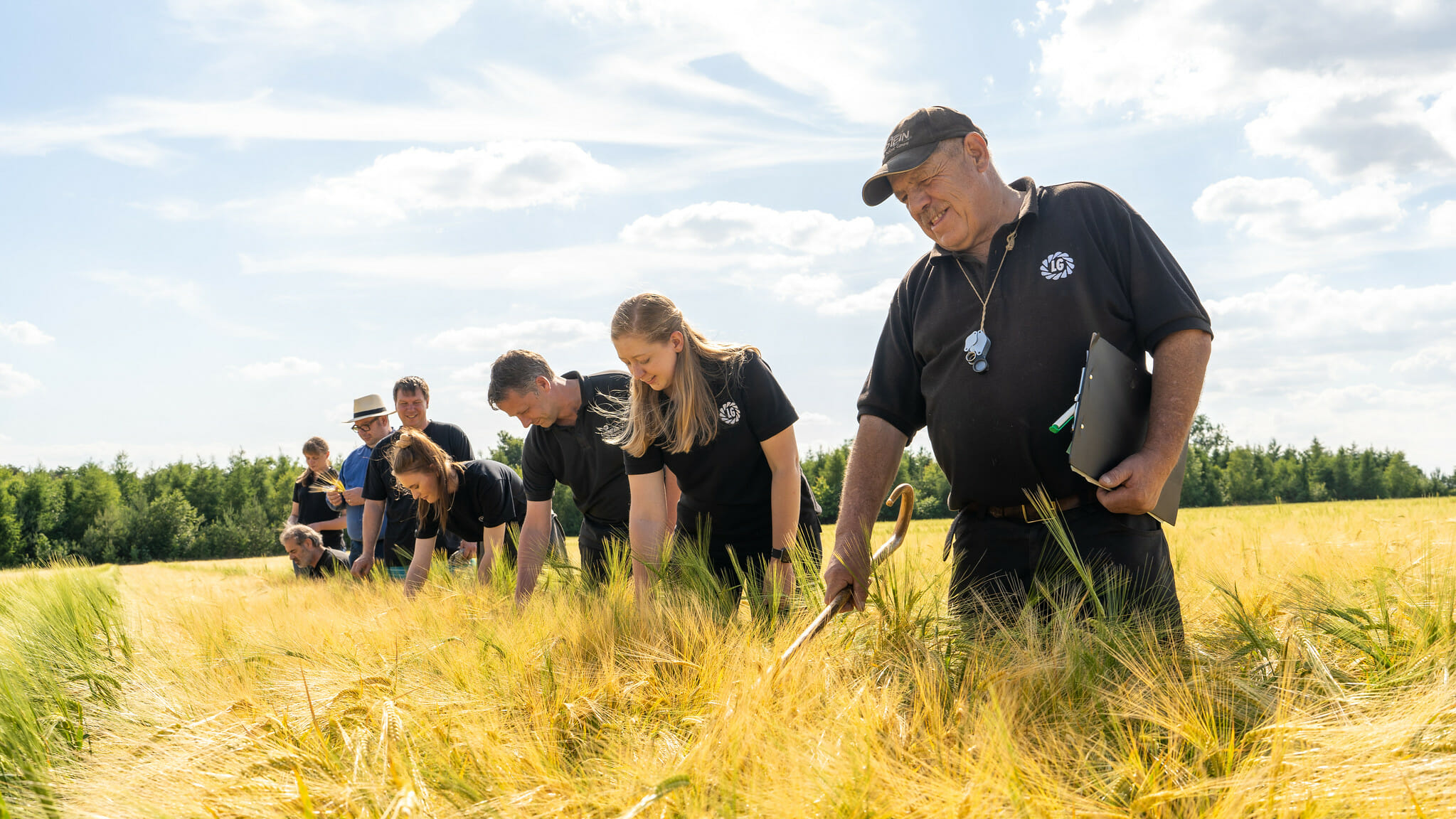
Breeders Limagrain UK have opened the doors to its main Lincolnshire Wolds trials site, to give growers a unique insight into the performance of new and existing cereal varieties in another challenging dry season.
The event, near Market Rasen, showcased numerous wheat and barley varieties coming through the firm’s breeding programme, alongside others already on the Recommended List, from Limagrain and rival breeders.
“The site is at a reasonably high altitude (around 300 ft above sea level), which means varieties can perform very differently here compared with other locations, so it’s important we use these trials to understand the variety differences better,” Limagrain’s Ron Granger said.
A relatively cold, dry spring, followed by a hot, dry start to summer, had caused reduced tillering and earlier senesce in many of the mid-October sown plots, but had highlighted some clear differences in the resilience of varieties to droughty conditions.
High yellow rust pressure earlier in the season had also reinforced the importance of strong genetics in keeping crops clean and maximising photosynthetic potential.
With continental conditions likely to become more common in the UK, Mr Granger said it was important the industry learned to adapt to the climate through variety choice and agronomy.
Indeed, he said Limagrain was exploring the potential benefits from several continental varieties, such as a German and French wheat that looked to have merit, although more would be known about their suitability for the UK after this harvest, once yield and quality assessments had been done.
Taller varieties
Breeding programmes for wheat are mainly located around the Cambridge region, and previous dry seasons had clearly highlighted the benefits of taller varieties being more robust in these testing conditions, Mr Granger continued.
LG Skyscraper, for example, had proved popular on the lighter land of the Wolds and had been the highest yielding variety for three years, with good specific weight and potential to go into a range of markets.
RL Candidate, LG Redwald, also looked very promising, with potential to raise the yield bar considerably, offering huge biomass and very high yield potential at 106%, plus decent disease scores for Septoria and Brown Rust, and Orange Wheat Blossom Midge (OWBM) resistance.
LG Redwald
The variety’s large, strong tillering capacity meant it covered the ground very well, and trials have shown that the variety could be sown at lower seed rates with minimal difference to yield. This made it a good potential option for wider row, direct drilling systems, although it should not be drilled too early. Nitrogen and growth regulator applications also had to be managed carefully, given the variety’s large biomass, Mr Granger noted.
Another moderately tall, strong tillering variety suited to earlier direct drilling and regenerative agriculture systems was LG Typhoon.
“It’s one of the latest varieties to move in the spring, so does suit the earlier drilling period. It’s not the highest yielding variety, but it has already proved to be a very safe and secure package, yielding 102% over the last three years across every region, and has shown promise as both a second wheat and in the earlier drilling situation.”
Crucially, for growers in high-risk areas for yellow rust and Septoria, such as Lincolnshire, LG Typhoon has a great disease resistance profile with stacked resistance for both diseases, offering one of the strongest genetic resistances available. It also has good standing power and OWBM resistance.
A variety that is National Listed and did not go forward as a Candidate this season is also showing potential for regen systems, LG Aldaniti. “It’s one of the cleanest varieties for rusts and Septoria and has great tillering capacity, short, stiff straw, good specific weight and early maturity.
“We need more varieties like LG Typhoon and LG Aldaniti to fit regen systems, as I don’t think all the current varieties on the RL will suit the situation. As breeders, we have so much diverse genetics and I think we can do better.”
LG Skyscraper
Investigating nitrogen
Given the increasing interest in regenerative agriculture and focus on improving nitrogen use efficiency (NUE), the Rothwell site had this season hosted nitrogen response trials.
In wheat, the response to increasing nitrogen rates was compared in four LG varieties – LG Aldaniti, LG Skyscraper, LG Typhoon and LG Redwald – to see how they fared at rates from 150 kg N/ha upwards, increasing in 30 kg N/ha increments.
“Many crops in general were being over-fertilised by up to 20%, so growers need to better adapt strategies to the season and plant requirements,” Mr Granger said.
The dry spring, for example, meant granular nitrogen had not been applied to plots until there was adequate soil moisture to facilitate root uptake. When in a drought situation, plant requirements were supplemented using foliar nutrients and trace elements instead.
Elsewhere, Limagrain was screening potential new ‘N-Flex’ winter oilseed rape varieties to find those with enhanced NUE, marketing manager, Will Charlton added.
Varieties were deliberately being grown in lower nitrogen situations to see which performed best and conserved a higher proportion of their optimal yield over multiple years, before being deemed to have the N-Flex trait.
“N-Flex is a characteristic identified in some of our elite hybrid WOSR lines that are able to convert available nitrogen into higher and more secure yields, giving enhanced yield security. So, when nitrogen applications are sub-optimal, yield penalties in N-Flex varieties are less than they are in other varieties.”
Ambassador was the first N-Flex variety to be launched and has since been joined by others including LG Aviron and LG Antigua, with further lines coming in the future, he noted.
Valuing regional trials
Local farmer, Colin Chappell, attended the Rothwell open day and valued the opportunity to assess how new varieties and existing varieties performed in local growing conditions, rather than having to rely on national trials information.
“I’m particularly interested to learn more about LG Redwald, as it’s one I’d like to try growing next season. We have maize in the rotation, so I’m considering sowing it after that, as a big biomass variety to mop up nutrients and stabilise soil structure after the maize has been harvested.”
Mr Chappell, who manages 645 ha near Brigg, is currently growing a range of milling, biscuit and feed wheats in a varied rotation. This season’s winter wheat varieties include 50 ha of the Group 1 milling wheat Crusoe, grown on contract for Warburtons.
“We’ve always grown a lot of LG varieties, and started growing Crusoe when it was launched, as it had decent yields and good quality. It has proven to be an easy variety to look after, and although brown rust risk does have to be managed, that’s fairly easy to deal with at ear wash timing.”
Nitrogen Use Efficiency has been a big focus for Mr Chappell. Last year, he used a range of in-season testing options to achieve an average NUE of 84% from the 220 kg N/ha applied to a crop of Crusoe that yielded 11.5 t/ha, and easily met his current 12.5% grain N requirement.
“The economics of chasing full 13% milling specification by applying 300 kg N/ha have to be questioned at today’s prices, and when you consider that half of the carbon footprint for one tonne of wheat is due to artificial fertiliser.”
Improving NUE would remain a priority, and he therefore welcomed the work that breeders, such as Limagrain was doing within this area to improve farm practices.
Wait for moisture to drill OSR
As harvest progresses almost a week earlier than normal and land is cleared, many growers will be looking to get their OSR crops into the ground – but don’t be tempted to drill until there is enough moisture, says Liam Wilkinson, arable development officer for Limagrain UK.
The dry summer has meant that crops have ripened early, but it also means that there is very little moisture in the soils, he says.
“Whilst some areas have seen some rain recently – many have not had any – and even where it has rained, it needs to be a serious amount to restore moisture levels to where they need to be to sustain a rapidly emerging rape crop,” he points out.
With not much rain in the early August forecast, many will be worrying about compromising establishment by holding off drilling until conditions improve.
Holding off doesn’t compromise yield, he notes. Mr Wilkinson’s advice is to look at and be guided by seedbed conditions rather than calendar dates.“It is possible to get good yields from later drilled rape, when sown into the right conditions. In fact, they often outperform some of the earlier drilled crops – and many later drilled crops have been winners in the YEN awards!” he says.
“Last year we saw crops of LG Antigua drilled mid-September up in the Lincolnshire Wolds achieve yields of over 6 t/ha, so there is definitely high yield potential for crops drilled into September in the right conditions.”
“Choosing the correct variety for this drilling window is key to success. If you are drilling in September, the focus should be on speed of autumn growth and vigour, so hybrids are a first choice because they are quick to get going and they accumulate biomass very quickly,” he says.
“Vigour is also important to get the crop established and putting roots down, but the speed of development for reaching over wintering biomass as quickly as possible is key.”
A variety in this situation will also benefit from a canopy in order to withstand potential pest problems, as well as harsh winter conditions.”
“Tried and tested varieties such as Aurelia and Ambassador have performed consistently in this slot, both on farm and in trial for a number of years now.”
“More recent additions of LG Aviron, LG Auckland and LG Antigua to the AHDB Recommended List strengthens the variety options available to growers, when drilling later than planned.”
Seed rate
With vigorous varieties, seed rates should target 25-30 plants/ m2, which is normally around 50 seeds/m2, and Mr Wilkinson recommends that growers assess seedbed conditions and adjust seed rates accordingly to account for field losses, particularly if conditions deteriorate.
Limagrain’s 2021 OSR Establishment Scheme provided extremely useful insight into when crops are drilled, which was then tracked against weather at the time.
When plotted against the weather, the data showed that where drilling was carried out in dry conditions, subsequent crop loss was closely correlated. However where there was rainfall on or around the two weeks from drilling, plant survival was much more likely.
“This data reinforces the need for moisture when drilling oilseed rape for successful establishment, as this allows the crop to germinate and grow up and away from CSFB as quickly as possible,” he adds.
Hutchinsons’ technical manager, Neil Watson, shares his views on why moisture is so fundamental in the germination process of OSR.
The OSR seed goes through a two-stage process before emerging; the first relies on it taking up 40% of its own weight in moisture before it can begin germinating. It then goes into a second stage of repair and stabilisation, which requires more moisture to complete germination.
How often have we seen seed that has started to germinate but then withers away through lack of soil moisture, before completing emergence? So sufficient moisture is needed in the soil to start the process and then more rain following drilling, to ensure there is sufficient moisture for the crop to emerge.
LG Astronomer biscuit wheat takes pole position on Suffolk farm
David Pettitt of West Hall Farms, Rickinghall, Suffolk is so pleased with the performance of his Group 3 biscuit wheat LG Astronomer, that he is making it his main first wheat variety for next season
Not having grown a soft Group 3 wheat in many years, David Pettitt of West Hall Farms, Rickinghall, Suffolk is so pleased with the performance of his Group 3 biscuit wheat LG Astronomer, that he is making it his main first wheat variety for next season, replacing current stalwart, Gleam.
We harvested 28 ha’s of LG Astronomer on the 20th July, which yielded 10.5 t/ha at 13.5% moisture and had a specific weight of 79 kg/hl.
The wheat followed spring linseed and the farm’s standard fungicide and nitrogen regime were applied; nothing was changed this season from the norm.
“Our best wheat yields are usually after oilseed rape, but we have dropped rape from the rotation over the last two years due to CSFB pressure. We would expect yields after OSR to be in excess of 10 t/ha.”
“However, since dropping the OSR, first wheat yields are more around the 9 t/ha mark, so we are really pleased with the Astronomer yields – at the end of the day, the crop costs the same to grow.”
“Offering good yields, a quality that opens up a wider market, and it is also easy to grow with good disease resistance and standing – what’s not to like about Astronomer?” he says.
David Pettitt
Sizing up local wheat opportunities
Growers in Essex recently got the opportunity to evaluate a host of new and established wheat varieties, when Limagrain UK opened the doors to one of its network of farm trial sites.
The winter wheat variety demonstration, hosted by JD & DJ Golding at Tolleshunt D’Arcy near Maldon, features treated and untreated plots of more than 30 varieties from Limagrain and other breeders, including established names from the AHDB Recommended List, alongside several exciting potential new additions.
It was the first time in six years that Limagrain had used the site, with emphasis on engaging with growers and agronomists, giving them a chance to see how varieties perform in the soil type, climate and growing conditions of the area, and in a “real-world” farm situation.
Crusoe Winter Wheat
As host farmer Tim Golding explained, the trials had been deliberately managed to be more representative of typical farm inputs, and fungicide treated plots had received much of the same inputs as commercial crops on the rest of the farm. This year, Mr Golding was growing 40 ha of the Group 1 milling wheat Crusoe, alongside the hard Group 4’s Gleam, RGT Skyfall and KWS Extase, in a rotation that included grass seed, oilseed rape and borage as the main cereal break crops.
“We love having the varietal trials on our farm, as we get really useful results, often enabling us to see how new varieties perform on our soils and in weather conditions, even before they are commercially available.”
Growers attending the event also recognised the value of being able to evaluate how different varieties performed in local conditions, rather than having to rely on data based on trials conducted elsewhere in the country, where soils, disease pressure and climate were often very different.
Indeed, this part of the Essex coast is one of the driest places in the country, which presents many challenges for growers, especially in seasons like 2022 when rainfall has been well below average.
Quality wheats
Limagrain’s Tom Barker said the climate created opportunities too, and the heavier bodied soils combined with high levels of sunlight and proximity to end users made the South East a good location for growing higher protein Group 1 and 2 milling wheats, such as Crusoe.
“Crusoe is now 12 years old, but it’s still rated 9 for yellow rust and has a good rating for Septoria, and reliably delivers good specific weight, Hagberg and protein, which is why it remains a firm favourite among the millers.”
He acknowledged it had been several years since the last new addition to the Group 1 sector, but insisted breeders were working hard to bring new varieties to market.
Two coded Limagrain UK varieties currently in National List 2 trials were on show at the Essex site, with both offering milling potential. “They’ve got KWS Extase type yield, but with better quality.”
There were some potential future LG early generation material for the Group 2 sector as well, including a new white wheat with Crusoe parentage, that if successful could allow millers to produce a white wholemeal loaf.
“White wheat has historically been a bit of a niche market, that’s been difficult for breeders to develop reliable varieties for. However, our potential new variety looks to be the best white wheat we’ve ever produced, has a much more stable Hagberg and is good on yellow rust and Septoria.”
Given the changing UK climate, Mr Barker said Limagrain was also looking to see whether continental varieties offered potential benefits. A German wheat being trialled in Essex looked to have merit, although more would be known about its suitability after this harvest, once grain quality and milling assessments had been done.
New varieties drive yield
At the other end of the Recommended List, there were several exciting new Group 4 Limagrain varieties being trialled, which included RL Candidate LG Redwald and National List 2 coded varieties.
“LG Redwald is a huge biomass variety, that’s quite tall and very high yielding at 106%, with decent disease scores and Orange Wheat Blossom Midge (OWBM) resistance. Its large tillering capacity means it covers the ground really well, and could be sown at lower seed rates with minimal difference to yield.”
Mr Barker said OWBM resistance was a particularly important trait for growers in the South East, especially as insecticide use declined, and was something that Limagrain UK had successfully bred into many of its varieties through the use of genetic markers. Barley Yellow Dwarf Virus (BYDV) resistance was another trait the firm was bringing into its breeding programme for future varieties, he added.
“There’s never been a more important time for growers to evaluate what they are doing on-farm, and variety choice is a key part of that, he concluded. Visiting local trials offers a great opportunity to see how varieties might perform on your own farm in future seasons.”