Many silage clamps are still well stocked this spring, after 2019’s bumper grass crop. This presents producers with a rare opportunity when it comes to improving the quality and productivity of their grass leys.
Many silage clamps are still well stocked this spring, after 2019’s bumper grass crop. This presents producers with a rare opportunity when it comes to improving the quality and productivity of their grass leys.
“Producers might be tempted, because they still have plenty of silage in the clamp, to skip reseeding a proportion of their grassland this spring,” says Limagrain’s Ian Misselbrook. “But it’s a great opportunity to do a stocktake and make some real improvements to grassland productivity.
“Having more forage in the clamp offers a safety net. There’s a good buffer, so it’s a rare chance to do more reseeding and grassland renovation than in the past few years.” Mr Misselbrook fears that some producers will be behind with reseeding after a few tricky grass growing years, due to a late spring in 2017 and a dry summer in 2018.
Remedial action
“The recommendation is to reseed 20% a year but, in reality, many are doing far less and skipping some years. Reseeding regimes and plans are out of kilter on many units, which is far from ideal, so for many, now is this time to catch up.” The goal is to maximise the farm’s potential in producing the best-value feed – grass. And that starts with productive leys, packed with good quality grass varieties.
Grass leys are at their most productive in their second year. Fall off is gradual but, by year five, a ley’s productivity will be just 50% of year two. A reseed will pay for itself in a year, depending on the condition of the resulting ley.
As a ley ages, grass weeds could will compete with and replace ryegrass varieties. “That said, don’t simply assume that it’s your oldest leys that will need to be reseeded. It’s important to assess the leys by eye and base decisions on the grass species that you see.
“And don’t assume that a lush green sward is the most productive or efficient,” stresses Mr Misselbrook.
Just such a sward may fill the silage trailer or offer a decent bite of grazing, if the percentage of weed grasses – such as annual meadow grass or Yorkshire fog – are too high then the quality and yield of the resulting forage will be compromised.
Ryegrass plants
He recommends that producers walk their leys and examine what’s there. “Look for gaps and broadleaved weeds, obviously, but also look at the grasses. “Don’t worry about identifying the individual grass weeds. What’s key is being able to spot the ryegrass and to then evaluate the proportion of it in a sward.”
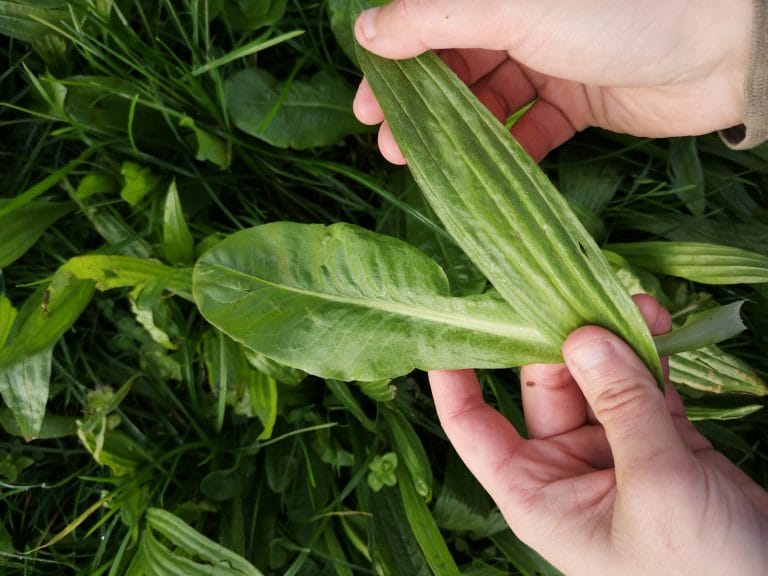
Spotting perennial ryegrasss is quite easy. “Look for grass plants with a purple base and folded leaves, which are shiny on the inside and matt on the outside. And examine a square metre of grassland. You’re looking for more than 70% of the grass plants to be perennial ryegrass – any less then productivity begins to be significantly compromised and reseeding will yield a significant return on investment.”
If the perennial ryegrass content of a sward is between 70% and 80%, then overseeding – rather than a full reseed – can renovate a ley and extend its productive life.
There are also significant gains to be made from using high-quality grass mixtures. “This can make a real difference. I’ve often heard producers say that a reseed hasn’t taken and they often blame the weather or the soil. But it’s typically because they’ve taken a standard ‘off the shelf’ mixture – and little, if any, agronomy advice. The mixture is the problem.
“So always buy from a reputable merchant, and one that sources seed mixtures from a recognised seed house. Look out for LGAN accreditation, to show that a mixture meets both growing and feeding criteria,” says Mr Misselbrook.
“And, when selecting a mixture, remember it’s not just about the species within the mixture, it’s how they’re mixed – the proportions and the formulation. Varieties have a complementary action in a mixture. And there’s more to it than simply putting the best varieties on the recommended list together.”
“A high proportion of tetraploid ryegrasses are important in a grass seed mixture for dairy leys – both for grazing and cutting – because they’re more drought tolerant than diploids. The latter are important in terms of putting a ‘bottom’ into the ley, but tetraploids are key to building resilience and stamina into a ley. And they’re also faster to establish.”
Mixture selection
When choosing a mixture, it’s also important to consider what they ley will be used for – grazing, cutting or a combination.
“Many producers simply opt for a general purpose mixture and, typically, this will do the job. But there are productivity gains to be had if, for example, you know an out-lying field will only ever be cut for silage or zero grazing. Reseeding with a mixture that’s formulated for cutting, rather than grazing, will be beneficial and offer better yields and quality for silage.”
Mr Misselbrook cites Turbo, a ‘leafier’ mixture that’s ideal for grazing early- to mid-season, but great for a cutting later in the summer. Prosper, conversely, is the ideal choice for producers who want to take one or two cuts of silage and then graze a good quality aftermath.
Grass breeding
“It’s well worth having a conversation with your agronomist or seed merchant about exactly what you want from a ley and to take advice to help you select a ‘best fit’ mixture.”
And make sure that the mixture offers quality – not just yield. “Grass breeding has come a long way during the past 10 years. Digestible NDF is key to feeding the rumen bugs and it’s a bigger driver for a high ME, in grazed grass and grass silage, than sugars,” says Mr Misselbrook.
Better quality mixtures offer higher yields and feed quality and make reseeding even more cost effective and producers should look to take advantage of the accredited seed mixtures that are on offer. “Look out for LGAN accreditation when buying seed as a guarantee of testing and quality.”
The return on investment is 10:1 for a five-year ley, with reseeds breaking even in the first year. Productivity will peak in the second growing year, which will be 2021 for 2020 reseeds.
Ensuring that swards are in tip-top condition means that they’ll be better able to weather whatever mother nature has in store – this year and looking further ahead.
“Grass is the core of all home-grown forage production – and the foundation of all dairy businesses,” he adds. “And heading into 2021 with leys that are at their productive peak will offer producers peace of mind that, however 2020 pans out, grassland will be poised to help maximise returns and mitigate any other challenges – environmental or political – that dairy businesses may face.”
Come rain or shine…fodder beet comes up with the goods
Two contrasting seasons weather wise have shown off the exceptional value of fodder beet in dairy cow diets. “it’s a perfect crop to grow in the UK,” says Limagrain UK’s Martin Titley. “Come rain or shine, yields and feed value per hectare supersede many other forages”.
Limagrain’s annual fodder beet trial results demonstrate the consistency of the crop in yield and feed value. “Fodder beet is sown any time from March to April, and harvested from October,” says Limagrain’s Martin Titley. “So it was subject to the dry summer of 2018, and the exceptionally wet conditions experienced in many parts of the UK in autumn and early winter 2019.”
Despite these relatively extreme conditions, trial results from the company’s Lincolnshire site where more than 20 varieties of commercially available fodder beet varieties are compared each year, show high fresh yields, with dry matter yields that exceed most other forages. Average results for 16 varieties on trial are shown in Table 1.
“There’s a lot of consistency in performance, despite contrasting and challenging conditions,” adds Mr Titley. “Even the control variety delivered 73.3 tonnes per hectare of fresh weight in 2018 and 112.5 tonnes in 2019. More than 70t/ha of yield is good going in these dry conditions and in 2019 dry matter yields for most varieties on trial were above 18 tonnes/ha.
“In 2019, the top 20% of varieties in our trial produced fresh yields in excess of 110 tonnes per hectare with 37% having dry matters above 20 tonnes per hectare. “This is a phenomenal output.”
Grown in the UK for more than 50 years, fodder beet ‘took off’ due to its monogerm breeding – one plant per seed – making it easier to harvest. Since then the number of varieties has increased and breeders have worked to enhance cleanliness of root and disease tolerance.
“The UK climate is perfect for fodder beet. Wet, moist soils in spring are ideal and grows through to October or November, adding 30% to its dry matter yields in the last few months when there’s likely to be more moisture.”
Table 2 shows the performance of the control and four popular fodder beet varieties used in dairy cow diets.
Contractor Aaron Hughes from Shropshire agrees that this season’s fodder beet yields have been the biggest he’s ever harvested, despite challenging harvesting conditions.
His company, Roger Davies Contractors, specialises in beets and, with a remit to supply stone-free, muck-free beet, they harvest, wash, clean and chop about 100 hectares on behalf of dairy farmers. For many they also contract drill the crop in spring.
“We have the equipment to wash the beet and ensure all the stones are removed if it’s for a feeder wagon. Some farmers are now using mulcher buckets that crush the beet before adding it to the wagon. Either way, the popularity of this crop on dairy units is growing yearly.
He says that there aren’t really any downsides to fodder beet – even though 2019 harvesting conditions were challenging. “We always manage to get the crop; we’ve invested in a 6-wheeler beet harvester with wide, low pressure tyres causing less ground compaction and if it’s wet, we load into trailers over the hedge. It’s the trailers that cause the soil damage and so we keep them off the field.”
This season much of the crop has had to be washed twice. “It’s not too often we get such wet conditions,” adds Aaron, “but it did give us more work.” But this doesn’t deter anyone and every year they get more interest in growing the crop for livestock units. “Cows love it – they sift through the silage to find it.”
Wiltshire-based nutritionist Diana Allen certainly encourages farmers to include fodder beet in dairy rations as a cost-effective homegrown forage.
“Fodder beet is also one of the best ways of boosting milk protein,” she says. “It’s a great source of sugar and fermentable energy which can stimulate the rumen bacteria, but it must be balanced with an equally rumen available source of nitrogen for the bugs from feedstuffs like rapeseed meal, distillery by-products and urea. And the overall sugar and starch must be balanced to prevent any risk of the rumen becoming too acidic.”
The crop offers flexibility when it comes t harvesting, and it can be left in the ground, with little feed value deterioration, until January or February.
“If it’s harvested early it can be clamped in layers with maize silage as long as it’s pre-chopped and well consolidated,” adds Ms Allen. “Or it can be clamped in the spring, before going too soft, and in layers with 25% soya hulls to absorb effluent. This can provide a valuable feed through summer.”
Sown in March – April
Can be part of grass rotation or alternative to spring cereal crop to provide livestock feed and break the pest and disease cycle
Harvest from late October until March
Can be left in the ground without a loss in feed value
High energy feed provides high feed value
Average ME 12.5-13MJ/kg DM, 162,500 – 202,500MJ/ha with more recent varieties producing well above this level. In 2019 trials, high dry matter, deep rooted variety Brick produced 256,000MJ/ha in 2019 trials. The energy requirement for producing 25 litres milk is 197 MJ per day.
Choice of variety to suit the system
Rhizomania resistant varieties are available, such as the more recently introduced Brick and Tarine
Deep rooted (more than 70% in ground) for those with access to specialised harvesting equipment and who want to maximise feed value.
Less deep rooted (about 50%-60% in ground) with medium dry matter for easy lifting, even for grazed in situ
New high energy fodder beets introduced for 2020
New varieties boost home grown feed value
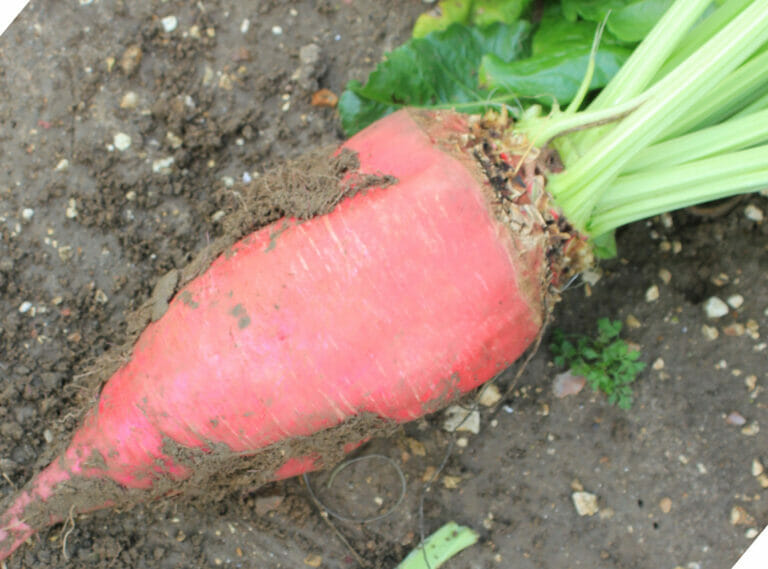
Limagrain UK has introduced the new fodder beet variety Ribambelle this year. A triploid beet with red skin, and already used extensively in France, Ribambelle ranks highly among fodder beet varieties for its high energy and medium dry matter content.
Field trial results show that this new variety has an average dry matter of 16%, which makes it ideally suited for dairy or beef cattle.
“As well as high feed value, Ribambelle has the advantage of being rhizomania tolerant (a disease that can cause yield loss) and medium rooted,” says LG’s Martin Titley. “It grows with 50% of its root out of the ground, compared with deeper rooted varieties that typically have 70-80 % of their root in the ground. This makes for easier harvesting and a cleaner root.
Its root depth also allows for grazing in situ which appeals to sheep farmers looking for a high energy forage once the grass stops growing to finish lambs, or for those looking for a high value feed for dairy heifers and for finishing beef.
A limited seed supply of the new variety, Primula is also available from LG. This pink-skinned variety is rhizomania tolerant and has a dry matter content of between 18% and 19%.
Limagrain’s Martin Titley attributes part of their rise in popularity to the improved varieties, which offer better yields and feed values. “Producers want more milk from home grown forages and a range of fodder crops that can take the pressure off grass or silage,” he says. “And a crop like forage rape or stubble turnips, which slots in between grass crops or after harvest and helps break the insect cycle, is also valuable in today’s grass rotations.” Incorporating any green manure after the crop has been grazed or lifted improves soil structure and health. “And for the same reasons, there’s a role for these fodder crops in arable rotations.” “These crops have far more potential now than, say, 10 years ago, thanks to new varieties with improved genetics and with more knowledge about their growing patterns. “We’ve now got forage rape varieties with crude protein contents above 20% and fodder beet varieties with dry matter yields above 20 tonnes per hectare.” He uses the developments in fodder beet varieties as an example. Table 1 shows 2017 trial data for three key varieties; Kyros introduced in 1995, and two more recent varieties; Tarine and Brick, introduced in 2015 and 2016 respectively. “The dry matter yields of these newer varieties are a staggering 11% and 24% higher than Kyros; one of the main varieties 25 years ago. Brick has a dry matter content over 5% higher than Kyros. Both Tarine and Brick are Rhizomania tolerant with high feed values making them ideal for dairy diets.” Fodder beet is a nutrient hungry cop and requires a careful weed control programme. “But it does yield double the energy supply of other fodder crops – and can now achieve a ME of well above 200,000 MJ per hectare.” Most fodder beet is lifted, stored and used in winter rations for housed cattle. “This can mean for some it’s a non-starter, but producers in current or previous sugar beet growing areas may find they have access to contractors with the right equipment. Grazing in situ is an option if conditions are favourable; for dry cows and young stock.” Table 1: Yield and dry matter contents of ‘old’ and ‘new’ fodder beets
Variety
Relative DM yield %
Relative fresh yield %
DM content %
Kyros
93
104
18.5
Tarine (RT)
104
104
20.8
Brick (RT)
117
103
23.6
Limagrain UK Trials 1998-2018 Relative dry matter yield 100% = 18.3 tonnes/haRelative fresh yield 100% = 88.2 tonnes/ha RT = Rhizomania tolerant.Easy options The ‘easier’ fodder crops for dairy units are forage rape and hybrids and stubble turnips. These crops can follow grass – or cereals – and are sown between May and August. Quick growing, in between 10 and 12 weeks, there’s a fresh fodder crop to graze, and with few inputs, they are relatively cheap to grow. Stubble turnips are an estimated £305 per hectare, with forage rape at £408 per hectare. “The growing and management will also have a bearing on the crop’s success,” says Mr Titley. “Sowing dates are a case in point. Dry matter yield can fall by more than 50% in crops sown four weeks apart.” Limagrain ran trials with its highest yielding and most popular, in terms of preferential grazing, stubble turnip variety; Samson and the rape/kale hybrid variety; Interval. Three crops of each were sown three weeks apart at two-week intervals from July 28, 2017. Fertiliser (20:10:10) was applied into the seedbed at 35kg of nitrogen per hectare. The crops were harvested in mid-December and oven-dried to establish their dry matter content. “The results showed that the highest dry matter yields came from those crops sown earliest. In the stubble turnips, dry matter loss was 33% in crops sown two weeks later and 59% in crops sown four weeks later.” Table 2 shows the dry matter yield from the three crops. Table 2: Dry matter yield of Samson stubble turnips t/ha
Sowing date
28/7/17
15/8/17
31/8/17
Samson DM (t/ha)
6.6
4.4 (-33%)
2.7 (-59%)
The trial also highlighted the change in the ratio between leaf and bulb yield over time. Earlier sown crops produced higher yields of bulb to leaf (76% to 24%) compared with later sown crops (38% to 62%). Likewise, crops of forage rape variety; Interval, sown in mid-August had dry matter yields 22% less than those sown at the end of July. Yields from the crop sown at the end of August yielded 51% less dry matter per hectare than the late July sown crop. “This doesn’t mean that stubble turnips can’t be sown later in the season if a feed crop is needed. As the trials show, they will provide a good leafy crop, albeit lower yielding. It’s still worth doing,” adds Mr Titley. Flexible friend Perhaps among these three fodder crops, Mr Titley is seeing more ‘new’ interest in forage rape and hybrids. “I think this is because it’s flexible; more so than many other fodder crops. It can be grown on its own or with stubble turnips. And some like to sow forage rape with grass seed mixtures and grazed shortly after sowing while the grass seedlings are still establishing. “Forage rape also has a crude protein among the highest of any forage crop of 19% to 20% and an energy content between 10 and 11 ME/kg DM. It’s got plenty to offer dairy producers. And as long as it’s strip grazed and intakes are kept around 30% of total daily dry matter to avoid any risk of milk taint, then it’s a high value crop that lasts longer than stubble turnips and can help to extend the grazing season.” Fodder crops for dairy
Forage rape hybrids
Stubble turnips
Fodder beet
Pros
Fast growing High protein content Ideal break crop Flexible sowing period Flexible cropping Winter hardy varieties Low inputs
Low growing costs Fast growing Flexible sowing options Early sowing promotes yield
High energy crop New high yielding varieties. Suitable for storage and using in winter rations Can be grazed in situ Very palatable crop
Ave DM yield t/ha
3.5-4t/ha
3-6 t/ha
15-18t/ha
Average fresh yields t/ha
24-35t/ha
40-50 t/ha
80-100 t/ha
Dry matter
11-12%
8-9%
15-23%
Crude protein
19-20%
17-18%
12-13%
Digestibility
65%
68-70%
78%
ME
10-11MJ/kg DM
11MJ/kg DM
12.5-13.5MJ/kg DM
Forage rape’s a winner Forage rape has proved a winner for a spring calving cross-bred herd in west Wales. Simon and Alison Richards, and their son John, have sown two fields – about five hectares in total – of the 101-hectare unit based at Little Hasguard in Haverfordwest, Pembrokeshire. “We introduced forage rape as a fast growing forage crop in 2018 to eke out the grass,” says Simon. “We’re on red sandstone and the land can dry out quickly. Believe it or not, this year has been drier in parts than the previous year – contrary to much of the country.” With forage supplying two thirds of the dry matter intake for this spring calving cross bred herd, high-quality home-grown forages are paramount. “We rotationally graze paddocks, from mid-February with fresh calves, to late November, depending on conditions. Cows will typically only be grazing during the day in early spring and late autumn. We want about 4,000 litres of the average 6,000 litres of milk from home- grown forage.” The challenge is having enough grass throughout the long season. So with advice from Hugh Roberts from merchants Spunhill, they introduced the forage rape Rampart – a relatively new Limagrain variety that in trials has a fresh yield 6% higher than the control variety and a dry matter 2% higher, and high scores for mildew and Alternaria resistance. And it’s worked well. “It’s easy to grow and it suits our relatively simple system,” adds Simon. “We get three rounds of grazing before we burn the grass off, spread manure from the youngstock yards then plough before sowing the forage rape. We cheat a bit and use half the seed rate in the drill with the fertiliser, but go across the field twice in opposite directions so there’s no strips and the whole field is covered.” And, with some rain to get a good germination, which was a bit touch and go this summer but came just in time, and no further inputs the forage rape crop is ready for grazing in eight weeks – by late July. Fields are drilled three weeks apart to stagger the crop. “We strip graze the crop for two hours each evening. They never get more than 25% of their daily intake from the rape – so there’s absolutely no risk of milk taint. But it gives then a fresh forage daily and takes the pressure off the grass, giving it time to recover.” He’s pleased too that the cows clean up the crop well. “They take a day or two to get used to it, then they’re really keen. After a couple of hours, they go back to the grass sward.” And while some could see moving cows each night as a bit of a faff, Simon finds it worthwhile. “Yields have held up, even when the grass growth has slowed down – it’s kept us going through summer and it gives the grass chance to recover and grow so we’ve got plenty right into the autumn.” A grass reseed follows the forage rape, usually in early September, while there’s still some warmth in the soil to get a good germination. “The rape’s a great break crop,” adds Simon. “Dung from the cattle, plus any green material that’s ploughed in post grazing improves soil fertility and soil health. And we’ve got rid of the bugs that affect grassland which is important now certain insecticides are banned. It gives us a clean start to a new grass crop.” Simon admits that when they had arable crops, grass reseeds slotted into the rotation easily. But as more cows replaced corn, and the grass acreage increased, working out the reseeding rotation has not always been as obvious. He’s finding though that forage rape is a good solution and brings quite a few advantages.
Last Call for Sowing New High Yielding Forage Kales
Livestock producers looking for a high yielding forage that offers good feed value and a flexible feeding period should sow a crop of forage kale. And, says Limagrain’s forage crop director Martin Titley, opting for the latest variety Bombardier can help tip the scales in favour of improved digestibility and feed value.
“It’s the second season in the UK for Bombardier and it was highly successful in trials and on farm in 2018,” he says. “Sown up to mid-July, it survived in dry conditions and provided a high feed value grazing crop in autumn through to the end of January.”
Results from Limagrain’s innovation site in Lincolnshire showed fresh weight yields of 80 tonnes per hectare and nine to 11 tonnes of dry matter per hectare. Dry matter content was 13.5% and digestibility of 72.2%.
“The relative dry matter yield for this new variety was 18% above the control variety, that’s 1.74 tonnes more from each hectare – a real boost for forage stocks.”
Bombardier has been bred for improved stem and leaf utilisation, and this has provided a higher feed value crop. Poor stem quality, that may have been 60% to 70% of the total yield, has held back the feed value of forage kale. The softer and more digestible stems seen in these new varieties bring improved feed value and utilisation of the crop.
“In the past, farmers have faced a bit of a dilemma when it comes to kale,” adds Mr Titley. “If the kale crop is grazed well, then crop utilisation is good, but the poor feed value in the stem will limit liveweight gain. A less well-grazed crop, where a proportion of the stem is left, will achieve better liveweight gains but poorer crop utilisation.
“Marrow stem kales like Bombardier are highly digestible and have improved dry matter yields and utilisation potential, can overcome this dilemma.”
Kale should be drilled in spring and before mid-July at a seed rate of 5kg per hectare, and growers are encouraged to opt for varieties that are club root tolerant and where the seed can be supplied with a fungicide seed treatment.
“The great benefit of a kale crop is its flexibility,” says Mr Titley. “It can be used any time from September to February, so it is ideal for outwintering production systems and it is a popular choice for dairy young stock, beef cattle and sheep.”
Kale – the facts:
Sowing rate 4-5kg/ha
Growing costs £496/ha
Dry matter 9-11t/ha
Crude protein 16-17%
ME 10-11kg DM
NSA Sheep Event visitors invited to bring a bag of fresh grass for free quality test
Limagrain, suppliers of Sinclair McGill and Monarch grass seed mixtures, will test fresh grass samples using its NIRS mobile testing machine and provide an immediate nutritional analysis of the crop.
Limagrain is inviting farmers to bring fresh grass samples to their stand at NSA Welsh Sheep (May 21st), NSA North Sheep (June 5th) and NSA South West Sheep (June 18th) for a free ‘on the spot’ analysis.
Limagrain, suppliers of Sinclair McGill and Monarch grass seed mixtures, will test fresh grass samples using its NIRS mobile testing machine and provide an immediate nutritional analysis of the crop.
Any grower bringing a sample for testing will be able to find out the key nutritional attributes of their grass such as metabolizable energy, sugar, and digestible fibre content and will also be entered in a free prize draw to win 10 acres of grass seed.
“We are drawing attention to the importance of high-quality grass seed mixtures,” says Limagrain seed specialist John Spence. “We also want to emphasise the importance of considering the nutritional qualities of the seed mixture, as well as its agronomic values.”
“The aim is to grow high energy grass,” adds Mr. Spence. “Trials have shown that proven mixtures can provide additional energy that results in improved weight gains and higher digestibility. These mixtures support improved lamb birth and weaning weights and daily live-weight gains in lambs.”











 “Many producers simply opt for a general purpose mixture and, typically, this will do the job. But there are productivity gains to be had if, for example, you know an out-lying field will only ever be cut for silage or zero grazing. Reseeding with a mixture that’s formulated for cutting, rather than grazing, will be beneficial and offer better yields and quality for silage.”


 Incorporating any green manure after the crop has been grazed or lifted improves soil structure and health. “And for the same reasons, there’s a role for these fodder crops in arable rotations.” “These crops have far more potential now than, say, 10 years ago, thanks to new varieties with improved genetics and with more knowledge about their growing patterns. “We’ve now got forage rape varieties with crude protein contents above 20% and fodder beet varieties with dry matter yields above 20 tonnes per hectare.” He uses the developments in fodder beet varieties as an example. Table 1 shows 2017 trial data for three key varieties; Kyros introduced in 1995, and two more recent varieties;
  The challenge is having enough grass throughout the long season. So with advice from Hugh Roberts from merchants Spunhill, they introduced the forage rape
  He’s pleased too that the cows clean up the crop well. “They take a day or two to get used to it, then they’re really keen. After a couple of hours, they go back to the grass sward.” And while some could see moving cows each night as a bit of a faff, Simon finds it worthwhile. “Yields have held up, even when the grass growth has slowed down – it’s kept us going through summer and it gives the grass chance to recover and grow so we’ve got plenty right into the autumn.” A grass reseed follows the forage rape, usually in early September, while there’s still some warmth in the soil to get a good germination. “The rape’s a great break crop,” adds Simon. “Dung from the cattle, plus any green material that’s ploughed in post grazing improves soil fertility and soil health. And we’ve got rid of the bugs that affect grassland which is important now certain insecticides are banned. It gives us a clean start to a new grass crop.” Simon admits that when they had arable crops, grass reseeds slotted into the rotation easily. But as more cows replaced corn, and the grass acreage increased, working out the reseeding rotation has not always been as obvious. He’s finding though that forage rape is a good solution and brings quite a few advantages.
 Limagrain is inviting farmers to bring fresh grass samples to their stand at NSA Welsh Sheep (May 21st), NSA North Sheep (June 5th) and NSA South West Sheep (June 18th) for a free ‘on the spot’ analysis.