
















Farming on the northern margins of the North Wessex Downs, Hamish McIntosh has always tried to maximise the contribution maize makes to his milking ration.
Soil types vary across the farm, some being challengingly heavy, so success has come with tailoring variety selection according to field conditions, as well as staying abreast of the latest developments in maize breeding, in order to continually improve his output.
In 2025 – a year that has proved challenging for many maize growers – the decision to grow one of the very latest early maturing varieties to come onto the BSPB/NIAB Descriptive List has certainly paid dividends.
Based at Hardwell Farm, near Knighton in Oxfordshire, Hamish runs a 400-cow milking herd alongside 200 acres of arable cropping and a similar acreage of grassland. The herd is conventionally managed, calving all year round, housed in the winter months, and outside during the grazing season. In an area where TB is a continual threat, as many heifers as possible are retained on the farm, in a quest to maintain numbers.
Hamish McIntosh and his dairy herd at Hardwell Farm.
The aim is to minimise parlour-fed concentrates and derive as much as possible from the mixed ration, to support average yields of 9,000 litres/cow. Maize silage certainly plays a key part in this strategy, comprising around half of the forage component.
Around 200 acres of maize are grown on the farm, fitting into a rotation with winter wheat and grass, and this year a quarter of the acreage was given over to newly listed LG Highlight.
“It’s a variety that has looked really promising in trials and fits perfectly with Hamish’s requirement for high dry matter yields, quality in the clamp, and a sufficiently early harvest to allow a following crop of winter wheat to be established,” says Nickerson seed specialist Fraser House. “LG Highlight will be one of the top new varieties for dry matter yield on the 2027 maize Descriptive Lists, and with an FAO rating of 170 it certainly has the earliness. It also has high starch yields and strong agronomic characteristics. Where farmers are looking for the combination of yield, quality and earliness, this is a variety that really hits the sweet spot.”
It was grown alongside Prospect, also FAO 170, and the slightly later maturing Conclusion, both from the Limagrain Field Seeds UK breeding programme and having a proven track record on the farm.
“Some of the land at Hardwell Farm is not the best for maize, so the policy is to grow what we think will perform in the particular circumstances,” continues Fraser. “Robust varieties with early vigour, good standing power and the necessary disease tolerance are what’s required, plus early maturity and high dry matter yields. Increasingly, we are seeing varieties that will deliver this full package, with the additional benefits of high cell wall digestibility that ensure farmers like Hamish can rely on having a full clamp of energy dense forage.”
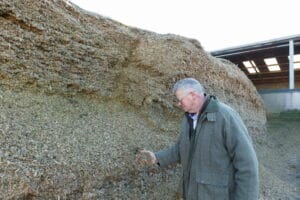
Hamish was delighted with the yield and quality of the LG Highlight silage.
With so much rain falling throughout the winter and spring, Hamish had to work hard to create a suitable seedbed for his 2025 maize crop. All the maize ground is ploughed, with slurry and manure applied before and sometimes afterwards.
“The heavy rain seems to be becoming more common and it does not help our heavier ground,” he says. “We’re increasingly needing to sub-soil, and on our heavier ground we’ll normally need to power harrow before drilling. We have our own maize drill, so we can be timely, going when the conditions are right.”
Optimum drilling date is 1st May at Hardwell Farm, and maize is drilled with DAP fertiliser down the spout and 125kg N/ha onto the seedbed. Pre- and post-emergence herbicides maintain good weed control, and – with that including a reduction in blackgrass on the farm – offers a wider benefit of having maize in the rotation.
“I’m aware of the specialist maize fertilisers and developments like foliar sprays, and we’ll keep a close eye on any ways to improve, but – at the moment – our system seems to be working. Growing the right varieties is a good part of our success, and being aware of the progress in maize breeding.”
The maize at Hardwell Farm was harvested on 20th September and, whilst it was not the best year for maize generally, Hamish was happy to see the LG Highlight standing out.
“It was our largest crop with big mature cobs, so it delivered what we wanted,” he says.
“We probably cut a little earlier than some, because I like to see some green leaf in the clamp. Overall, I’m very happy with the performance of the maize, and it was off in good time to establish the winter wheat.”
The maize will go into the ration at what Hamish considers the optimum level of around 50% of the forage, alongside grass silage, biscuit meal, a rape-soya meal and urea.
With maize breeding progress providing earlier varieties that avoid any compromise on dry matter yield or forage quality, it is a crop that will continue to be of great value at Hardwell Farm, for both milk production and crop rotation.
Limagrain Strengthens RL 2026/27 with High-Yielding Wheat, Barley and Oilseed Rape VarietiesLimagrain Field Seeds UK has reinforced its commitment to delivering high-performing, resilient crop genetics with the addition of several standout varieties to the AHDB Recommended List (RL) 2026/27.
Commenting on the latest RL additions, Liam Wilkinson, head of technical for Limagrain Field Seeds UK, said: “In a year where we have seen disease ratings across established varieties change significantly, and two new hard feed wheats enter the AHDB Recommended List with some of the highest untreated yields available, this latest update is a clear testament to the targets of the Limagrain wheat breeding programme.”

Liam Wilkinson brings technical expertise to Limagrain’s breeding programme, driving innovation in UK varieties.
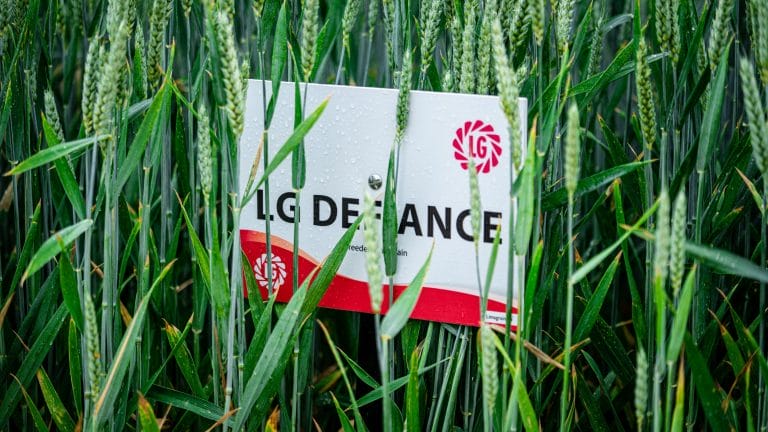
LG Defiance is one of the highest-yielding feed wheats on the new RL, achieving 109% of the UK mean yield. With an untreated yield of 95% — the highest currently available — and a strong disease profile, including an 8 rating for yellow rust, LG Defiance is particularly well suited to main and late drilling slots.
The variety has shown strong performance following roots and maize, while internal trials indicate a positive response to split plant growth regulator (PGR) applications.

LG Defiance is a high yielding hard feed wheat with the highest untreated yield on the AHDB RL 2026/27.
Another strong addition is LG Challenger, which also ranks among the highest-yielding winter wheats on the RL. Delivering consistent performance across all regions, the variety excels in northern trials and sits as the joint highest-yielding second wheat.
With excellent grain quality and orange wheat blossom midge (OWBM) resistance, LG Challenger offers a robust and reliable option for growers seeking yield security.

LG Challenger has performed consistently across all regions, but stands out in the North.
In winter barley, LG Catapult sets a new benchmark as the highest-yielding BYDV-tolerant two-row winter barley available for the coming season. Historically, BYDV tolerance has been associated with a yield penalty; however, LG Catapult is the first Limagrain variety to close the gap on conventional high-yielding feed barleys.
Combined with a comprehensive disease package, the variety provides growers with an effective integrated pest management (IPM) tool, particularly in high aphid pressure situations.

LG Catapult is the highest yielding BYDV tolerant two-row winter barley available to growers for the forthcoming season.
Limagrain has also strengthened its oilseed rape portfolio with LG Calvin CL, a Clearfield® tolerant hybrid winter oilseed rape that joins the RL as the highest gross output variety in the Clearfield® sector. Fully loaded offering Limagrain’s signature traits — including TuYV resistance, RLM7, and pod shatter resistance.
LG Calvin CL has demonstrated consistent performance across all regions. Its strong light leaf spot resistance makes it a particularly attractive option for northern growers managing high brassica weed pressure.
These latest additions highlight Limagrain Field Seeds UK’s ongoing commitment to breeding consistent, resilient varieties across its crop portfolio, delivering performance across all UK regions and farming systems.
Growers are encouraged to watch for further updates on where these new varieties can be seen performing in a range of on-farm situations during the 2026 season.
LG Avenger is a World Record Crop!How LG Avenger Delivered a World Record Oilseed Rape Yield
Earlier this year, Lincolnshire farmer Tim Lamyman set a new World Record for oilseed rape of 7.52 t/ha with Cabbage Stem Flea Beetle Resilient Variety LG Avenger.
Mr Lamyman grew LG Avenger for the first time last season and mentioned that his main reason for choosing it was its fantastic autumn vigour. He wanted a variety that could be sown later to help mitigate flea beetle risk, and that would get away quickly and establish a strong canopy going into winter.
Supporting the vigour of LG Avenger with a comprehensive nutrition programme is essential to building a big biomass crop and high yield potential, Mr Lamyman believes.
Given the exceptional performance of LG Avenger last season, Mr Lamyman has sown it again across an area of 90 ha.
LG Calvin CL: The UK’s Top Clearfield Hybrid Variety
The Agriculture and Horticulture Development Board (AHDB) Recommended List brings new varieties in focus and on the oilseed rape side, LG Calvin CL is newly recommended for the UK as the highest yielding Clearfield hybrid variety, with good autumn vigour, turnip yellow virus (TUYV) and pod shatter (POSH) resistance.
Capitalise on Your Oilseed Rape CropWith the mild autumn and good establishment, oilseed rape crops are looking good across the country. However, while forward or large canopies can seem beneficial, if not properly managed they can limit yields and leave the advantage of good establishment underutilised.
Here are 5 top tips for how you can capitalise on a forward oilseed rape crop:
1. Measure and quantify the canopy. You can manage what you can’t measure. An oilseed rape canopy contains nitrogen which can be remobilised by the plant. Using GAI apps or satellites, you can measure the green leaf area in relation to the ground. 1 GAI is equal to 50 kg/ha of nitrogen. Or, cut 1 m² of above-ground biomass; 1 kg equals 55 kg N/ha.
2. Reduce the first split of nitrogen. High doses of early nitrogen encourage rapid stem elongation, causing shading and plant competition. This leads to lower branches aborting—branches that have the capacity to hold the most pods and yield.
3. Aim for a GAI of 3.5 at flowering. This is equivalent to 175 kg of N/ha in the canopy. Using knowledge of what is already in the crop can help save on nitrogen input. AHDB report PR447 suggests only 60% of spring-applied nitrogen is utilised by the crop, so adjust rates accordingly.
4. Don’t delay sulphur availability. If using products such as DoubleTop®, reducing nitrogen also reduces sulphur. Lack of sulphur can be yield-limiting: slowing leaf and tissue development, reducing nitrogen-use efficiency, lowering stress tolerance, and reducing oil content. Pick a product that applies 40–75 kg/ha of SO₃.
5. Apply micronutrients early. In particular, Boron, as low levels can result in stem splitting during rapid spring growth, allowing potential entry for disease. Boron is also key for good pollination and stress tolerance.
Early Maturing Maize Varieties: What Farmers Really Gain by Going Earlier
Producing milk without maize isn’t something that Flintshire dairy farmer Tom Beltcher would like to consider.
Not only is it a vital part of his 450-cow herd’s ration, but it has become an integral part of his farming system, fitting into a rotation in which double-cropping is now commonplace.
Success in recent years has come through the use of the earliest maturing varieties available, with continuing progress by maize breeders meaning that an early harvest does not have to result in any compromises on yield, nutritional value or digestibility.
“We’ve grown maize for as long as I can remember, but it has become more important to us in the last ten years,” says Tom. “Our cows are averaging around 10,000 litres, so maize silage is essential to complement grass silage. We make our grass silage using a multi-cut system. This produces a high quality forage but, with grass, there is always more risk of inconsistencies resulting from variable growing conditions and unpredictable weather at the time you’re cutting. Maize now typically makes up around half of our forage ration and offers all-important stability and consistency that ensures we keep the cows performing.”
The Beltchers are based at Argoed Hall Farm, near Mold, and typically grow around 250 acres of maize each year, with a further 150 acres usually grown on contract on neighbouring farms. Whether the maize is grown at home or on contract, Tom insists on a responsible approach that looks after the land and minimises the risks of any problems associated with a late harvest in wet conditions.
“The aim is to have the crops off as early as we can, allowing the opportunity to establish another crop in the autumn,” he says. “On our farm that is usually winter wheat, but it can be a grass crop that will provide an early first cut. We apply the same thinking with crops grown on contract, because double-cropping is the best way to manage the land, environmentally and economically. It’s about working together for the best mutual outcomes.”

Tom Beltcher with his father Roger.
Argoed Hall Farm is predominantly a heavy clay site, so is considered marginal for maize. The policy is to grow the earliest maturing material available, with Limagrain Field Seeds’ Ultra Early variety Duke standing out in 2025. Duke is an example of the type of genetic progress resulting from an extensive UK breeding programme that is focused on producing stable varieties that deliver high yields of dry matter within a shorter growing window, without compromising on nutritional quality and digestibility.
With up to eight trials sites across the UK, Limagrain Fields Seeds is selecting LG varieties that have the proven consistency of performance required in UK conditions by farmers like Tom Beltcher, delivering a number of new improved varieties onto the NIAB/BSPB Descriptive List every year.
“Overall, we’ve averaged around 18-19 tonnes per acre across all our maize crops this year, and Duke has been the standout performer,” adds Tom. “We drilled about a week earlier than usual, in the first week of April, because seedbed conditions were right. It was something of a gamble, but it paid off because we had moist soils during the critical establishment phase. Given the early start the maize had, it’s been a good year for the crop, and our earliest harvest ever.”
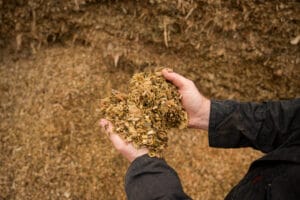
Making up around half of the forage ration, maize provides much-needed stability and consistency alongside grass silage.
For Tom, maize is his priority, which he admits sometimes means the farm is not making full use of cover crops grown over winter. It’s a sacrifice he considers worthwhile, however, as it means the maize always has the best possible start.
“We want to have the maize ground mucked, ploughed, broken down and power harrowed by early April, so we can drill as soon as soil temperatures are right,” he says.
“That may mean we’re taking a very early first cut off a grass crop, and losing potential yield, but I’d rather maximise what we can achieve from the maize.”
Maize is drilled with a microgranular phosphate and nitrogen fertiliser down the spout, and receives a further 100 units of nitrogen per acre when the crop is around knee-high. Crops receive pre-emergence and post-emergence herbicides, but no other specialist inputs.
“It’s a great crop, when you consider the amount of high quality dry matter you can put in the clamp, and an ideal complement for grass silage.
“Maize has at times had something of a bad name, in relation to issues such as soil erosion, but there is really no need for that to be the case. Growing the very early maturing varieties, which can now deliver great yields and quality, should – more often than not – allow the opportunities to harvest in good conditions and establish an over-winter crop. In the majority of cases, this should be a positive for soil health and the environment, as well as producing clamps full of high quality forage.”
Maize drives high intakes in high performing herdHigh-Quality Maize is Driving Exceptional Dry Matter Intakes in UK Dairy Herds
For Somerset dairy farmer Andrew Bristol, dry matter intake is the key parameter as he seeks to maintain performance in his 240-cow high yielding Holstein Friesian herd.
At an impressive 27.1 kg DM/cow/day with the full ration included, he is on target, driving yields of 11,400 litres/cow and with an improving milk from forage figure sitting close to 3,500 litres/cow.
Though it makes up only around twenty percent of the dry matter in the ration, high quality maize is an essential element, giving much needed balance alongside grass silage, and boosting the energy levels of the forage component.
“Intakes, intakes, intakes … that’s my mantra,” says Andrew. “I am a great believer in giving the cows variety in order to stimulate intakes, and maize certainly delivers that, and more. If we could grow more maize and increase the proportion in the ration, we would, but most of our land is simply too heavy. Improvements in maize breeding are certainly helping, so the contribution is growing, and perhaps in the future we’ll be able to increase from current levels.”
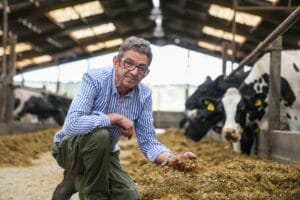
Maize is an essential part of the milking ration, offering an ideal balance to the grass silage and helping to drive intakes.
Based at Greenlands Farm, near Wincanton, Andrew operates a relatively simple dairying system, with just himself and one herdsman employed. Running a flying herd, and calving all year round, with grazing only for the later lactation cows, the focus is primarily on management of the cows and their housed ration, with full reliance on contractors when it comes to maize growing, for example. Andrew also works with Pearce Seeds agronomist Ben Allard, who is involved not only in maize variety selection but also has a valued input throughout the growing process.
“Given the heavy wet clay soil type on most of this farm, we are looking for very early varieties in order to achieve a mature crop in the shortest window, to avoid harvesting in wet conditions that can result in soil damage and erosion,” says Ben. “On Andrew’s heaviest ground, we grew Limagrain’s new ultra early variety LG 31.152, the earliest he’s ever grown. This variety yields very well and also benefits from good early vigour, so the crop was up and out of the ground very quickly, resulting in a good start that proved particularly important this season. On the lighter ground, we grew the slightly later variety Dignity, another Limagrain variety with good early vigour and strong agronomic characteristics, and very high yielding.”
The good start culminated in a very impressive outcome, with maize being harvested at the end of August, a full month earlier than usual, and the overall average yield across the farm’s sixty acres averaging around 18 tonnes per acre.
“Our yields were slightly up on what we normally expect,” reveals Andrew, “and the LG 31.152 most certainly contributed to that, despite being a very early variety. From an early forage analysis, the dry matter percentage is a little lower than optimal at 29.0%, but a starch level of 33.4% and ME of 11.7% are where we want them to be.”
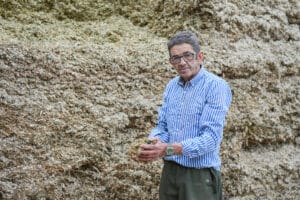
Maize yields at Andrew Bristol’s Greenlands Farm were higher than usual from a harvest that was around a month earlier than the norm.
Another factor that impressed Andrew was the stay-green characteristic of the varieties, something that has been a feature of Limagrain’s breeding programme for many years as it strives for better and better nutritional value in forage maize.
“To have a good hard mature cob whilst the leaves and stem are still green is a real benefit,” he says. “It means the crop ensiles better and the end result is a more stable and palatable forage for the cows. You can see it on the clamp face and in the cows’ intakes.”
Maize is grown as part of a rotation at Greenlands Farm that includes wheat, which all goes into the milking ration either rolled or caustic-treated. The ground destined for maize receives around 6,000 gallons/acre of slurry and 10 tonnes/acre of farmyard manure in the spring before being ploughed. Two passes with a power harrow are usually sufficient before drilling, with the heavier ground also being sub-soiled when necessary. Maize was drilled in 2025 on 26th April, when soils were still moist. Apart from pre- and post-emergence herbicides, the only other input is nitrogen fertiliser applied to the seedbed at 60 units N/acre.
The summer of 2025 proved to be a good one for growing maize, at least in Andrew’s area, but it was still a surprise to have a mature crop as early as the end of August. The fact that yields were slightly up on the norm underlines how modern maize breeding can deliver earlier maturity without compromising significantly on output.
Andrew began feeding the maize almost immediately, including it in a mixed ration alongside grass silage, a rape meal and protected rape blend, rolled and caustic treated wheat, minerals and yeast, fed once a day.
“It’s a key ingredient in the ration so I don’t like to be without it,” he adds. “There’s no doubt that having earlier varieties that deliver high yields is making the crop more viable on a heavy land farm like ours, which could in future mean we are able to grown more. In addition, qualities like stay-green help to add value when it comes to feeding out, not least in helping to drive those all-important intakes.”
Table: Typical fresh weight milking ration at Greenlands Farm
| Fresh weight (kg/cow/day) | |
| Grass Silage | 40.0 |
| Maize Silage | 17.0 |
| Rape meal / protected rape blend | 4.0 |
| Caustic Wheat | 4.0 |
| Rolled Wheat | 2.5 |
Yorkshire farmer Richard Barker is inviting visitors to his farm near Richmond on Tuesday 2nd December to see how home-grown beans can cut feed costs, boost sustainability and reduce reliance on imported soya.
The From Field to Feed open day is organised by the NCS Project, in which Richard is a ‘Pulse Pioneer’ trialling wholecrop beans in his beef herd’s diet.
Visitors will discover how beans are grown, harvested, stored and fed on farm – and how they can provide a high-protein, home-grown alternative to bought-in feeds.
Richard said: “As livestock farmers we need to balance cost, sustainability and performance. Wholecrop beans have proved a valuable option for my business – they fit well in my rotation, yield well and provide a reliable protein source for my cattle. I’m looking forward to sharing my experience and hearing from others.”
The open day will start at 10am at the Black Bull Inn, Moulton (DL10 6QJ) with presentations from leading experts including PGRO’s Erin Matlock on the agronomy of successful bean production, and an update on varieties from Limagrain. Michael Carpenter from Kelvin Cave Ltd will share insights into harvesting, processing, preservation and storage, and livestock nutritionist Lizz Clarke will tackle bean nutrition and ration formulation.
After lunch, a tour of Richard’s farm will include a look at the wholecrop bean storage, along with an opportunity to discuss feeding results and practical adoption with specialists.
The event is free to attend, but please register at www.tinyurl.com/NCSOpenDay.
From Field to Seed Open Day 2025