













Benefits of balanced nutrition
Avoiding nutrient deficiencies
Improvement of crop tolerance to adverse conditions
Increase of crop yield per area
Optimization of economic benefit per area
Improvement of nutrient use efficiency
Establishment & Autumn Crop Nutrition
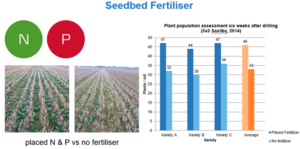
Oilseed rape establishment is influenced by autumn nutrition. Autumn fertiliser, particularly nitrogen and phosphate significantly increase both emergence and establishment of the oilseed crop. Early root growth is key to rapid emergence, and this is stimulated by readily available phosphate and nitrogen which in turn allows the plant to develop a bigger more efficient root system.
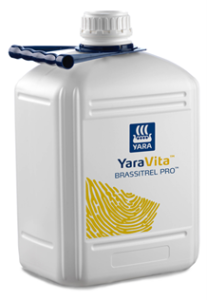
Once successfully established ensuring adequate nutrition of oilseed rape crops is vital to maximise yield and profitability. Good crop development before winter is the basis for high and stable yields. Oilseed rape needs to develop a strong, deep reaching main root with root collar diameter of about 8 mm and 8 to 10 leaves before winter. There are several nutrients the crop requires over and above nitrogen, phosphate, potassium and sulphur. YaraVita Brassitrel Pro was developed specifically for the oilseed rape crop. It contains Boron, Molybdenum, Magnesium, Manganese, Nitrogen and Calcium, all the essential nutrients in an easy-to-use formulation. A fully replicated trials programme conducted over 6 years (2016 – 2021) showed that two applications, applied once in the autumn and again in the spring just prior stem extension, delivered an average yield increase of 0.29 t/ha. It’s so easy – all the essential nutrients your OSR crop needs, in one can.
2 Key Reasons for Autumn Foliar Nutrition Applications
1) Provides nutrients straight into plant to maintain crop growth and improve winter hardiness
- 2) Loads the plant up with nutrients ready for spring growth – maintaining momentum!
Spring Crop Nutrition
Oil seed rape canopy management begins with plant population and can then be manipulated with nitrogen fertiliser and if necessary, plant growth regulators.The yield of oilseed rape is a function of producing an optimal number of seeds/m2. This can be derived from developing a canopy that has the optimal number of pods / m2 and seeds / pod. AHDB funded research has concluded that this number should be 6 – 8000 pods/m2. At this density pods will typically contain 10-15 seeds giving around 100,000 seeds/m2, the amount required for a yield of 5 t/ha. The target canopy size to achieve this can be described by the Green Area Index (GAI – the ratio of green plant material relative to a square metre of soil). The target is to grow a canopy of a GAI of 3.5 during flowering and seed fill. In the example below you can see how achieving an optimum canopy size delivers a higher seed yield than an overly large canopy.
Canopy Size effects on yield
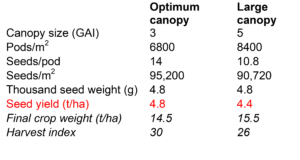
Source: ADAS
Nitrogen & Nitrogen Timing
Assessing the green area index of oil seed rape before spring growth is a good starting point to planning the nitrogen applications the crop will require. In replicated trials Yara found a seed yield of more than 4 t/ha requires 180 – 240 N per ha. Understanding the amount of nitrogen that is already in the crop and an assessment of what will be available from the soil will avoid excessive applications of nitrogen which can reduce seed yield and oil content by increasing protein level. Applying all the Nitrogen early will often over-shoot optimum canopy size (Particularly for crops with large GAI) so we need to plan to apply some Nitrogen later. Split applications at the beginning of vegetation and early stem elongation have been found to be the most efficient approach. Nitrate form of Nitrogen also resulted in higher yield compared to other sources of Nitrogen fertiliser.
Sulphur & Sulphur timing
Atmospheric deposition has been declining for many years and Sulphur is known to improve yield, quality and increases nitrogen fertiliser efficiency. Leaf area index and rate of photosynthesis are considerably increased by the sulphur. Sulphate is as mobile as Nitrate, therefore highly leachable so we need to plan to apply the crops requirements as close to early spring development as possible. Most sulphur is absorbed from soils by plants in the sulphate form. A lack of sulphur in the stages of early development reduces yield so the application of sulphur in spring should be at the start of the vegetative period ideally in the Sulphate form rather than the Elemental form. A delay to the availability of Sulphur can lead to lower seed yields and lower oil content.
Don’t forget about Potassium
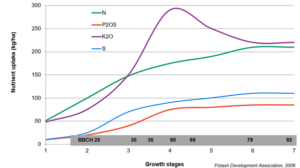
Potassium is involved in activation of several enzymes that control formation of proteins, carbohydrate metabolism, transpiration, and production & translocation of assimilates. It provides strength to plant cell walls and promotes oil synthesis therefore it optimizes growth and development of oilseed rape. Potassium uptake by oil seed rape is significant in the spring as can be seen in the below chart. Having sufficient potash available to the crop is therefore essential to maximise yield potential. In Yara’s trials production of about 3 – 3.5 t seed per ha requires 80 – 120 kg K per ha and increasing K application rate resulted in increase of oil content.
Nutrient uptake during growth stages of oilseed rape