











It is 14 years since Group 1 milling wheat Crusoe joined the AHDB Recommended List, which is quite a feat considering the many other varieties that have come and gone over that time.
Crusoe is now the oldest variety on the RL, yet remains popular among end users for its flour quality and baking performance, while its inherently high protein content continues to give growers the confidence to target premium milling wheat markets.
One of those is Essex farmer Richard Carr, who has grown Crusoe almost every year since its launch at his 220 ha (540-acre) farm near the coastal town of Maldon. This year, he has 85 ha of winter wheat in the ground at Lawling Hall Farm, split evenly between Crusoe and Skyfall, alongside a small area of SY Cheer.
“One of our biggest challenges farming in this area is the lack of rainfall, which means we struggle to achieve the really high yields that some new Group 4 varieties promise, despite being on strong wheat-growing ground,” says Mr Carr.
“That’s why we go for milling wheats; if yield is going to be compromised due to lack of rainfall, we’re better off going for a premium market instead.”
And in the 13 years he has been growing Crusoe, the variety has achieved milling specification every time, allowing him to build strong relationships with local buyers. “We need to be over 13% protein, but more often than not it’s nearer to 14% or above, which in some years can earn us a small extra premium on top of the milling price if supplies are tight.”
Switch to min-till
Recent years have seen a move away from plough-based establishment at Lawling Hall Farm, to a minimal tillage approach, although Mr Carr remains flexible, with decisions made on a field-by-field basis.
“We’ve invested in drainage at the farm, which has made a big difference to soil health, crop uniformity, and has helped us go down the min-till route,” he notes. “It also means we can usually get a head start for early applications of fertiliser and sprays in the spring.”
Indeed, Mr Carr knows that early yellow rust, and later brown rust, is a risk in Crusoe, but says it is relatively easy to manage, providing disease is controlled properly from the outset.
“We typically start by applying a good triazole at T0 to make sure crops are clean going into the main growing season, and maintain this protection with other chemistry at T1, T2, and T3. In high-pressure years, we might need an interim spray to cover the gap between T1 and T2, but decisions really depend on disease pressure and the season.
“We’ve found that if we can keep yellow rust out from the start, then Crusoe is quite good at growing away from it once adult plant resistance kicks in.”
Getting onto ground early is also important for crop nutrition, with Crusoe typically receiving four applications of nitrogen each season, totalling 210-220 kg N/ha. The first is usually applied as urea in late February, followed by the main dose three to four weeks later, with the last ammonium nitrate plus sulphur going on in late April/early May. Crops also receive a foliar nitrogen top-up at cheesy ripe stage, as well as other micronutrients and trace elements throughout the season.
“Magnesium deficiency is one of the main issues, as although soil levels are quite high, they are prone to nutrient lockup, so we monitor crops with tissue testing and address with foliar treatments as necessary.”
Crusoe’s lack of orange wheat blossom midge resistance is something Mr Carr remains aware of, but says he has not needed to treat for the pest in the past five years. “Part of that might be due to the natural cycle of OWBM, or the fact that generally, farmers are now growing more midge resistant varieties.”
Safety in a catchy harvest
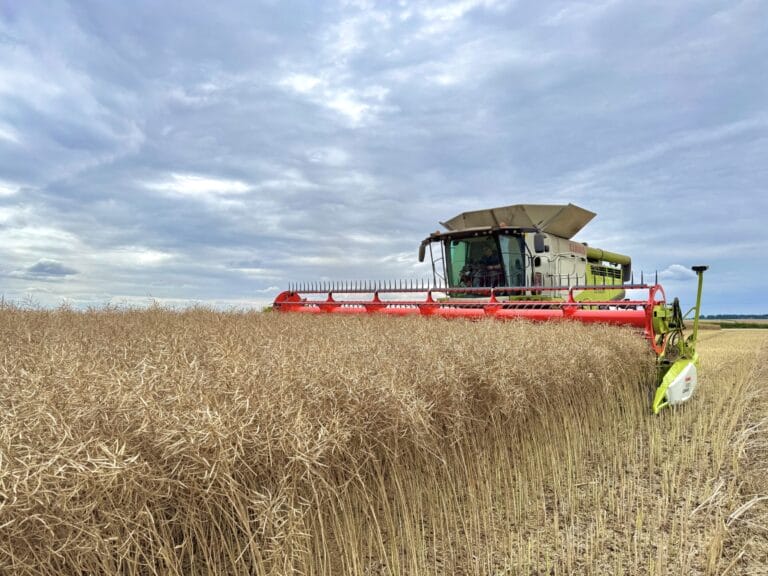
Mr Carr says Crusoe generally holds onto its Hagberg well in seasons where harvest gets delayed due to the weather, affording some level of security and flexibility. This can be particularly beneficial considering the farm does not have its own combine, but shares a hired machine with other neighbouring farms.
“Generally, if the weather is unsettled, we’ll prioritise combining the Skyfall first, as Hagbergs tend to drop quicker in that than in Crusoe .
“But one of our biggest stress relievers has been the recent investment in a 20 tonne/hour continuous flow system for cleaning and drying grain, which has made harvest management a lot easier, and is a good insurance policy that means we can cut at 20% moisture if need-be.”
Looking ahead to the coming autumn, Mr Carr plans to continue growing a similar area of Crusoe, but will also try a small area of two other new Group 1 varieties.
“At the moment, I can’t see any reason not to keep growing Crusoe. Any new varieties have got to prove themselves for both yield and quality before I make any significant changes.”
Lawling Hall Farm
- 220 ha farm near the Essex coast
- Predominantly heavy Windsor series clay soils
- Low annual rainfall, averaging 455-510 mm (18-20”) – ranging from 355 mm (14”) in 2025, up to 760 mm (30”)
- Cropping includes winter wheat (all Group 1s), lucerne, naked oats, winter beans and linseed
- Growing Crusoe since 2013
- Min-till establishment system
About The Author

Heather Oldfield
Cereals Product Manager