International cooperation showing positive results for Limagrain UK’s Pulse Breeding Programme
Limagrain’s pulse breeding programme focuses on winter and spring peas and beans. We are a multinational breeding team based in Europe and the UK and target a global pea and bean market.
Pulse breeding is centred in Rilland in the Netherlands, which is on the same line of latitude as London. The programme is spearheaded by pulses breeder Will Pillinger, along with his team consisting of Corrie Dekker (assistant breeder), Jaenet Ter Schure (assistant molecular breeder), Evelien Bakker-Breker (breeding assistant) and Lucie Collins (trials manager).
Major markets targeted include France, Germany and the United Kingdom, but we also breed for other markets within Europe and North America.
The EU Market for peas and beans is worth €10 million and the specific types of peas include green seeded types (€1.8m) for human consumption and yellow peas (€3m) for animal feed.
Field beans (€4.7m) make up roughly 1/3 of our breeding activities across spring and winter types, with our main market being the UK. Key traits for peas and beans are excellent agronomics, yield, quality and protein content.
The other targeted traits we look to develop include; resistance to lodging, Aphanomyces tolerance, tolerance to cold, Downy Mildew and Powdery Mildew and FEBRUARY 2022 GatePost Pea Seed borne Mosaic Virus (PSbMV), maturity and plant architecture.
The core activities for breeding comprise of crossing, early generation selection and seed production. Although we have many breeding targets for peas, there are some specifics for the human consumption market that are key, such as excellent seed colour retention.
When harvested at the right time, peas will retain the blue green appearance. They will quickly lose their colour if not harvested or stored correctly.
In 2021, we entered 15 varieties into National Listing across Europe and the UK. For a small breeding programme, that is a significant number and gives an idea of the potential challenges of being successful in each target market. As a result, the pressure on the seed purification team can be high.
Further developments over the next couple of years will be the ability to measure yield performance of our breeding material during the first year of field assessment. Additionally, the development of techniques to predict the performance of material without testing in specific environments, will help to advance the output of high performance varieties from the pulse breeding programme.
We are excited about the future of pulses and Limagrain have backed the programme with significant investment to further modernise our activities.
Treble success on the PGRO Descriptive List for Limagrain beans & peas
After another strong year spring bean LG Raptor moves from its P2 rating to fully join the PGRO DL offering high yields, excellent vigour and agronomics
• After another strong year, spring bean LG Raptor moves from its P2 rating to fully join the PGRO DL offering high yields, excellent vigour and agronomics • A second spring bean, LG Viper also fully joins the DL from Limagrain, offering a class-leading disease package • Blue pea LG Aviator also moves from a P2 to full recommendation with a world-class disease resistance package and standing power
Spring Beans
Yield performance – that is yield and consistency – is the most important factor for spring beans and is a major focus in the Limagrain breeding programme and this can be seen in our spring bean additions to the DL this year,” notes Will Pillinger, pulse breeder at Limagrain UK.-
“LG Raptor offers extremely high yield potential at 102% of control, and importantly has shown a consistency in these yields over the last few years, which is a really important and valuable attribute for a spring bean,” he says.
“But high yields need to be backed up by solid agronomics and traits – and LG Raptor offers all of this – it is fairly early to mature, stands well and offers a good disease package including rust.”
“LG Raptor is suitable for human consumption, fish feed and animal protein markets so offers a range of marketing opportunities.”
Tom Barker, pulses product manager for Limagrain, says.” LG Raptor’s consistent yields and disease resistance package mean it will be taking a big bite into the spring bean acreage – particularly in the north with its particular combination of traits.”
“LG Viper is our second spring bean to fully join the DL and a really exciting spring bean variety that offers a class leading disease package backed up by Limagrain’s comprehensive, extensive and reliable dataset,” says Mr Pillinger.
“Looking in particular at rust resistance; LG Viper’s rating of 7 is stand-out when compared to other varieties in the sector and really worth taking note of. The variety also has a good downey mildew rating of 6.”
“Standing is a really important attribute for on-farm management of spring beans, LG Viper has the highest standing power rating on the DL of 9.”
“Yield-wise the variety sits well up in the top of the pack at 102% of control.”
Mr Barker adds to the breeder’s comments, pointing out that the variety is suitable for the human, fish and animal protein markets offering a high thousand grain weight (633 (g)n (@15%mc) and an excellent protein content (% dry).
Peas
Large blue pea LG Aviator also moves from a P2 rating to a full recommendation with a yield of 100%.
Will Pillinger explains that the reason for these high yields is because LG Aviator is a multi-podded variety type. “For each node that LG Aviator produces, there are three pods, this means there are more pods at the top of the plant rather than spread through the plant, making for a more even maturity with less competition for light – and this is a significant characteristic in building yield.”
He points out that with this stunning and predictable plant habit, this new type of manageable green pea variety makes planning pesticide and nutrient applications far easier than conventional ‘semi-indeterminate’ types. This also applies for predicting the harvest period- which is really useful.
Agronomically there is much to like about the variety he adds. “LG Aviator offers one of the best resistances to downey mildew (8) and is highly resistant to powdery mildew. It’s early, and has good ratings for standing ability and straw length (rated 7) – making it one of the best agronomic packages of any other provisionally rated varieties.”
“Suitable for both human consumption and for animal protein, all of this makes for a very exciting variety and one that should perform well for UK growers. End users have already shown a significant interest in LG Aviator.”
LG Pulse Breeding aims for 2022 and beyond
• Producing consistently reliable varieties for variable seasons
• Increasing resistance to viruses
• Increasing pest tolerance
• Continued focus on breeding for root rot (Aphanomyces) tolerance
• Continued selection for high protein content in peas
LG Raptor’s Excellent Yields & Early Maturity
Excellent yields and the early maturity of spring bean variety: LG Raptor, have delighted Lincolnshire grower, Tim Lamyman. We ask Tim to share his thoughts on the crop and how he achieved these top yields.
Tim Lamyman
Harvested on the 16th September, the crop yielded 7.1 t/ha with a moisture content of 14.5%.
Reflecting on the growing season, Mr. Lamyman says: “We particularly noticed the high number of pods per plant, which was around 30. These pods were consistent in size, and this has obviously translated into yield.”
“We were a bit short of seed, so we planted at 200 kg/ha, rather than the recommended rate of 250 kg/ha.” As a result, there were 28 to 35 plants/m2. He firmly believes he could have pushed the yield further with more seed.
The spring beans follow spring barley in a rotation. “The field chosen for the crop was a south-facing grade 2 chalky Wold clay, which offers the potential for well-structured root systems, enabling easier nutrient uptake – which I believe is key to a high yielding crop.”
Mr. Lamyman believes that well-targeted crop nutrition is critical to success, and follows a strategy aimed at getting the young crop established and away promptly.
“We applied 1 l/ha 1-4-All and 2 l/ha of ToPPit (a liquid fertiliser containing phosphorus, potassium and micro elements) to reduce stress and strengthen the roots, helping the crop get away.”
LG Raptor
Prompt establishment and vigour from his crop nutrition strategy also helped to reduce any susceptibility to downy mildew, he adds.
To keep feeding and increasing biomass, another 2 l/ha application of ToPPit was made at early flowering, with 1 l/ha XStress (used to enhance photosynthesis and growth), and 0.5 l/ha CalFlux (used to help the flowering part of the plant). This was followed at mid to late term with 1 l/ha X-Stress and 1 l/ha CalFlux.”
Calcium is an essential part of the cell structure of new growth, and if a plant is put under environmental stresses at the flowering time, this can lead to almost complete pod abortion – as happened this spring, he says. He uses CalFlux because he finds it penetrates the flowers and remains there for the plant to draw on in stressful times, instead of using the calcium from the new growth.
“This spring, it was an essential requirement for pulse crops to have XStress and CalFlux technology, to get them through the incredibly dry spring we had.”
“We will be growing LG Raptor again in 2021. What we liked most about LG Raptor is its early maturity, which is difficult to find, stiff straw and the first-rate yield.”
Pulses product manager for Limagrain, Tom Barker, believes that LG Raptor gives farmers a new option in spring beans, combining early maturity and high yield.
With its high yield of 105% of control, good early maturity (7), and all-round agronomic package, growers should be excited by LG Raptor. It is suitable for the human consumption market, export and protein markets, and will certainly be a variety to watch out for.
All information is from the PGRO Descriptive List 2021, available at www.pgro.org
Moving up in the 2021-2022 PGRO Descriptive List
The spring bean LG Raptor continues to produce outstanding yields and moves to a P2 rating at 105% over control.
“Yield is the most important factor for spring beans, and is a major focus in our breeding programme,” notes Will Pillinger, pulse breeder at Limagrain UK.
“The success of this approach can be seen as LG Raptor moves closer to recommendation offering extremely high yield potential that could see it outyielding the market leader by next season, he says.
“This year LG Raptor showed excellent uniformity throughout the growing season which has translated into a uniform sample.”
“But high yields need to be backed up by solid agronomics and traits, and LG Raptor does this – it is fairly early to mature, stands well and offers a good disease package including rust. This combination of traits makes it a good variety for the north.”
LG Raptor is suitable for human consumption, fish feed and animal protein markets so offers a range of marketing opportunities.
Tom Barker, pulses product manager for Limagrain UK, sums the variety up.” LG Raptor’s consistent yields and disease resistance package mean it will be taking a big bite into the spring bean acreage.”
Large blue pea LG Aviator also moves to a P2 rating with a yield rating of 103% over control.
Will Pillinger explains that the reason for these high yields is because LG Aviator is a multi-podded variety type.
“For each node that LG Aviator produces, there are three pods. This means there are more pods at the top of the plant rather than spread through the plant, making for a more even maturity with less competition for light – and this is a significant characteristic in building yield.”
Agronomically there is much to like about the variety he adds. “LG Aviator is one of only three varieties listed to offer resistance to powdery mildew. It also offers very high levels of tolerance to downy mildew (with a rating of 7).
“It’s early, and has good ratings for standing ability and straw length (rated 6) – making it one of the best agronomic packages of any other provisionally rated varieties.”
“All of this makes for a very exciting variety and definitely one to watch over the next year as it moves towards full recommendation this time next year,” he says.
Key agronomics of LG Raptor – All information is from the PGRO Descriptive List 2021, available at www.pgro.org
LG Pulse Breeding Aims for 2021 and Beyond
Producing consistently reliable varieties for variable seasons
Increasing resistance to viruses
Increasing pest tolerance
Continued focus on breeding for root rot (Aphanomyces) tolerance
Continued selection for high protein content in peas
Moving up in the 2021-2022 PGRO Descriptive List
The spring bean LG Raptor continues to produce outstanding yields and moves to a P2 rating at 105% over control.
“Yield is the most important factor for spring beans, and is a major focus in our breeding programme,” notes Will Pillinger, pulse breeder at Limagrain UK.
“The success of this approach can be seen as LG Raptor moves closer to recommendation offering extremely high yield potential that could see it outyielding the market leader by next season, he says.
“This year LG Raptor showed excellent uniformity throughout the growing season which has translated into a uniform sample.”
“But high yields need to be backed up by solid agronomics and traits, and LG Raptor does this – it is fairly early to mature, stands well and offers a good disease package including rust. This combination of traits makes it a good variety for the north.”
LG Raptor is suitable for human consumption, fish feed and animal protein markets so offers a range of marketing opportunities.
Tom Barker, pulses product manager for Limagrain UK, sums the variety up.” LG Raptor’s consistent yields and disease resistance package mean it will be taking a big bite into the spring bean acreage.”
Large blue pea LG Aviator also moves to a P2 rating with a yield rating of 103% over control.
Will Pillinger explains that the reason for these high yields is because LG Aviator is a multi-podded variety type.
“For each node that LG Aviator produces, there are three pods. This means there are more pods at the top of the plant rather than spread through the plant, making for a more even maturity with less competition for light – and this is a significant characteristic in building yield.”
Agronomically there is much to like about the variety he adds. “LG Aviator is one of only three varieties listed to offer resistance to powdery mildew. It also offers very high levels of tolerance to downy mildew (with a rating of 7).
“It’s early, and has good ratings for standing ability and straw length (rated 6) – making it one of the best agronomic packages of any other provisionally rated varieties.”
“All of this makes for a very exciting variety and definitely one to watch over the next year as it moves towards full recommendation this time next year,” he says.
Key agronomics of LG Raptor – All information is from the PGRO Descriptive List 2021, available at www.pgro.org
LG Pulse Breeding Aims for 2021 and Beyond
Producing consistently reliable varieties for variable seasons
Increasing resistance to viruses
Increasing pest tolerance
Continued focus on breeding for root rot (Aphanomyces) tolerance
Continued selection for high protein content in peas
Continued investment in Pulses sees two exciting additions to the 2020/21 PGRO Recommended List
Large blue pea LG Aviator and spring bean LG Raptor move from Recommended List trials to a P1 rating.
The large blue pea LG Aviator joins the Recommended List with a yield of 99% over control; higher yielding than market stalwart, Prophet.
LG Aviator has excellent tolerance to downy mildew, with a rating of 7, and is resistant to powdery mildew. It’s early and has good ratings for standing ability and straw length (rated 6) – making it one of the best agronomic packages of any other provisionally rated varieties.
LG Raptor joins the 2020/21 Recommended List as one of the highest yielding spring bean P1 varieties. Its consistently high yields have played out over the last two years of Recommended List trials, yielding 107% of controls in 2019 and 100% of controls for this years’ listing, and it is expected to perform as well or better next year.
LG Raptor is one of the earliest maturing varieties on the RL. This, its short straw and excellent standing power makes LG Raptor one of the best agronomic packages of any spring bean on the market.
Pulse Crop Genetic Improvement Network (PCGIN)
Limagrain has been involved in PCGIN since its creation and has benefited from the excellent research into the genetic improvement of the pulse crop. The next event is on 14th Nov in Grantham and open for registration now…
Limagrain has been involved in PCGIN since its creation and has benefited from the excellent research into the genetic improvement of the pulse crop. In particular, the work on seed quality has helped in colour retention in large blue and marrowfat pea breeding.
The next event is the PCGIN 2019 stakeholder meeting and will be held on 14th November in Grantham, Lincolnshire.
This industry-led stakeholder meeting will present perspective talks on future market opportunities and relevant international developments, within the context of the latest developments in genetic research on UK pulse crops (PCGIN 2018-2023). There will be time for interactions over lunch.
We are very grateful to Agrii and Limagrain for their sponsorship of this meeting.
Programme
10:30 Arrival, tea & coffee
Welcome & introductions (Peter Smith, Agrii; Will Pillinger, Limagrain)
Chair: Peter Smith, Agrii
11:20 Overview of industry-academic exchanges – Marketplace of Ideas (Donal O’Sullivan, Reading)
11:25 The industry perspective, 2019 (12 minutes each speaker)
• Andy Bury, Frontier: Challenges for trading UK pulse crops
• Paul Sheldrake, Healy Group: Rising opportunities for vegetable proteins and UK pulses – Technical & Nutritional Challenges
• Nick Saltmarsh, Hodmedods: Opportunities for existing and novel legume crops in the UK
• Chris Harrison, Novofarina: Food product development and genetic targets in pea.
• The role of Pulses UK
12:45 LUNCH with poster* viewing
Chair: Will Pillinger, Limagrain
13:40 Flash presentations from junior scientists (5 minutes each speaker)
Tom Reynolds, NIAB: Evidence for sexual reproduction of the faba bean pathogen B. fabae in the UK
Gabriel Robinson, JIC: A nutritional review of UK pulses
Vicky Tagkouli, UoR: Selection schemes for small-scale faba bean breeding Jake Moscrop, NIAB/UoCam: Enhancing pollination in the field bean, Vicia faba
Ahmed Warsame, UoR: Identifying and quantifying the most important faba bean seed proteins
14:15 Legume crops and international activities (Pete Iannetta, The James
Hutton Institute)
Curation of legume crop germplasm (Noam Chayut, JIC)
14:40 Perspectives & open discussion on priorities (growers, NFU, Defra,
industry & scientists)
15:00 Wrap up & depart
*Poster presentations:
• Genotyping tools for faba bean (Deepti Angra, Reading)
• Towards saturation mutagenesis in faba bean (Tom Harvie, Deepti Angra, Reading)
• Improved management of viruses (Becky Howard, PGRO; FERA)
• Exploring soybean germplasm (Tony Miller, JIC)
• Nitrate sensors and uptake of nitrate by crops (Tony Miller, JIC)
• Favuleux – developing faba beans as a sustainable source of high-quality protein for food through optimised genetics, farming and processing (Thomas Wood, NIAB)
• Identification of a QTL conferring partial resistance to downy mildew on faba bean, Vicia faba (Anne Webb, Krystyna Gostkiewicz, Jane Thomas and Thomas Wood, NIAB)
On-farm thoughts from Rob Atkin of Field Farm, Field, Uttoxeter
For Rob Atkin of Field Farm, Field, Uttoxeter, it is the perfect opportunity for him to exploit a new market for his bean crop.
“We have grown beans since 2010, and have alternated between springs and winters depending on the rotation. However, with the opportunity to grow for Frontier’s processing plant which is fairly local, it made sense to opt back into spring beans.”
“As an alternative break crop, they have a valuable place in the rotation and if you get beans right, they can be a profitable crop, as they don’t really require high inputs.”
Mr Atkin has chosen to grow the variety; LG Cartouche, as it offers the highest protein content available on the spring bean PGRO Recommended List 2019, sitting 1.3% ahead of any other pale hilum variety at 29.1%.
“To meet the 29% protein target needed by Frontier, it made sense to start at the highest genetic protein base level.” LG Cartouche is also high yielding with very good standing ability and is early to mature. It’s a pale hilum bean, that’s also suitable for the premium human consumption market. “Rob will be following our bespoke agronomy advice, using dedicated yield and protein boosting products to ensure the crop
fulfils this potential,” explains Richard Plant, Frontier agronomist.
“Initial results from trials indicate that some of the new bio-stimulants have a positive effect on yield and protein. When used early in the growing crop, they have improved rooting and nutrient utilisation which helps in pushing for that extra quality.”
“LG Cartouche responds particularly well to this, with its higher base level protein content.” Mr Plant points out that should the beans reach human consumption quality, there is still an option to trade them for the more lucrative human consumption market.
Growing beans for a protein premium
Frontier is offering an attractive price of £40/tonne* for beans above November wheat futures, with an additional £10/t premium for growers who opt for Frontier’s specialist bean agronomy package and achieve the required 29% protein targets.
This comes about with the opening of a new de-hulling plant near Nottingham in July of this year, where beans are processed to produce a protein-rich binding agent that’s attractive to the fish farming industry.
* Contract premium correct as of 18th February 2019. Premiums can go up or down depending on market movement.
World record pea yields – for the second time!
A crop of LG Stallion blue peas has yielded a record 7.48 t/ha at 15.04% moisture
A crop of LG Stallion blue peas has yielded a record 7.48 t/ha at 15.04% moisture. The last world record set back in 2017 was also held a crop of LG Stallion which yielded 6.47 t/ha at an average of 15.35% moisture.
Harvested on Saturday 7th September at Worlaby Farm in Lincolnshire, grower Tim Lamyman is delighted with both the yields and quality to come off this year’s pea crop.
“Who would have thought that 2019 would be the year for a world record crop!” he says. “I am absolutely thrilled with the final performance of the peas as they have shown a consistency in biomass through the season – much more so than last year. In places the crop was 6ft tall – and this has obviously translated into yield.”
LG Stallion was the field pea variety of choice, selected for its high yield potential and good standing ability. This is the third year that Mr Lamyman has grown the variety, breaking the world record yield in 2017, and having success again with the variety in the very difficult season of 2018 when it yielded 5.6 t/ha at 14.76% moisture.
The peas follow a second wheat in the seven year rotation which also includes wheats, spring barley and oilseed rape. “The field chosen for the crop is much like last year; a grade 2 chalky loam which offers the potential for well-structured root systems, enabling easier nutrient uptake – which I believe is key to a high yielding crop,” says Mr Lamyman.
“As the spring was so dry, we adapted our cultivations for the peas through an intensive min-till approach which allowed us to create a more level seedbed.”
Before drilling, the field had two passes with a Lemken Terradisc and finished with a Vaderstad carrier (discs and crumble roller), and then it was rolled with Cambridge rollers the day after drilling.
The crop was drilled on 9th April using a Vaderstad Rapid, with the coulters set at a 4-inch row width. The seed was treated with Wakil XL + GPA, with the aim of early downy mildew control from the Wakil XL and better root development, as well as plant establishment with the phosphite-based nutrient GPA.
Established plant populations were 85 plants/m2, he says.
Mr Lamyman believes that detailed and well-targeted crop nutrition is critical to his success. “Leaf samples were taken at four different stages through the crop’s growth cycle in order to identify nutrient deficiencies, to which the relevant products were then applied as required.”
“Foliar applications were similar to those used in 2018. An early insecticide (50 ml Hallmark) was applied for weevil damage. Just before flowering, 2 l/ha of ToPPit +1 l/ha of Rainbow Wave went on.”
ToPPit is a 0-30-40 liquid fertiliser containing phosphorus, potassium and a range of micro-elements. Rainbow Wave contains boron and molybdenum.
“In 2017 we had virus in the crop, and given the high aphid numbers this year we applied Aphox early.”
“At flowering, the tank mix consisted of 280 g/ha Aphox, 1 l/ha X-Stress, 2 l/ha ToPPit, 0.5 kg/ha Signum and 0.5 l/ha CalFlux.”
The X-Stress is used to prevent a plant shutting down its stomatal and root absorption processes under stressful conditions. It does this by enhancing photosynthesis and growth by providing essential micro elements, including the correct proportions of iron, zinc, manganese and copper, as well as magnesium and glycine.
“Two weeks later, another spray containing 2 l/ha ToPPit, 0.5 l/ha CalFlux, 1 l/ha X-Stress, as well as 50 ml/ha Hallmark went on.”
“CalFlux is a key component in any record attempt, such as when the plant experiences stress,” explains Tim. “It will draw calcium from the flowering nodes and this can lead to pods and flowers aborting, and this is exactly what happened in the dry spring.”
“As harvest approached and the weather was very changeable, we decided to apply some Reglone on 23rd August, in case of a delay to harvest, and that helped.”
We are delighted to hear of such a high yield from the pea crop, says Chris Guest – Head of Seed for ADM Agriculture.
Achieving more stable yields with the pea crop is something that we see as highly important for the long term future of the combinable pea crop within the UK farm rotation, he says.
“Over the last two years, we have seen the benefit of micro-nutrients in peas – an important consideration for anybody planning the farm rotation based on a long-term view. We see some of the highest first wheat yields following peas – and as such, the two year gross margin is something that is important to consider.”
“Last year, Tim focussed on achieving the highest yields whilst still maintaining the full green colour which is so important for top grade human consumption quality. However, this year he has pushed for out and out yield,” he says.
“Looking at how this would translate in terms of gross margin based on a worst case scenario of feed quality with current values of circa £180/mt ex farm – this would equate to a gross margin of £915/ha (which includes the additional spend by Tim on the Bionature package).”
“However, if these were suitable for a low grade HC market – this gross margin would increase to £1401/ha (which again includes the Bionature package costs) with a market value of circa £235-240.”
“It’s worth noting that this is the highest gross margin achievable for any crop this season!” says Mr Guest.

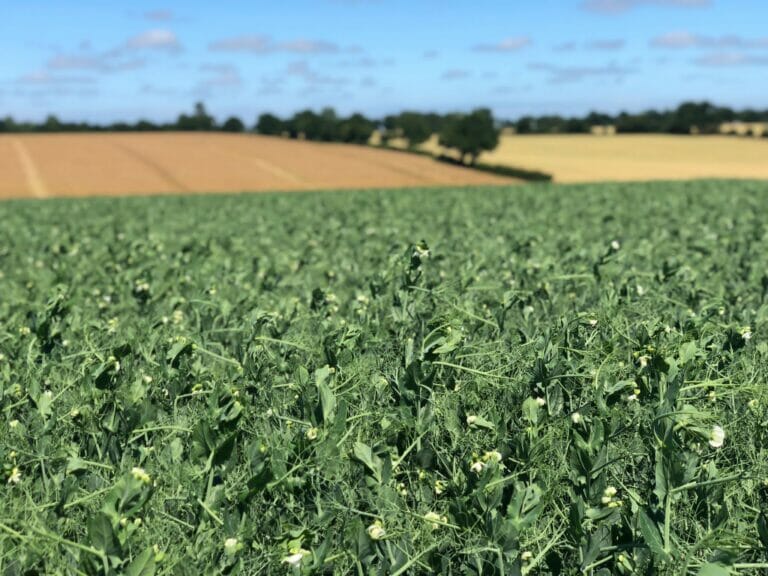
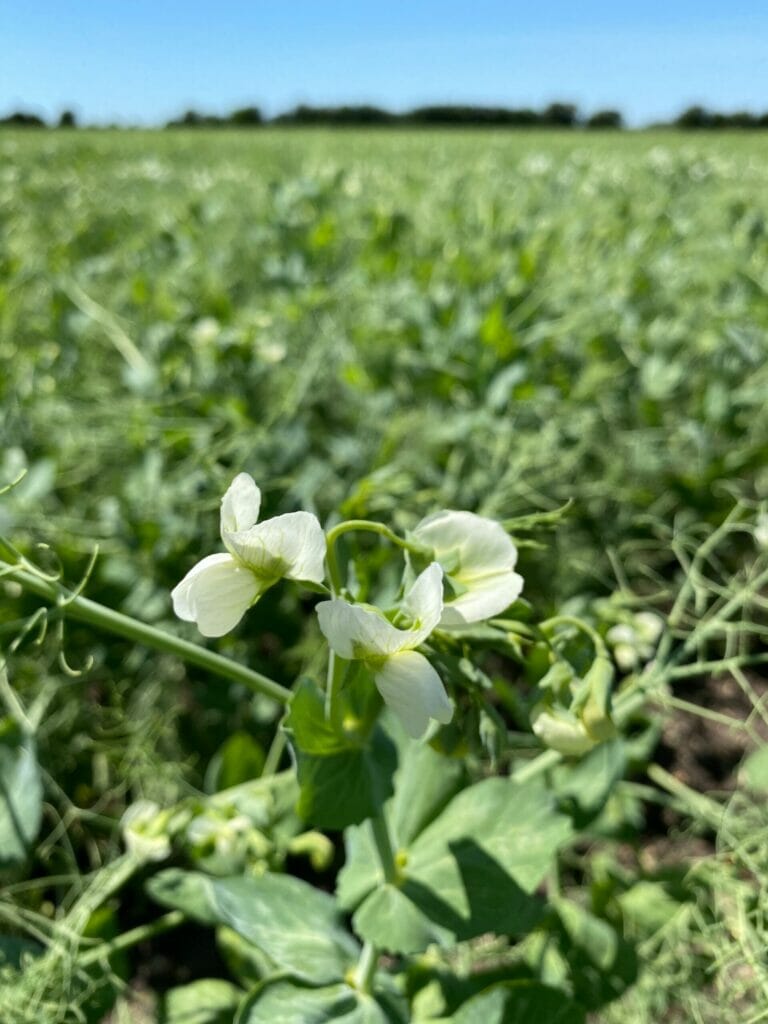








 Major markets targeted include France, Germany and the United Kingdom, but we also breed for other markets within Europe and North America.

 Will Pillinger explains that the reason for these high yields is because LG Aviator is a multi-podded variety type. “For each node that LG Aviator produces, there are three pods, this means there are more pods at the top of the plant rather than spread through the plant, making for a more even maturity with less competition for light – and this is a significant characteristic in building yield.”


 The large blue pea LG Aviator joins the Recommended List with a yield of 99% over control; higher yielding than market stalwart, Prophet.


