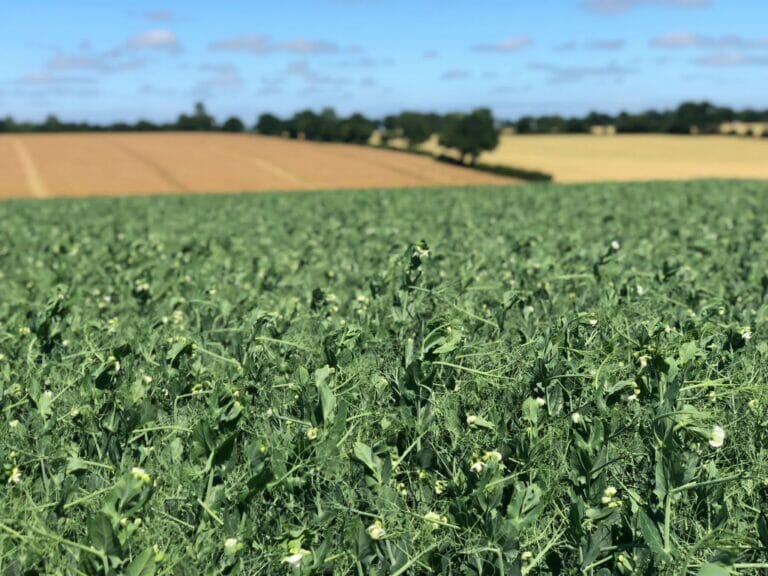
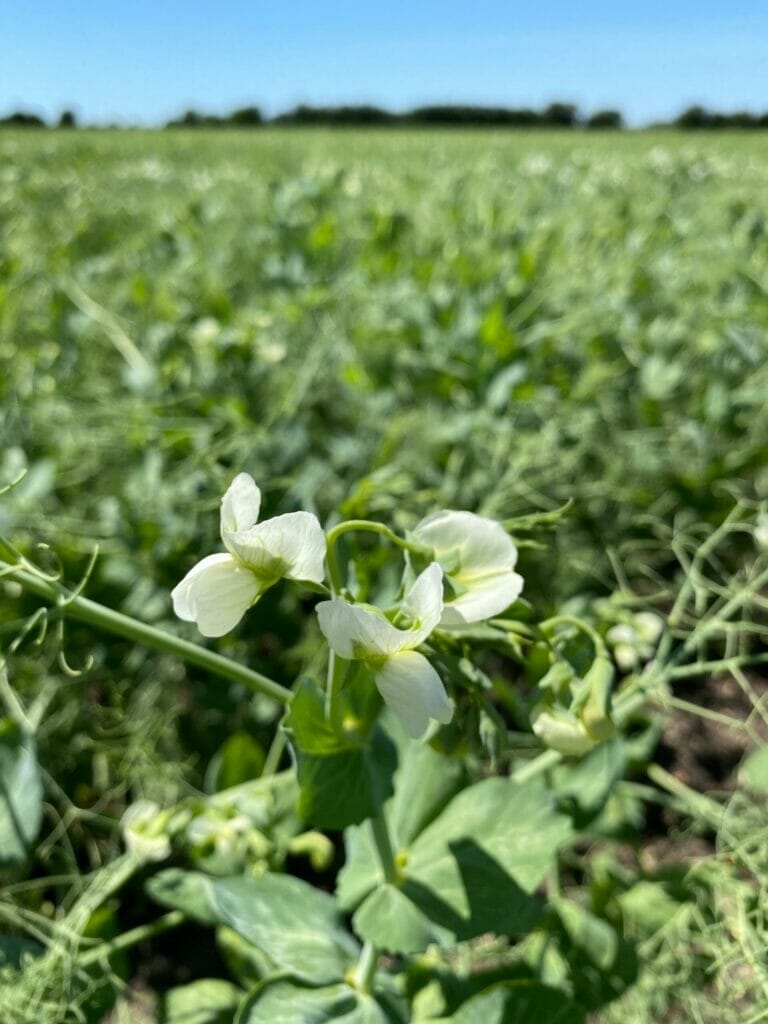
Yellow peas have historically been only a small proportion of the UK pulses market but are grown much more widely in Canada and France. Originally, only grown as a niche product for animal feed, they now command a premium for bird food and human consumption markets.
The area of yellow peas has been increasing steadily in the UK over the past decade. Justin Barrett, from Askew and Barrett (Pulses) Ltd, explains “we are finding that yellow peas have a higher yield than large blue and marrowfat types. They are also flexible, as they are used in a number of processes including for fractionation, pea flour and split peas used for soups, stews and casseroles”.
Limagrain’s first yellow pea in the UK, LG Ajax, was first listed in 2022 and was followed by LG Corvet. Both of these varieties have a step up in disease resistance over other types, especially against powdery and downy mildew.
“One of the major benefits of yellow peas for growers, is there is no risk of bleaching during growing and harvesting and they are usually the first of the dry peas to be combined. I expect the market to continue to increase for yellow peas” says Justin.
Peas perform in dry conditions
Lincolnshire grower Edward Knight of James Knight Farms near Folkingham, Sleaford, Lincolnshire, was very pleased with how well the large blue pea LG Aviator coped with the challenging dry conditions of 2022.
“They stood up nicely to combine and yielded 3.7t/ha,” he says.
“This is the first year we have grown LG Aviator peas, which will go to Limagrain UK for seed”.
“We are impressed with LG Aviator as a variety – it’s clean, vigorous and with the dry conditions we didn’t have to spend too much on it. We also bale the straw as the cattle like pea straw, so it’s a good value crop for us.”
Direct drilling peas
“We have grown pulses on and off for the last fifteen years, depending on where they fit in the rotation. We work the soil in the autumn with a Sumo trio, and then drill in the spring once soils have warmed up enough. For the first time, we direct drilled the peas using a Mzuri in an attempt to conserve as much soil moisture as possible – which worked well.”
Importance of disease resistance
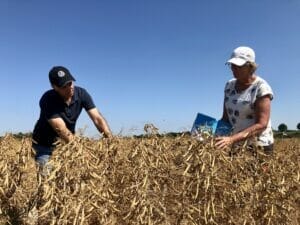
At a time when farmers are looking carefully at crop inputs, a variety like LG Aviator should provide some much needed varietal security as it offers the best disease resistance package of any large blue pea variety, including powdery mildew resistance,” says Corrie Dekker, Assistant Pulse Breeder for Limagrain UK.
“The variety also exhibits a unique architecture with most of the pods near the top of the plant, which keeps them off the ground and makes for easier combining.”
For these reasons, Ms Dekker believes that LG Aviator will feature in generations to come and is why it has been significantly taken up by the industry.
Farm facts
JK Farms
Family Farm & Contracting Rotation Peas/Beans Wheat Wheat/Spring Barley Linseed Wheat Wheat/Spring Barley OSR
LG Aviator peas in summary
• Good yield performance with consistent flowering and even maturity
• Excellent tolerance to downy mildew and powdery mildew resistant
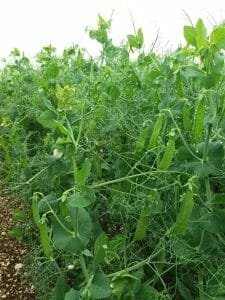
• Multi podded type with a condensed pod set at the top of the plant
• Suitable for micronizing, feed and human consumption market
This year, to mark 10 years of the Yield Enhancement Network (YEN), a new Innovation Award has been commissioned which was presented at the YEN conference on 24th January. The award is for an outstanding contribution to on-farm innovation and has been sponsored by Limagrain.
“Limagrain has been an active supporter of YEN since its inception so it seems only fitting that we sponsored the Innovation Award for the 10th anniversary conference,” says Limagrain’s Arable Marketing Manager, Will Charlton.
“As a company that invests in UK based breeding activities for all major arable crops, innovation is a core value of our business. Alongside bringing new varieties to market, we invest a considerable amount of time and money in examining how our varieties perform in different farming systems. Over the years YEN has been invaluable in helping us facilitate this work by providing a structure and detailed analysis to aid Limagrain’s collaborations with innovative farmers across the country.”
The standard of nominations was exceptionally high with all the farmers demonstrating a passion for progress, learning and collaboration. However, there could only be one winner. The award was presented by Limagrain’s Arable Technical Specialist, Liam Wilkinson.
Liam Wilkinson and Russ McKenzie
“I’m delighted to announce that Russ McKenzie, farm manager of DJ Tebbit and John Sheard Farms, has won the YEN innovation Award. Russ has demonstrated his commitment to YEN by being one of the few farmers to provide an entry every year since YEN began.
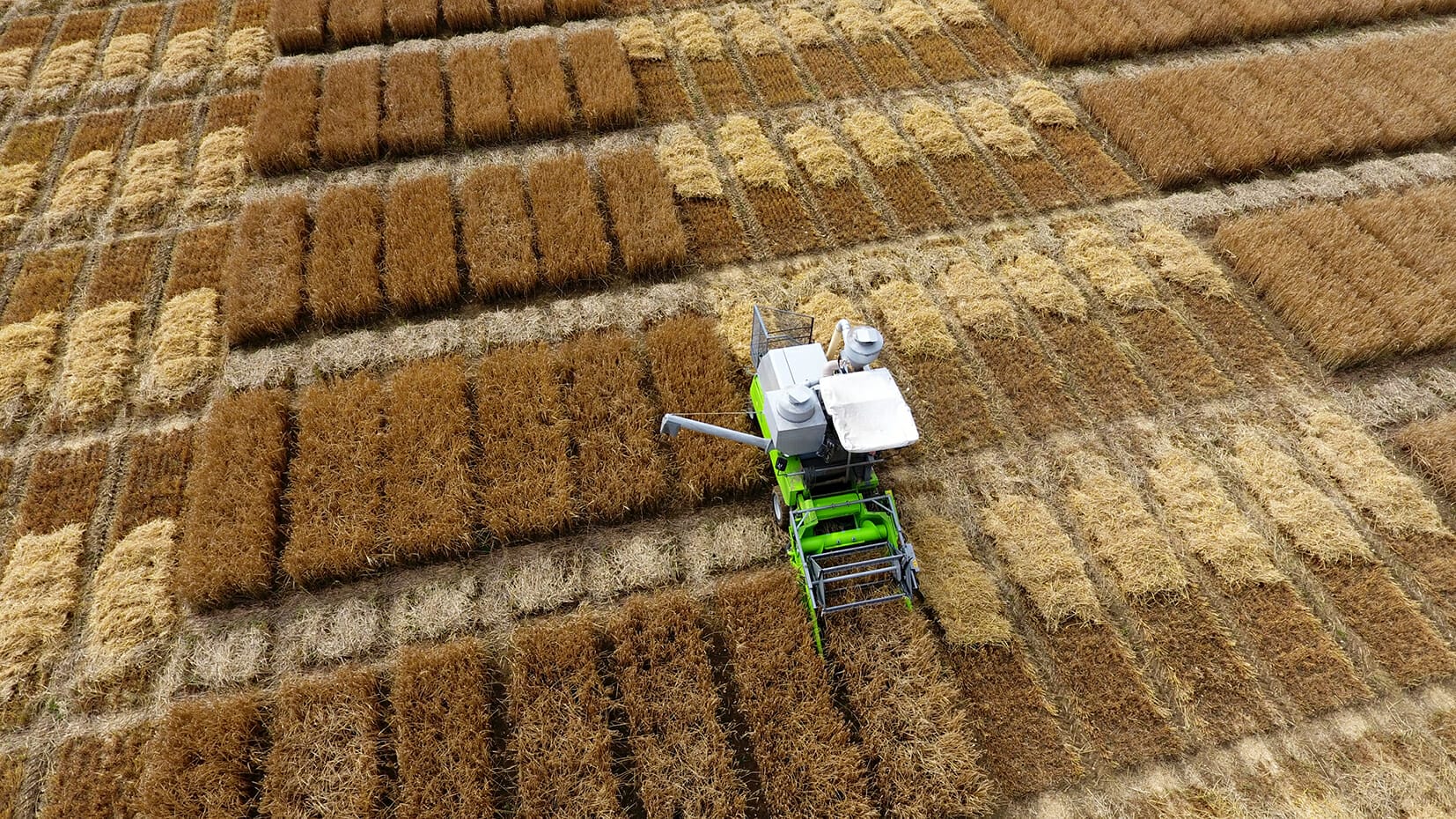
In particular, the judges were impressed by his recent on farm trials work which has sought to investigate fungicide, nutrition and variety interactions under his own establishment system, utilising the latest digital and molecular diagnostics, alongside a trials plot combine to analyse the results. The complexity of his trials required dedication and a significant time commitment throughout a busy growing season. The data generated has provided valuable insights into how different inputs interact and influence a farming system.”
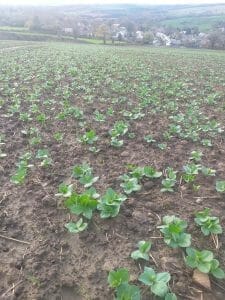
Winter beans provide crucial protein source for Northumberland farmer
For Northumberland farmer, Wayne Bean of T Bean & Sons, growing his own livestock feed is key to maintaining profitability from his cattle and sheep.
Whole crop beans, maize, kale, forage rape, fodder beet and grain are grown for this purpose at Broad Oak Farm, near Newcastle-upon-Tyne.
“We are totally self sufficient in producing the ingredients for our rations. By growing our own feed, it puts us in control of our own costs as much as possible,” explains Wayne.
“We know the margins that we have to operate within between profit and loss, and this is particularly important when we buy cattle in, as it helps us to know our margins are fixed before starting.”
“It’s also important that in our cattle ration we include a protein source, as well as fibre, which whole crop beans provide.”
Beans became central to the rotation at Broad Oak Farm back in 2008, initially in response to a price hike in protein and nitrogen costs when 20 acres were drilled on a trial and now there is as much as 80 acres grown in any one season.
“Initially we grew spring beans, but have changed to winter varieties as we have found we can drill them into the heavier ground where maize can’t be grown as a break crop and weed control.”
“With our land being up to 1000 ft above sea level, conditions in the spring are unpredictable, so it takes the risk away.”
“We are now growing the variety Tundra. Whilst it’s not the highest yielding variety available, it has one of the highest protein contents which is key for us, and agronomically we like it for its good standing and earliness of maturity,” he says.
“We harvest the beans using a direct disc header on the forage harvester. We generally try to avoid using pod stick to keep costs down, as find that this approach helps us to reduce seed losses.”
“We aim to get the maize crop as dry as possible for high DM. The grain we grow is crimped and the whole crop beans go on top of the crimped grain in the clamp. We use an additive (Safesill), which is applied by the harvester and we usually wait for about 4-6 weeks before feeding.”
“It’s not the way that many would feed beans but it works very well for us!”
Saskatchewan Pulse Growers and Limagrain Field Seeds forge a new path in plant breeding for pulses
Saskatchewan Pulse Growers (SPG) and Limagrain Field Seeds are excited to announce a new collaboration for pulse breeding in Saskatchewan, Canada.
This new collaboration has a strong commercial focus and will bring new and additional investment into pea and lentil breeding locally in Saskatchewan, increasing competition, and creating a strong
environment to foster innovation.
Developing new and better performing varieties of peas and lentils is the focus of the breeding collaboration. Farmers’ priorities and greatest production challenges are at the forefront of the breeding program, with major areas of focus including resistance to root disease in peas and lentils, increased protein content, and overall improvements in yield performance under varying conditions.
Breeding will take place in Saskatchewan for the benefit of Saskatchewan producers. “We are excited for this new direction in pulse breeding for farmers in Saskatchewan. It is important to continue fostering innovation and competition in pulse breeding and to bring new perspectives to challenging on-farm issues like root rots and herbicide resistance,” says Shaun Dyrland, Chair of SPG Board of Directors.
“We believe this new collaboration with Limagrain on pulse breeding will allow for targeting grower priorities and ensuring that growers’ direction and voices are at the table helping to drive new varieties.”
The new Limagrain Field Seeds breeding, and research program will be based in Saskatoon, where a dedicated pulse breeding team will be created, bringing new expertise in breeding, pathology, molecular genetics, and field trial evaluation to the region.
This technology driven program will lead to higher performing varieties being made available to producers more quickly by deploying all available technology to both shorten the breeding cycle and accelerate seed production.
Commitment and Collaboration
“Limagrain is very committed to producing plant-based proteins. Saskatchewan is at the heart of global pulse production, so it makes perfect sense for Limagrain Field Seeds to extend its existing cereal breeding research in Saskatoon, and to now include these two pulse crops reinforcing our commitment to Saskatchewan,” remarked Régis Fournier, CEO of Limagrain Field Seeds.
“Collaboration is a core value for Limagrain and partnering with SPG, a fellow farmer-led organization is a crucially important component.”
Both SPG and Limagrain are farmer-led with farmer-based boards of Directors. This is an important pillar to this new collaboration, which was developed around shared values to support and foster profitable growth and opportunities for Saskatchewan farmers.
The collaboration has SPG and Limagrain sharing in upfront investments, with future royalties from the sale of new varieties to be shared. SPG will provide input on breeding priorities and ensure that farmers’ voices, needs, priorities, and challenges are driving the goals of the program every step of the way.
Benefits for European and UK pulse markets
Will Pillinger, pulse breeder for Limagrain UK believes European and UK markets can expect to see the benefits from this incredibly significant pulses breeding collaboration in the near future through combined technology and genetic diversity. “The partnership with Saskatchewan Pulse Growers (SPG), has increased our investment in genomic selection and specific trait related genetic markers for peas, beans and lentils.”
“This increased global pulse breeding will have an immediate impact on the ability for Limagrain UK to access accelerated improvements in yield, quality and disease resistance and it should not be too long before we see these attributes on UK farms.”
International cooperation showing positive results for Limagrain UK’s Pulse Breeding Programme
Limagrain’s pulse breeding programme focuses on winter and spring peas and beans. We are a multinational breeding team based in Europe and the UK and target a global pea and bean market.
Pulse breeding is centred in Rilland in the Netherlands, which is on the same line of latitude as London. The programme is spearheaded by pulses breeder Will Pillinger, along with his team consisting of Corrie Dekker (assistant breeder), Jaenet Ter Schure (assistant molecular breeder), Evelien Bakker-Breker (breeding assistant) and Lucie Collins (trials manager).
Major markets targeted include France, Germany and the United Kingdom, but we also breed for other markets within Europe and North America.
The EU Market for peas and beans is worth €10 million and the specific types of peas include green seeded types (€1.8m) for human consumption and yellow peas (€3m) for animal feed.
Field beans (€4.7m) make up roughly 1/3 of our breeding activities across spring and winter types, with our main market being the UK. Key traits for peas and beans are excellent agronomics, yield, quality and protein content.
The other targeted traits we look to develop include; resistance to lodging, Aphanomyces tolerance, tolerance to cold, Downy Mildew and Powdery Mildew and FEBRUARY 2022 GatePost Pea Seed borne Mosaic Virus (PSbMV), maturity and plant architecture.
The core activities for breeding comprise of crossing, early generation selection and seed production. Although we have many breeding targets for peas, there are some specifics for the human consumption market that are key, such as excellent seed colour retention.
When harvested at the right time, peas will retain the blue green appearance. They will quickly lose their colour if not harvested or stored correctly.
In 2021, we entered 15 varieties into National Listing across Europe and the UK. For a small breeding programme, that is a significant number and gives an idea of the potential challenges of being successful in each target market. As a result, the pressure on the seed purification team can be high.
Further developments over the next couple of years will be the ability to measure yield performance of our breeding material during the first year of field assessment. Additionally, the development of techniques to predict the performance of material without testing in specific environments, will help to advance the output of high performance varieties from the pulse breeding programme.
We are excited about the future of pulses and Limagrain have backed the programme with significant investment to further modernise our activities.
Limagrain continue to support vining pea market
The demand for frozen peas has slightly increased in the last year, this may be down to more people cooking at home during lockdown, or perhaps a more health conscious nation. Either way, it is good news for the sector.
The Yes Peas! campaign has also greatly helped the cause with fantastic coverage for peas on This Morning with Holly and Phil, and articles in national publications such as the Mail and Hello! Magazine.
Limagrain UK were delighted to help support the social media campaign to promote Great British Pea Week back in 2021. By working in a close partnership with our French sister company, Vilmorin Mikado, Limagrain is breeding new varieties which provide improved disease resistance and higher yields.
Growers and processors are looking for varieties with a better agronomic package going forward, especially due to the loss of Wakil XL seed treatment. Limagrain are launching two new afila type vining pea varieties this year; LG Valiant and LG Infinity. LG Valiant is +8 maturity with excellent yield potential, resistance to powdery mildew and medium-to-small sieve size.
LG Infinity is very different because at +17, it would be one of the latest maturing vining pea varieties, which can offer growers a very attractive option. LG Infinity has moderate field resistance to downy mildew, is resistant to powdery mildew and has excellent yield potential.
Limagrain were pleased to host their annual Vining Pea conference in November 2021, attended by farmer groups, processors and agronomists.
The 2-day event included a presentation by Limagrain on their vining pea portfolio and production, a trip to Market Rasen racecourse and a tour of the seed plant at Holton-le-Clay.
It was fantastic to get all parts of the industry together again after the event was cancelled last year.
Treble success on the PGRO Descriptive List for Limagrain beans & peas
After another strong year spring bean LG Raptor moves from its P2 rating to fully join the PGRO DL offering high yields, excellent vigour and agronomics
• After another strong year, spring bean LG Raptor moves from its P2 rating to fully join the PGRO DL offering high yields, excellent vigour and agronomics • A second spring bean, LG Viper also fully joins the DL from Limagrain, offering a class-leading disease package • Blue pea LG Aviator also moves from a P2 to full recommendation with a world-class disease resistance package and standing power
Spring Beans
Yield performance – that is yield and consistency – is the most important factor for spring beans and is a major focus in the Limagrain breeding programme and this can be seen in our spring bean additions to the DL this year,” notes Will Pillinger, pulse breeder at Limagrain UK.-
“LG Raptor offers extremely high yield potential at 102% of control, and importantly has shown a consistency in these yields over the last few years, which is a really important and valuable attribute for a spring bean,” he says.
“But high yields need to be backed up by solid agronomics and traits – and LG Raptor offers all of this – it is fairly early to mature, stands well and offers a good disease package including rust.”
“LG Raptor is suitable for human consumption, fish feed and animal protein markets so offers a range of marketing opportunities.”
Tom Barker, pulses product manager for Limagrain, says.” LG Raptor’s consistent yields and disease resistance package mean it will be taking a big bite into the spring bean acreage – particularly in the north with its particular combination of traits.”
“LG Viper is our second spring bean to fully join the DL and a really exciting spring bean variety that offers a class leading disease package backed up by Limagrain’s comprehensive, extensive and reliable dataset,” says Mr Pillinger.
“Looking in particular at rust resistance; LG Viper’s rating of 7 is stand-out when compared to other varieties in the sector and really worth taking note of. The variety also has a good downey mildew rating of 6.”
“Standing is a really important attribute for on-farm management of spring beans, LG Viper has the highest standing power rating on the DL of 9.”
“Yield-wise the variety sits well up in the top of the pack at 102% of control.”
Mr Barker adds to the breeder’s comments, pointing out that the variety is suitable for the human, fish and animal protein markets offering a high thousand grain weight (633 (g)n (@15%mc) and an excellent protein content (% dry).
Peas
Large blue pea LG Aviator also moves from a P2 rating to a full recommendation with a yield of 100%.
Will Pillinger explains that the reason for these high yields is because LG Aviator is a multi-podded variety type. “For each node that LG Aviator produces, there are three pods, this means there are more pods at the top of the plant rather than spread through the plant, making for a more even maturity with less competition for light – and this is a significant characteristic in building yield.”
He points out that with this stunning and predictable plant habit, this new type of manageable green pea variety makes planning pesticide and nutrient applications far easier than conventional ‘semi-indeterminate’ types. This also applies for predicting the harvest period- which is really useful.
Agronomically there is much to like about the variety he adds. “LG Aviator offers one of the best resistances to downey mildew (8) and is highly resistant to powdery mildew. It’s early, and has good ratings for standing ability and straw length (rated 7) – making it one of the best agronomic packages of any other provisionally rated varieties.”
“Suitable for both human consumption and for animal protein, all of this makes for a very exciting variety and one that should perform well for UK growers. End users have already shown a significant interest in LG Aviator.”
LG Pulse Breeding aims for 2022 and beyond
• Producing consistently reliable varieties for variable seasons
• Increasing resistance to viruses
• Increasing pest tolerance
• Continued focus on breeding for root rot (Aphanomyces) tolerance
• Continued selection for high protein content in peas
LG Raptor’s Excellent Yields & Early Maturity
Excellent yields and the early maturity of spring bean variety: LG Raptor, have delighted Lincolnshire grower, Tim Lamyman. We ask Tim to share his thoughts on the crop and how he achieved these top yields.
Tim Lamyman
Harvested on the 16th September, the crop yielded 7.1 t/ha with a moisture content of 14.5%.
Reflecting on the growing season, Mr. Lamyman says: “We particularly noticed the high number of pods per plant, which was around 30. These pods were consistent in size, and this has obviously translated into yield.”
“We were a bit short of seed, so we planted at 200 kg/ha, rather than the recommended rate of 250 kg/ha.” As a result, there were 28 to 35 plants/m2. He firmly believes he could have pushed the yield further with more seed.
The spring beans follow spring barley in a rotation. “The field chosen for the crop was a south-facing grade 2 chalky Wold clay, which offers the potential for well-structured root systems, enabling easier nutrient uptake – which I believe is key to a high yielding crop.”
Mr. Lamyman believes that well-targeted crop nutrition is critical to success, and follows a strategy aimed at getting the young crop established and away promptly.
“We applied 1 l/ha 1-4-All and 2 l/ha of ToPPit (a liquid fertiliser containing phosphorus, potassium and micro elements) to reduce stress and strengthen the roots, helping the crop get away.”
LG Raptor
Prompt establishment and vigour from his crop nutrition strategy also helped to reduce any susceptibility to downy mildew, he adds.
To keep feeding and increasing biomass, another 2 l/ha application of ToPPit was made at early flowering, with 1 l/ha XStress (used to enhance photosynthesis and growth), and 0.5 l/ha CalFlux (used to help the flowering part of the plant). This was followed at mid to late term with 1 l/ha X-Stress and 1 l/ha CalFlux.”
Calcium is an essential part of the cell structure of new growth, and if a plant is put under environmental stresses at the flowering time, this can lead to almost complete pod abortion – as happened this spring, he says. He uses CalFlux because he finds it penetrates the flowers and remains there for the plant to draw on in stressful times, instead of using the calcium from the new growth.
“This spring, it was an essential requirement for pulse crops to have XStress and CalFlux technology, to get them through the incredibly dry spring we had.”
“We will be growing LG Raptor again in 2021. What we liked most about LG Raptor is its early maturity, which is difficult to find, stiff straw and the first-rate yield.”
Pulses product manager for Limagrain, Tom Barker, believes that LG Raptor gives farmers a new option in spring beans, combining early maturity and high yield.
With its high yield of 105% of control, good early maturity (7), and all-round agronomic package, growers should be excited by LG Raptor. It is suitable for the human consumption market, export and protein markets, and will certainly be a variety to watch out for.
All information is from the PGRO Descriptive List 2021, available at www.pgro.org
Moving up in the 2021-2022 PGRO Descriptive List
The spring bean LG Raptor continues to produce outstanding yields and moves to a P2 rating at 105% over control.
“Yield is the most important factor for spring beans, and is a major focus in our breeding programme,” notes Will Pillinger, pulse breeder at Limagrain UK.
“The success of this approach can be seen as LG Raptor moves closer to recommendation offering extremely high yield potential that could see it outyielding the market leader by next season, he says.
“This year LG Raptor showed excellent uniformity throughout the growing season which has translated into a uniform sample.”
“But high yields need to be backed up by solid agronomics and traits, and LG Raptor does this – it is fairly early to mature, stands well and offers a good disease package including rust. This combination of traits makes it a good variety for the north.”
LG Raptor is suitable for human consumption, fish feed and animal protein markets so offers a range of marketing opportunities.
Tom Barker, pulses product manager for Limagrain UK, sums the variety up.” LG Raptor’s consistent yields and disease resistance package mean it will be taking a big bite into the spring bean acreage.”
Large blue pea LG Aviator also moves to a P2 rating with a yield rating of 103% over control.
Will Pillinger explains that the reason for these high yields is because LG Aviator is a multi-podded variety type.
“For each node that LG Aviator produces, there are three pods. This means there are more pods at the top of the plant rather than spread through the plant, making for a more even maturity with less competition for light – and this is a significant characteristic in building yield.”
Agronomically there is much to like about the variety he adds. “LG Aviator is one of only three varieties listed to offer resistance to powdery mildew. It also offers very high levels of tolerance to downy mildew (with a rating of 7).
“It’s early, and has good ratings for standing ability and straw length (rated 6) – making it one of the best agronomic packages of any other provisionally rated varieties.”
“All of this makes for a very exciting variety and definitely one to watch over the next year as it moves towards full recommendation this time next year,” he says.
Key agronomics of LG Raptor – All information is from the PGRO Descriptive List 2021, available at www.pgro.org
LG Pulse Breeding Aims for 2021 and Beyond
Producing consistently reliable varieties for variable seasons
Increasing resistance to viruses
Increasing pest tolerance
Continued focus on breeding for root rot (Aphanomyces) tolerance
Continued selection for high protein content in peas
Moving up in the 2021-2022 PGRO Descriptive List
The spring bean LG Raptor continues to produce outstanding yields and moves to a P2 rating at 105% over control.
“Yield is the most important factor for spring beans, and is a major focus in our breeding programme,” notes Will Pillinger, pulse breeder at Limagrain UK.
“The success of this approach can be seen as LG Raptor moves closer to recommendation offering extremely high yield potential that could see it outyielding the market leader by next season, he says.
“This year LG Raptor showed excellent uniformity throughout the growing season which has translated into a uniform sample.”
“But high yields need to be backed up by solid agronomics and traits, and LG Raptor does this – it is fairly early to mature, stands well and offers a good disease package including rust. This combination of traits makes it a good variety for the north.”
LG Raptor is suitable for human consumption, fish feed and animal protein markets so offers a range of marketing opportunities.
Tom Barker, pulses product manager for Limagrain UK, sums the variety up.” LG Raptor’s consistent yields and disease resistance package mean it will be taking a big bite into the spring bean acreage.”
Large blue pea LG Aviator also moves to a P2 rating with a yield rating of 103% over control.
Will Pillinger explains that the reason for these high yields is because LG Aviator is a multi-podded variety type.
“For each node that LG Aviator produces, there are three pods. This means there are more pods at the top of the plant rather than spread through the plant, making for a more even maturity with less competition for light – and this is a significant characteristic in building yield.”
Agronomically there is much to like about the variety he adds. “LG Aviator is one of only three varieties listed to offer resistance to powdery mildew. It also offers very high levels of tolerance to downy mildew (with a rating of 7).
“It’s early, and has good ratings for standing ability and straw length (rated 6) – making it one of the best agronomic packages of any other provisionally rated varieties.”
“All of this makes for a very exciting variety and definitely one to watch over the next year as it moves towards full recommendation this time next year,” he says.
Key agronomics of LG Raptor – All information is from the PGRO Descriptive List 2021, available at www.pgro.org
LG Pulse Breeding Aims for 2021 and Beyond
Producing consistently reliable varieties for variable seasons
Increasing resistance to viruses
Increasing pest tolerance
Continued focus on breeding for root rot (Aphanomyces) tolerance
Continued selection for high protein content in peas
Continued investment in Pulses sees two exciting additions to the 2020/21 PGRO Recommended List
Large blue pea LG Aviator and spring bean LG Raptor move from Recommended List trials to a P1 rating.
The large blue pea LG Aviator joins the Recommended List with a yield of 99% over control; higher yielding than market stalwart, Prophet.
LG Aviator has excellent tolerance to downy mildew, with a rating of 7, and is resistant to powdery mildew. It’s early and has good ratings for standing ability and straw length (rated 6) – making it one of the best agronomic packages of any other provisionally rated varieties.
LG Raptor joins the 2020/21 Recommended List as one of the highest yielding spring bean P1 varieties. Its consistently high yields have played out over the last two years of Recommended List trials, yielding 107% of controls in 2019 and 100% of controls for this years’ listing, and it is expected to perform as well or better next year.
LG Raptor is one of the earliest maturing varieties on the RL. This, its short straw and excellent standing power makes LG Raptor one of the best agronomic packages of any spring bean on the market.










 premium for bird food and human consumption markets.
 At a time when farmers are looking carefully at crop inputs, a variety like
 “We know the margins that we have to operate within between profit and loss, and this is particularly important when we buy cattle in, as it helps us to know our margins are fixed before starting.”
 This technology driven program will lead to higher performing varieties being made available to producers more quickly by deploying all available technology to both shorten the breeding cycle and accelerate seed production.
 “The partnership with
  Major markets targeted include France, Germany and the United Kingdom, but we also breed for other markets within Europe and North America.

 The 2-day event included a presentation by Limagrain on their vining pea portfolio and production, a trip to Market Rasen racecourse and a tour of the seed plant at Holton-le-Clay.

 Will Pillinger explains that the reason for these high yields is because LG Aviator is a multi-podded variety type. “For each node that LG Aviator produces, there are three pods, this means there are more pods at the top of the plant rather than spread through the plant, making for a more even maturity with less competition for light – and this is a significant characteristic in building yield.”


 The large blue pea LG Aviator joins the Recommended List with a yield of 99% over control; higher yielding than market stalwart, Prophet.