Robert Fleming farms with his father and brother at Winfield Farm, Berwick-upon-Tweed, and oilseed rape is a key crop within their arable rotation.
The rotation at Winfield farm varies but is generally based on winter barley, oilseed rape, winter wheat followed by a break crop, back into wheat, and then winter barley again. The break crop can be clover, oats, or winter beans.
“We use rape as an entry crop to our winter wheat, and usually have around 53ha in the ground, depending on where we are in the rotation. Yields have averaged 4.7t/ha over the last five years, with anything above 4.5t/ha considered acceptable,” Robert points out.
“Fingers crossed we don’t see too much of an issue with CSFB – it’s certainly something we hope we never do, as we have a lack of break crop options, such as sugar beet.”
“We tend to grow two varieties at a time, which gives us a good comparison if we want to try something new. Key attributes in any variety we choose to grow are pod shatter resistance – we are on a disused airfield so the wind can be brutal – and vigour.”
“We need to have a decent amount of ground cover in the back-end, and it also needs to be quick off the blocks in the spring, once it is able to get hold of early nitrogen.”
For this reason, Mr Fleming has always opted to grow hybrids, and this year he is trying Aurelia for the first time, on the advice of his seed specialist; Douglas Bonn of Nickerson Seeds.
“We chatted through our options with Douglas and explained that we are looking for a variety that would offer the vigour and pod shatter that we needed, but also wanted a variety that wouldn’t get too high and would sit at a better height for combining.”
Aurelia is one of the highest yielding varieties on the 2020/21 AHDB Recommended List for the UK, with very high yields for the north (109%) explains Douglas.
“The variety offers an excellent set of genetic traits; including pod shatter resistance, TuYV resistance and also the best disease resistance profile out there, with an ‘8’ for light leaf spot and stem canker.” “It offers pretty much the whole package!”
“It’s vigorous and also has the standing power needed in Robert’s circumstances,” he explains.
Robert planted about 18ha of Aurelia last autumn, and so far, he is pleased with how it is looking, having come through the winter well, with good ground cover.
“The crop was drilled on 27th August, slightly later than we would normally drill, but we were behind on account of the wet weather. It went in at a seed rate of 3.2kg/ha, following cultivations with a 5-leg subsoiler.”
“The previous barley straw was all removed to help reduce the slug pressure. A starter fertiliser goes down the spout with the seed, the Aurelia got 130l/ha of liquid 7-20-0; we find that this gives it a good push to get going.”
“We have tended to move away from a pre-emergence herbicide to a post-emergence option, as it is often too dry to get maximum efficiency, with a follow-up of propyzamide if conditions allow. This means there is enough viable crop for us to spray, and allows us to identify any further issues in the crop.”
“Generally, we aim get some tebuconazole on in the autumn for light leaf spot control, as if we can’t then get on early in the spring, we have some protection. However, the high light leaf spot score of Aurelia, an ‘8’, may lead us to re-thinking our autumn fungicide plans this year – we shall see what conditions are like at the time.”
“It’s TuYV resistance is another tick box, allowing us to move away from pyrethroid insecticides, which is a massive bonus – we have a good relationship with the local beekeeper who places hives around our oilseed rape fields.”
Moisture and vigour crucial to OSR establishment
Moisture and vigour are key to getting oilseed rape crops away, according to Shropshire-based farmer John Preece and his son Philip.
Working east-facing farmland at about 200m above sea-level can be challenging; autumn weather can be very wet, and soils slow to warm up in the spring.
As a result, the Preece’s have hard and fast rules on strategy, but make decisions according to conditions on the land at the time.
On the recommendation of James Hood of United Oilseeds, last year they followed early-maturing wheat variety Graham with oilseed rape hybrid LG Aurelia, and they are very pleased with the result so far.
LG Aurelia is one of the highest yielding hybrid varieties on the 2020-2021 AHDB Recommended List, with an extremely high gross output across all regions of the UK at 108% over control. These levels of output are backed up by excellent agronomic characteristics; TuYV resistance, pod shatter resistance and the highest disease resistance ratings of 8 for both light leaf spot and phoma.
“We had 5-6mm of rain and planted the rape on 6-7 September, with just enough moisture to get it away. It survived well and now as we go forward in spring, it is looking very healthy,” Philip says.
“In comparison, another variety drilled just a few days later on 10-11 September had to be ripped up, as it did not have the vigour or moisture to establish.”
John & Philip Preece’s Shopshire crop of LG Aurelia OSR
Approach to drilling
Soils at Red Lion Farm are treated with sewage cake before planting first wheats. “The crops do better with the sewage cake underneath. When wheat is followed with oilseed rape, there is still some residue that helps get the crop established,” explains Philip.
“However, application of biosolids means more traffic on the land, so conditions need to be dry at application. We may look at using digestate in the future, if it is available.”
Soils are cultivated just enough to be able to drill without losing too much of the precious moisture, as this helps the crop establish more quickly. Planting is done with seed rate of 2.7kg/ha, and a starter fertiliser of 30kg/N, followed by a post-emergence herbicide.
“We prefer the later planting slot because we have found that although we have smaller plants going in to winter, it reduces the threat from cabbage stem flea beetle (CSFB),”says Philip.
Even so, the Preece’s have found the need to apply an insecticide, spraying it in the evenings to mitigate the impact on the environment. “We need to adapt to changing circumstances since the loss of neonicotinoids, so quicker vigour in our oilseed rape varieties is very important.”
When choosing a variety the Preece’s look at the overall agronomy package, looking for vigour and disease resistance to stem canker and phoma.
“We are very happy with our move to growing LG Aurelia, and will definitely grow the variety again, and this year we may also try it behind spring barley.”
How important is vigour?
Beckii Gibbs, seed manager with United Oilseeds, considers vigour to be one of the most important traits in any oilseed rape variety, along with a strong resistance to disease.
“Choose a trait-loaded variety that demonstrates good autumn and spring vigour as it will help your crop grow away from flea beetle and establish quickly,” she advises. “On this basis, LG Aurelia is a true stand out variety, as it was rated the top variety for vigour in the AHDB 2019 harvest trials.”
“It is a trait-loaded variety that provides high resistance to pod shatter, TuYV, light leaf spot and stem canker – in fact it’s the only variety with a twin “8” ratings for light leaf spot and stem canker on the AHDB Recommended List 2020-21.”
“Combined with a high gross output, this variety is clearly a major step-up in oilseed rape growing.”
Farm Facts:
Third generation
Farm size: 285ha, 126 owned, 159ha rented
Crops grown:
100ha winter wheat (this year 70ha because of the wet autumn weather)
65ha winter oats
26ha sugar beet (fluctuates on rotation between 26-30ha according to the rotation)
80ha spring barley
26ha winter oilseed rape (planted 40ha, but ripped up 14ha of Incentive)
Extended wet and dry periods causes concern for wheat potential
For David Hoyles, farms director at GH Hoyles, Long Sutton in Lincolnshire, winter wheats are coming into the spring looking promising, despite a mix of planting dates as a consequence of the very wet weather.
However he is concerned that the recent prolonged spell of dry weather may impact further on the later drilled crops that have struggled with poor establishment.
Drilling started well, with winter wheat planted after vining peas around October 10, he points out. “However, the constant wet weather delayed lifting the sugar beet, so, as a result, the last of the wheat to be drilled went into cold, waterlogged soil in February.”
David Hoyles’ LG Skyscraper after vining peas
“Our soils are mainly Wisbech series alluvial Grade 1 silt, and the soil structure suffered with the continuous rain and may now become worse as conditions have now become very dry.”
As a result the roots, which had little stimulus for growing when it was so wet, may now find it difficult to penetrate and scavenge for water and nutrients.”
“Whilst the crops are not looking too bad now, our results will be very dependent on what the weather does as we go on through spring and into summer, particularly with the late-drilled crops.”
“If they do not have a chance to develop their rooting system and we have a drought, it could be a perfect storm.”
If that happens, he is concerned that there may be up to a 15% hit on yields, which last year averaged 10.4 t/ha across the farm.
“However, it is early days yet and we do not know how the rest of the season will develop.”
But he is giving the late-drilled wheat its best chance, by protecting and nurturing it as much as possible.
SMN testing in LG Skyscraper
Nutrition strategy and fertiliser applications are fine-tuned, and very much dependent on the previous crop and how much N is left in the soil, he points out. “Soil Mineral N (SMN) core samples are taken to estimate available nitrate and ammonium, after the winter rainfall and previous cropping.”
“As we grow a wide range of crops, we apply different strategies. For example, wheat following vining peas or kale typically receives 160 kg/ha N, whereas after sugar beet we find it needs 240 kg/ha.”
His herbicide strategy is also targeted according to the particular conditions and weed burden of each field. “Our main weeds are potato volunteers, small nettle, cleaver and some polygonums.”
“We use a pre-emergence spray at drilling, and then have a tidy up at T1; our usual spend on herbicide is around £50-£60 per hectare.”
“This year, we found some early signs of yellow rust in the backward wheat. It was not yet ready for T0, so we applied tebuconazole to get on top of it.”
Moving on to discuss variety choice, David says: “I am looking for a variety that performs on my soil type from looking at trials.”
“If it is high yielding and soft, then that helps due to potential price premiums. Other characteristics like maturity, orange wheat blossom midge (OWBM) resistance and lodging, play an important role in my decision making.”
Having previously grown LG Skyscraper very successfully as a seed crop, the choice had been clear for the well-established enterprise.
Weetabix, is an important market in the area and the variety is now on the company’s approved list.
“I like LG Skyscraper and it has performed well for us in the past, otherwise I wouldn’t have grown it again!”
LG Skyscraper performed well in the 2018 drought, averaging yields of 13.4 t/ha. Comparing it to other wheats on the farm in 2018, Graham yielded 13.4 t/ha, Frieston 12.19 t/ha and LG Jigsaw 13.15 t/ha.
LG Skyscraper also produced an acceptable yield in the saturated soils of 2019 of 11.6 t/ha. In 2019, Graham reached 10.63 t/ha, Graduate 10.54 t/ha and Frieston 9.96 t/ha – this was partly because a Frieston field was knocked by a hail storm just before harvest and lost a lot of yield, and also went flat, he explains.
When choosing a variety, David looks at Septoria and fusarium scores. “We can have quite big issues with them both, being our biggest potential yield robbers.”
He notes that as a tall variety, LG Skyscraper needs an application of a robust PGR. “We have found it to stand up fairly well to relative drought and flooding but two years ago, strong winds in July caused some problems in the seed crop.”
Looking at this year’s crop, the LG Skyscraper winter wheat planted after vining peas around October 10, reached Growth Stage (GS) 30 during the last week of March, and received its T0 and PGR.
“The autumn planted fields are showing potential for a relatively good crop this year, so fingers crossed we get through this dry period relatively unscathed,” says David.
October planted wheat
February planted wheat
Soil type
Wisbech series alluvial Grade 1 silt
Wisbech series alluvial Grade 1 silt
Soil condition
Moist and warm
Wet and cold
Tillage/drilling strategy
Patriot, combi drill
Subsoil, plough, combi drill
Previous crop
Vining peas
Sugar beet
Seed rate
250 to 280 per sq. m
Up to 400 per sq. m
Nitrogen
160 kg/ha
240 kg/ha
T0 and PGR
Applied last week of March
Applied second week of April
Extra care
Application of tebuconazole for yellow rust
Farm facts:
Total farm area: 700 ha over four farms, mostly on reclaimed land, going down to 2 m below sea-level
Seed rate: Average 280-300 per sq. m but variation between 250-400 per sq. m, depending on timing and conditions
Soil: Wisbech series alluvial Grade 1 silt
Rotations: Wheat grown one in seven years. Other crops include potatoes, beetroot, sugar beet, vining peas, beans, leeks, kale and mustard for seed, for Colman’s
Fertiliser: N applications between 160 kg/ha and 240 kg/ha
Preemergence: Choice of active ingredient depends on the weed burden in each particular field
Postemergence: Tidy up at T0
10 year average annual rainfall: 610 mm
Fodder beet gives cows a high energy treat
Fodder beet gives cows a high energy treat – once tasted, never forgotten
For six months of the year the Derbyshire-based Hollyhurst Holstein herd tucks into fodder beet as part of their ration. It’s a firm favourite among his 200 cows, and it’s a feed that producer John Chamberlain rates highly.
Fodder beet has been part of the ration for the past six years on this dairy unit near Ashbourne. “We tried it out to supplement the forages in the diet – to add some energy to the ration,” says John. “It was so successful on all counts that we just kept using it. And the cows love it,” he adds, defying anyone to find any fodder beet along the feed face 30 minutes after feeding out at 8am.
The 200 milkers are fed 7kg of fodder beet daily as part of a TMR with grass silage, soya hulls, caustic wheat and a specially formulated blend. This supports average yields in this all year round calving herd of 10,000kg of milk at 4.5% fat and 3.45% protein on twice a day milking. Milk is sold to Arla on a 360 contract.
“We add it to the ration from the start of November until April – as long as it remains fresh,” says John. “It drives intakes and as soon as it goes into the ration butterfats improve. “My only regret is that it’s not available all year round.
“The good thing is that cows eat it as an extra, rather than instead of other forages. It’s very palatable and it certainly adds energy, cost-effectively, to the ration.”
John feeds 250 tonnes of fodder beet through winter, taking 10 tonne loads from Gary Pattison who grows 10 hectares of the crop every year for local’ish dairy and sheep producers.
“I usually grow four varieties,” says Gary, who points out that pretty good soils are needed to grow the crop. “The land can’t be too wet and heavy, otherwise the soil sticks to the beet.
“And the land must be worked to a fine seedbed before sowing from late March to mid April – after the frosts but in time to get it germinating early.
With the help of his merchant Rob Simister based in Ellastone, Derbyshire, Gary selects varieties that grow only partially in the ground as opposed to totally in the ground. “These are easier to lift – we harvest the beet early, before the frosts, and aim to get it all in the clamps by the end of November.
“We also look for a fairly clean beet that doesn’t need washing. We remove stones and loose soil before delivery.”
This year the varieties Brick and Robbos are among his selections. Some of the seed will be primed – Limagrain has a limited amount of Robbos primed seed available – to encourage faster germination thereby reducing the opportunity for pest and disease damage in the early establishment stages when the seedlings are at their most vulnerable.
“Growing a few varieties spreads the risk,” adds Gary. “Different varieties grow well on some fields and not others, so if we have a mix we can compensate for a shortfall if necessary.”
Having said that, Gary and his family are tried and tested fodder beet growers – they know the tricks of the trade and how to grow a good crop; one tip is adding salt to the seedbed before sowing which they nearly always do. “Fodder beet was always grown by the sea – it grows well with a bit of added salt,” he adds.
Aspirational performance despite a tough start
A crop of Aspire OSR has managed to pull back from the brink to reap a very healthy gross output
Drilling his crop of winter oilseed rape on what turned out to be the hottest day of the year with 30mph winds and at a lower than normal seed rate, Tim Lamyman believed his crop of Aspire OSR would never reach its full potential..
However the crop has surprised everyone – producing an unbelievable gross output of 6.5t/ha with 45.4% oil content – only 0.5t/ha behind last years world record.
Aspire is a conventional variety that sits in lead position on the AHDB OSR Recommended List for 2019/20, offering the highest gross output for both the east/west and north regions. It is Turnip Yellows Virus (TuYV) resistant, suits early drilling and has short and stiff straw.
“We drilled the crop on the 19th August at 2.5 kg/ha – and this was a big mistake as we had not realised that the seed had been supplied in 2ha packs and not the standard 3ha packs that we were used to. So of course this meant that the crop was only drilled at two thirds of the standard seed rate!” he explains.
By mid-October, there were bare patches in the field and Mr Lamyman was not sure if he was going to spend any more money on the crop.
“ There was more bare ground than there was crop! I was threatening to plough it up and re-drill it with spring barley.”
“Basically, the oilseed rape had died in the combine trails where the volunteers had used up all the moisture and killed the rape plants – and I thought if there were no plants to start with, then there wasn’t much else to be done”.
“However the crop was left in the ground over winter and in the spring, Mr Lamyman walked the field with Ron Granger of Limagrain UK. They both believed that there would be learnings to be had from what had gone wrong, so the OSR was entered into the Yield Enhancement Network (YEN) competition in the Yield Potential category.
This category awards the three top OSR crops with the highest percentage of potential yield – which in this case would most likely be a low yielding result, as the potential of the crop was so low to start with.
“Once I had committed to this, it was a case of really looking at what the crop needed in terms of nutrition and pushing it as hard as possible, as it came out of the spring,” says Mr Lamyman.
In March, the crop received; 1 l/ha XStress + 5 l/ha Delta K + 1 l/ha MagSulFlux (magnesium and Sulphur)
“The results were not as spectacular as I wanted and once again at the end of March I was ready to admit defeat and definitely plough the crop up, as even though it had altered, it looked as if I had completely wasted my money.”
But Mr Lamyman persevered.
In April, he applied; 1 l/ha XStress + 5 l/ha Delta K + 2.5 l/ha TipTop + 0.25 l/ha Toprex
“It was at the end of April, that I started to see the first miracle happen in the field and the Aspire miraculously started to grow and was filling in some of the gaps.”
Early days with the crop showing bare patches, before the crop really turned round!
By May, the crop was really looking to show some potential so he gave it; 1 l/ha XStress + 2.5 l/ha Delta + 0.5 l/ha Rainbow Wave + 0.5 l/ha CalFlux + 0.5 l/ha Amistar.
“The Aspire now finally looked like a half decent crop of rape, with just a few patches.”
This was when the variety started to show its true colours, he says. “The crop really took off and the massive gaps every 7 m across the field had completely disappeared, even the double gaps on the headland where the combine had turned.”
“Suddenly I had an OSR crop that turned into the best looking rape crop on the farm, with unbelievable height and branching right from the base, with fantastic sized pods.”
“I do not ever think I have seen a crop recover as well as this has done.”
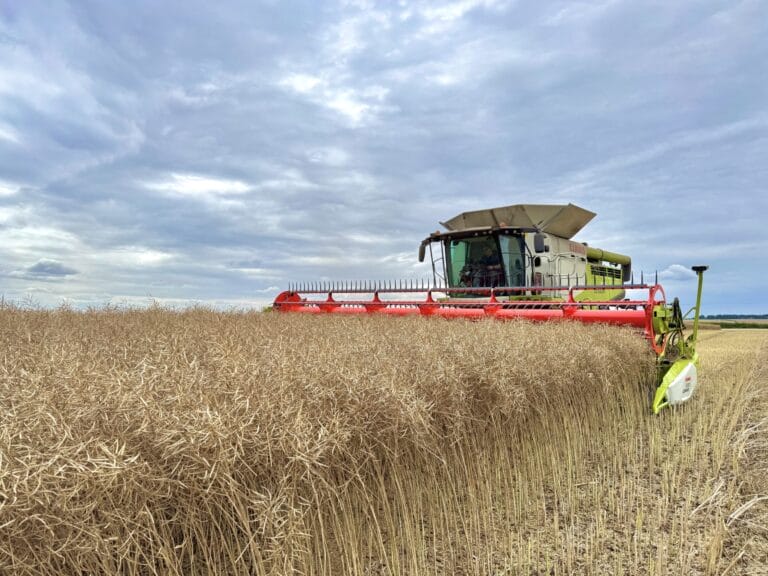
The Aspire was harvested on Sunday 4th August, and the results have been amazing considering the tough start that crop had – afterall it’s only 0.5t/ha less than we had in our record breaking oilseed rape crop last year!”
Key Crop Facts
OSR following spring barley 2018, winter wheat 2017
Soil type: Grade 2 chalky loam
Pre drilling Cultivations
Lemken Terra Disc at 15 cm depth
Vaderstad Carrier at 10 cm depth
Vaderstad Drill
Roll
Combine: Claas Lexion 750
Crop weighed over AW Smith and Sons weigh-bridge at Belchford
Choosing a good all-rounder barley
Growers in the north-west are sticking with Sienna as their barley of choice because of its good all-round qualities, says Agrovista agronomist Steven Gate.
“With Sienna there are no trade-offs or compromises. It has excellent grain quality, a good yield and a decent straw.”
Growers were recording good specific weights as high as 67kg/hectare, in last year’s challenging north-west England harvest.
Sienna yielded very well for both grain and straw, and its only weakness being that if harvest opportunities were missed due to unforeseen circumstances, such as contractors being committed elsewhere, then the variety did take a battering from the inclement weather we experienced last autumn, he said.
As well as being approved for malt distilling, it is also very popular for home feeding of livestock, in Cumbria and south west Scotland.
Soils in these arable areas are mainly light sandy loam, and their free draining characteristics are helpful to growers getting their spring barley crops drilled in late March or early April. They are then ready for harvest by late August or early September.
As with most crops, getting the seedbed right is key, with fine tilth and a good fertiliser diammonium phosphate (DaP) as well as nitrogen (N).
A target of 110kg/ha of total N is aimed at, taking into account in-depth soil sample results, field history and any organic manures applied prior to establishing the crop, says Mr Gate.
Of this, at least 1/3 of the requirement needs to be placed in the seedbed as near the seed as possible, and the remaining applied when the tramlines are visible.
Locally-held trials in 2019 showed 15-20% more tillers in crops that had received DaP, he reveals.
“This is a significant difference, and at our Open Day in July, this difference was still visible.”
He wanted to take the trial plots through to harvest to record yield, but unfortunately last year it was not possible.
“Getting the nutrient strategy right helps the crop to get away quickly too, so it has time to develop.”
“There is a lot of livestock in our area, and soil fertility and structure is kept to a good standard, thanks to applications of farmyard manure (FYM)” he notes.
He recommends aiming for 300 surviving plants/m2 for crops drilled early to mid-March, rising to 325-350 for later sown crops. Seed rates of 160-180kg/ha are recommended, depending on thousand grain weight (T.G.W).
The variety’s disease resistance is also very good, he notes.
“A split prothioconazole-based fungicide with the addition of chlorothalonil (CTL) at T2 has kept the crop clean in the past. However, with the absence of CTL going forward, we may see Ramularia pressure increase.”
Moving on to talk about tips for getting the best out of the variety, he reminds growers to include a PGR programme to keep it standing.
“It can get a little bit tall, so you need to keep the height manageable, but the straw length remains good afterwards.”
“Overall, Sienna is a really good variety to work with; it is clean and it goes through the combine well.”
John Maxwell of J G Maxwell & Son c2 seed producers in Dumfriesshire says:
“Sienna performs very well for us and our customers, producing a good bold grain along with good amounts of straw which suits the requirements of mixed farmers in south west Scotland.”
Richard and Geoff Graham of Egremont put all their 50ha of spring barley to Sienna and have done for a number of years.
Richard says: “We like the grain yield and quality that Sienna produces, along with the good amount of straw.”
“A great all-rounder.”
Why LG Diablo is making strides into the malting barley market
LG Diablo, which was recommended in 2018 and achieved full approval for distilling in 2019, is set to make significant in-roads into the spring barley acreage this spring and claim its place as a mainstream variety.
As with all malting barley’s, there is a considerable time lag between recommendation and market take-up. However this does give growers and end-users time to see how the variety really performs from one year to another, explains Dr Steve Hoad, of the SRUC.
“Newcomer LG Diablo is giving the end-users the confidence to break up the market dominance held by Concerto and more latterly Laureate, based on what they have seen from the variety over the last few years as it goes through testing and evaluation.”
“As a dual purpose variety with its very good grain and malting quality, LG Diablo ticks all the right boxes, and the results so far are very promising, with just the final hurdle of brewing approval to come later this spring,” he adds.
Don Peters, seed manager for Scotgrain Agriculture, the procurement arm of Bairds Malt, is excited about the addition of LG Diablo to the malting barley portfolio, having had the variety in macro scale evaluation over the last two years.
“LG Diablo will be one of the mainstream varieties being contracted for harvest 2020. It was the first distilling bulk we processed from the 2019 crop and we are pleased to report vigorous germination despite the relative immaturity.”
“The malt quality showed high extract and associated predicted spirit yield, so we are confident our distiller customers will be pleased with the variety when they process it.”
“One of the reasons LG Diablo processes so well is that its hot water extract is a similar level to that of Concerto – a trait that helped Concerto to become a benchmark variety. A high hot water extract is heavily desired by the end user in order for them to achieve higher sugar extraction rates from the malt and the ability to create more alcohol”, explains arable technical manager for Limagrain, Ron Granger.
“LG Diablo also has a very good specific weight, which is important in the malting industry as malting is a volume-based process and low specific weights cause reduced throughput in the processing plants.”
He points out that this will be more significant than ever this spring with more barley going into the ground across the UK to make up the deficit from reduced autumn winter wheat plantings, as in times of over production, growers with low specific weight parcels will incur penalties if specifications are not met.
For growers and processors alike, LG Diablo’s very high yields are exciting, particularly in the north with a yield of 107%, out-performing other leading varieties such as RGT Planet and Laureate, by a significant amount, he says. LG Diablo’s untreated yields also sit at the top of the table alongside Laureate at 97% of control, and 2% over that of RGT Planet, demonstrating the variety’s very robust disease resistance profile.
“The variety has shown resilience, as shown by its consistent yield performance in the very testing seasons of 2018 and 2019.”
In terms of agronomic package, LG Diablo has straw characteristics similar to RGT Planet; medium in height (73cm) with good lodging and brackling resistance. On the 2020/21 AHDB Recommended List, LG Diablo’s maturity is rated at +1,” says Mr Granger.
Gordon and Graham Mackie of The Laws Farm, Kingennie, Dundee, have grown LG Diablo for two seasons and have been so pleased with its performance, that they will up the acreage this spring.
“We talk to Bairds malt about any new varieties worth looking at and try a small area alongside our established varieties. A couple of years ago, we started growing a small area of LG Diablo alongside Chronicle and Sassy to see how it would do on our farm – and whereas before we have seen slight incremental improvements from a new variety, LG Diablo demonstrated a real step change in performance,” Gordon explains.
“We have had fantastic yields across the farm in different fields and very different seasons. Last year we had over 7.5 t/ha, and no issues with quality.”
“There’s no doubt the variety is pushing the boundaries of current yields whilst holding onto its quality specification.”
“Maturity wasn’t an issue for us, and let’s face it, we can’t harvest over 80 hectares of barley in a day, so a spread of varieties and maturities works well. We harvest the Chronicle first, then Sassy followed by LG Diablo.”
“Importantly, straw yields are also good.”
“In the wetter conditions last year, we didn’t see any skinning or brackling. We also found LG Diablo easy to handle in the combine; it thrashed well, and it flowed really easily, taking half the time to tip.”
Further north, the enthusiasm for LG Diablo is as strong; Stewart Grant of TW Grant, Faich-hill Farm, Gartly near Huntly, started growing a small amount of LG Diablo after being impressed with it in local trials.
“It certainly looked like it ticked all of the farmer boxes, and it has not disappointed. LG Diablo was our highest yielding variety last year, bringing in around 7.9 t/ha – well above that of Concerto and Laureate, with no quality rejections.”
Mr Grant likes to have a range of maturities so that he can spread harvest out, so last year the Concerto was harvested first, then Laureate followed by LG Diablo.
Mr Grant will aim to grow about 120 hectares of LG Diablo again this year, if not a fraction more, depending on his field sizes and will stick with the three varieties as it helps to manage risk, and spread out harvest.
This is an approach that his agronomist John Watts of Agrii fully supports. “Having such a large area down to one variety is simply not an option.”
“We adopt a “little and often” approach to fungicide use, applying three sprays at approximately three week intervals which we find gives us good, season long protection.”
“This is important not only in maximising yield but also in protecting malting quality in an area which can get significant rainfall. The 2019 growing season demonstrated this with a very wet June presenting us with lush crops carrying tremendous yield potential but with high Rhynchosporium pressure.”
“The LG Diablo responded well to our fungicide programme and delivered good yields which fell within malting specification.”
The Laws Farm, Kingennie, Dundee
Faich-hill Farm, Gartly, Huntly
400 hectares between 3 sites
540 hectares
Rotation of potatoes (ware), wheat, spring barley, winter oats, oilseed rape, winter barley, 75 suckler herd
Rotation spring & winter barley & permanent grass
Soils in good condition range from sandy loam to heavier clay loam
Soils are predominantly good loamy soils
Cultivations for spring barley: conventional plough and 1 pass system with seed sown behind harrow
Cultivations: Plough, drill and roll
2019 LG Diablo drilled between 28th and 30th March at a rate of 200kg/ha
2019 LG Diablo drilled beginning March at a rate of 190kg/ha
Nutrition: 500kg/ha Yara 14:13:21 + S compound at sowing and a top dressing of 177kg/ha of 33.5% N Yara Extran at crop emergence
Nutrition: 350kg/ha 10:26:26 at sowing
The Grants target 120kg/ha N on their malting barley so 245kg/ha Nitram is top dressed on as soon as tramlines are visible
Harvest Date: 25-08-19
Harvest Date: Beginning Sept
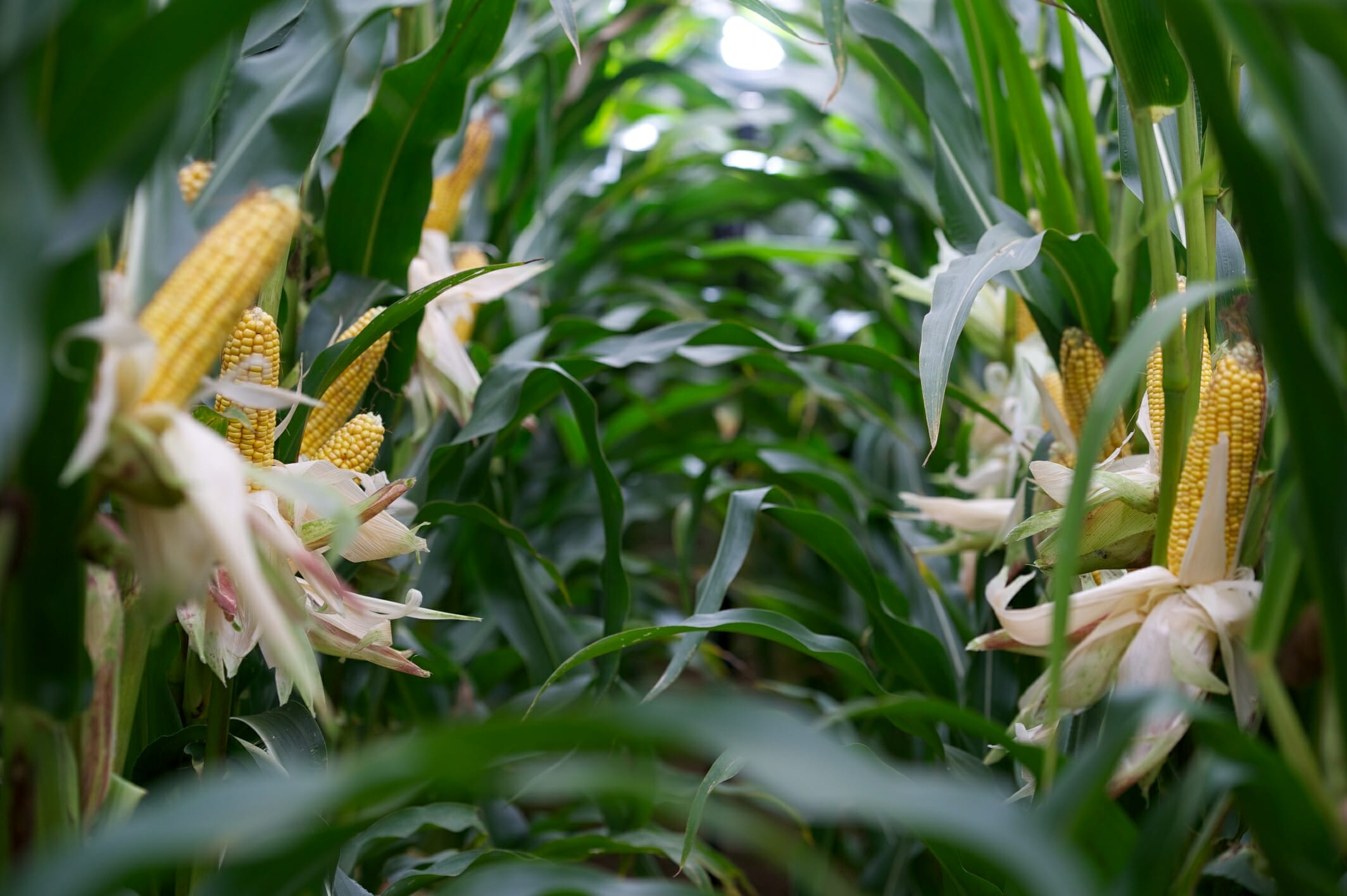
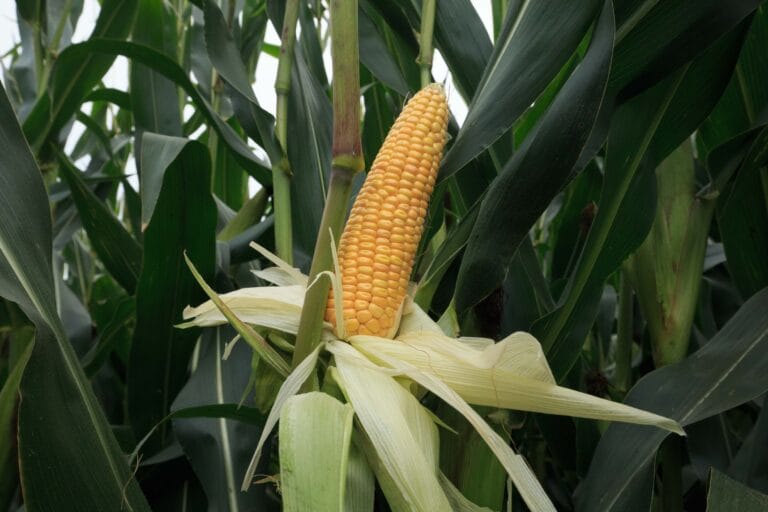
Correct variety choice allows maize to deliver in challenging circumstances
At 520 feet above sea level, on heavy clay loam soils and with over 38 inches average rainfall, Great Lakes near Holsworthy in North Devon is certainly a marginal site for growing maize. But this hasn’t stopped Nick Shadrick from achieving excellent results with the crop.
Nick Shadrick (left) with Paul Cholwill, Harpers Feeds.
Nick runs a herd of 70 cows averaging 9000 litres through a De Laval robot, but a second robot will be installed next year, and the herd size will increase to around 120. The cows graze in the summer and are fed big bales grass silage when housed. But for the last five years, maize has been an integral part of the system.
“While the cows were milking well, we thought they were capable of doing better,” comments Paul Cholwill from Harpers Feeds who advises Nick. “Milk ureas were high and so we decided the diet would benefit from more starch. As concentrates are only fed through the robot, maize silage was the obvious choice and would have rotational benefits but growing it would be a challenge.
“We had to plan for a short growing season as with heavy soils and plentiful rain we had to budget for possibly late drilling. We also needed it off early while we could still travel easily and not be left with a difficult harvest. This meant early varieties with good early vigour, but at the same time we need feed quality”
In the first year Nick grew 10 acres of Ambition as it met his criteria and he knew it grew well in the area. All field work is undertaken by local contractor F J Webber & Sons and the acreage has increased with an additional 12 acres grown on his son-in-law’s farm. As cow numbers increase, he will move to grow closer to 30 acres annually.
“We find maize fits our system well as it gives us an outlet for slurry,” Nick explains. “We don’t rush to drill, waiting until the soil has warmed up and we can work the ground down well. This year we didn’t drill until the second week in May but as we choose varieties with good early vigour, we know they will get away strongly, and by selecting early maturing varieties we can be confident of getting the crop off early most years. We have been growing continuous maize for four years.”
This year for the first time he grew the LG variety Pinnacle which is maturity class 9 (FAO 190) making it very early. He moved from Ambition on the recommendation of Paul Cholwill who emphasised the excellent ME yield and content coupled with a high starch yield in Pinnacle.
“The crop got away well and looked good all season. When we had the crop NIR tested, the indication was that it would be fit in early October, but we had to wait for the weather and eventually harvested a few weeks later and our contractor said it was the best crop he harvested this year, averaging 18 tonnes/acre.
“The maize has analysed well at 35.5% dry matter, 11.2 MJ/ME and 31.7% starch. We are feeding around 10kg maize per cow per day along with 20kg of baled grass and some molasses in the trough. Since going back on the maize, we have seen milk quality improve, we are averaging 30 litres per cow and the top cows are giving 50 litres plus.”
Paul Cholwill says Nick’s success demonstrates the benefit of selecting varieties carefully, taking account of the site class and growing conditions. “Maize is not the cheapest crop to grow but you can do a lot to maximise the return on investment and exploit the benefits it can bring.”
Soft wheat, LG Skyscraper remains at the top of the AHDB 2020-21 Recommended List after another promising season, yielding 105% over controls.
“LG Skyscraper has continued to demonstrate its ability to perform across a wide range of situations and environments, says Ed Flatman, senior wheat breeder for Limagrain UK.
“The variety has now shown over a series of contrasting years, its capacity to establish well and develop a good foundation in the early season, which it then converts into a consistently top yield of sound bold grain.”
Agronomically, the variety has held up well; its rating for yellow rust has held fast when many around have fallen and its brown rust rating has gone up from 5 to 6 on this year’s Recommended List.
Ed Flatman, Senior Wheat Breeder for Limagrain
LG Skyscraper also has Orange Wheat Blossom Midge resistance (OWBM) which is an important trait that is of increasing value in wheat varieties due to restrictions on insecticide products, says Mr Flatman.
LG Skyscraper’s excellent performance across the UK, once again dispels any myths surrounding soft wheats being lower yielding than hard wheats, adds Limagrain’s arable technical manager, Ron Granger.
He points out that LG Skyscraper offers a large grain and its specific weight of 76.9 kg/hl and HFN coming in at 218, makes an attractive package when compared to other feed varieties.
“As a soft wheat, LG Skyscraper has the additional benefit of distilling, which in a season when it will be critical to make as much as possible from crops in the ground, is a very valuable attribute.”
For many growers who are still looking to drill their wheat, it is worth noting that in Limagrain’s 2019 trials, LG Skyscraper was the highest performing variety in the late drilled slot. In fact, the variety has shown itself to take this poll position over three very different seasons, he points out.
“LG Skyscraper can be drilled comfortably up until the end of January, and even later into February further north, but seed rates will need to adjusted accordingly.”
“LG Skyscraper ticks a lot of boxes for on-farm performance and is an excellent choice for the second wheat situation,” adds Mr Granger.
Ron Granger, Arable Technical Manager for Limagrain
FARMER PROFILE
With a best yield of 13 t/ha, a good disease profile and flexibility on planting date, LG Skyscraper has performed very well for Peterborough-based grower, Seb Richardson.
The variety has proven itself in a testing year and plans are now to increase the acreage where it will be grown, he says.
It performed well across soil types, averaging 10 t/ha, up over the five year farm average – even where it was planted on thin ground productivity held up, providing yields of 8-9 t/ha.
“The crop was mostly drilled in the third week of October, but the last field was not drilled until mid-November but we still got close to 11 t/ha from it,” he explains.
However, he feels that given the right conditions, the yields could have been even better; “the drought early in the year held back the yields from LG Skyscraper.”
Situated on Northampton heavy clay soil, he finds a conventional tillage regime, subsoiling to break the pan, ploughing and pressing to be the most effective.
His normal routine comprises three fungicide applications, combined with the use of pre-emergence herbicides plus another for broad-leaf weed and volunteer bean control. Moreover, Mr Richardson found that while he followed a sound fertiliser regime which included micronutrients and foliar feed, he did not need to apply any special nutrients.
Moving on to talk about some of the difficulties of the 2019 growing season, he points out that lodging was not a problem despite the really heavy June rainfall.
Peterborough-based grower, Seb Richardson
“There was just one field, which had received a lot of farmyard manure the year before, where the crop went down.”
Cabbage stem flea beetle has made it no longer feasible for Mr Richardson to grow oilseed rape, so, in addition to increasing the wheat area, he is also growing more winter beans.
“We find beans make a nice entry into a first wheat,” he continues, remarking that he does not grow second wheat. “Beans can be grown in a rotation of five to seven years, and this fits with our system of growing a mixture of winter and spring crops.”
“We are very pleased with LG Skyscraper; we like both its versatility and its yield – not forgetting its disease profile helps us keep fungicide use to a minimum.”
“Next year, not only will we be growing it again ourselves, but also on the contract farm we manage.”
Farm Facts
Area farmed: 500 ha at home + 200 ha contract farming
Soil: Heavy clay, Grade 3 Northamptonshire soil
Crops grown: Winter wheat, winter barley, winter beans, spring barley & spring oats
Drilling dates: 20th, 21st & 22nd October, 2018
Seed rate: 425 seeds per sq. m
Nutrition: Nitram double top, DAP (Diammonium Phosphate), good spectrum micronutrients (including manganese, zinc and potassium), plus later in the season – a foliar feed with manganese and potassium.
Crop protection: Herbicides: Avadex (thiocarbamate) and Crystal (flufenacet + pendimethalin) applied pre-emergence. Also a herbicide for broad-leaf weeds, applied for bean volunteer control.
Fungicides & PGR’s: Applied at T1, T2 and T3, to control Fusarium and rust.
LG Skyscraper – the variety of choice for flexible drilling
Winter wheat LG Skyscraper is quick to get going in spring and also quick to pick up tillers, says contract no-till farmer Aaron Hogsbjerg who grew the variety for the first time this year.
“We really like LG Skyscraper because it is vigorous and fits well with our no-till regime,” he says. Despite the challenging weather conditions of 2018, he achieved an average of between 9-10t/ha and compared well with other varieties grown on the Suffolk and Essex-based farms where he works.
For Aaron, planting date flexibility is a real benefit, and he reports that even the fields sown the week before Christmas went to 9t/ha. “We were chuffed to bits. We used to grow Evolution, but LG Skyscraper is streets ahead.”
A different variety sown on 25 November only did 8.5t/ha, he reports, adding that Graham works well when it is in the right place and conditions are right, but is renowned for its slow growth. “LG Skyscraper was quick to establish across the farm, and worked equally well across a number of soils, from sandy and clay loams, and even patchy light sand.”
“Since changing to a no-till regime, the improvement in the soil has been remarkable, it was now nicely friable and the crop was out of the ground in seven days.” Moreover, he remarks, even in wet weather of autumn 2019 he has been able to get on the land, and drilling through a cover crop keeps mud off the drill. However, drilling in a no-till regime can result in a few plants being lost early on, so seed rates ranged between 400 and 550 per m2, with the later drilled crops getting the higher rate.
“It sounds quite a high rate, but it gets us the results we wanted,” says Aaron. He notes that because of its height, when growing LG Skyscraper, treatment with a PGR is necessary but effective; for example despite the heavy rainfall in June 2019, none of it fell over. “This could be a problem in other years, but you can manage crop height using PGRs.”
Moving on to talk about his strategy, he explains that 25% of the land is used for growing sugar beet, and rotations can be three, five or seven years, depending on the land and conditions. “We have been building our confidence in the break crop, and next year we might grow more oilseed rape.” Aaron follows a standard programme with a “no fire engines” approach particulary at the start of the season. “We are believers in feeding the crop to keep it healthy to keep chemistry use to a minimum, and we found that the crop kept itself quite clean.”
He tissue tests the crop to check for any nutrient deficiencies. This year plants were low in boron, resulting in top-ups of both boron and manganese and reduced rates of fungicides. Moreover, he was pleased to discover that even in the late, wet harvest of 2019, bushel weight held up, where other varieties may have struggled. “LG Skyscraper is a nice variety to combine and the straw chops well.”
Plans are to grow more of it, and it will be Aaron’s variety of choice for late drilling after sugar beet. “Of course, so far we have only grown it for one year, but we really like this variety.”
Three year: Sugar beet, spring barley, winter wheat
Fertiliser: Liquid
Crop protection: Fungicide applied at T0 and T1 or T1.5
Herbicide Strategy:
Pre emergence: Movon (Flufenacet + flurtamone + diflufenican) Wicket (Prosulfocarb)
Post emergence: Sunfire (flufenacet) Claymore (pendimethalin) where needed
Early spring: Broadway star (pyroxsulam + cloquintocet-mexyl + florasulam) for broome patches
Sugar Beet varieties to fit a range of situations
Ron Granger, Arable Technical Manager gets the growers’ perspective on the on-farm performance of the latest sugar beet varieties…
Bolting resistance is key for sugar beet grower, Andy Cooper of North Norfolk and last campaign he turned to Betaseed’s BTS 3325, for early drilling.
Managing 730ha of tenanted land on the Sandringham Estate, north east of Kings Lynn, Mr Cooper typically grows three varieties across his 160ha beet area in early, mid and late-drilled slots. Strube variety, Haydn has taken the early slot into the farm’s sandy loams over chalk in recent seasons, with the variety having the lowest bolter numbers on the BBRO Recommended List when sown on or before 5th March.
However, Mr Cooper replaced Haydn with BTS 3325 for the 2018-19 campaign as it offered suitability for early drilling, plus higher yield and improved disease resistance. In 2018, the farm received half of its annual rainfall between January and March, so drilling was delayed until April and its bolting resistance was not tested, after conditions quickly turned hot and dry post-drilling.
Andy Cooper, Norfolk Farmer
However, Mr Cooper was pleased with the performance of the variety in its first year, despite the delayed establishment, giving an adjusted yield of 80t/ha from a late-November lift.
High-yielding sugar beet variety finds favour in Lincs
Lincolnshire sugar beet grower, Charles Roe has opted for variety BTS 1140 this year, lured by the potential for 7% higher yield over two of last year’s picks. Overseeing 243ha near Horncastle with his father, John, Mr Roe has grown sugar beet for many years on the farm’s mostly sandy clay loams but took a break for a decade, due to increasing levels of weed beet.
Charles Roe, Lincolnshire Farmer
The crop returned to the rotation for the 2018-19 campaign and he opted to split his 30ha area between three varieties; Betaseed’s BTS 3325, Haydn and Firefly. With individual varieties outclassed relatively quickly as the remarkable improvement in sugar beet yield potential continues, the farm opted to revise its variety line-up this year. Mr Roe believes yield is king when selecting a sugar beet variety and at 104.9% of mean adjusted tonnes, BTS 1140 offers a massive 7% increase over BBRO Recommended List control varieties; Haydn and Firefly, which it has now replaced. “When you are looking at Recommended Lists, I can’t get excited about one or two per cent, but anything over 5%, I see as significant and that’s why we went with BTS 1140 this year,” he explains.
Limagrain UK 2020 UK beet crop varieties
BTS 3325
Has good early sown bolting tolerance, outyielding many of the traditional varieties in this early drilling slot. It has a very high sugar content and good overall disease resistance.
BTS 1140
Offers a significant yield advantage over many varieties on the new BBRO Recommended List. It offers a high sugar content, combined with good foliar disease tolerance.
BTS 4100
Joins the 2020 BBRO Recommended List with the highest sugar content of any sugar beet variety. It has high yields and low bolting counts at early sowing.
On-farm thoughts from Rob Atkin of Field Farm, Field, Uttoxeter
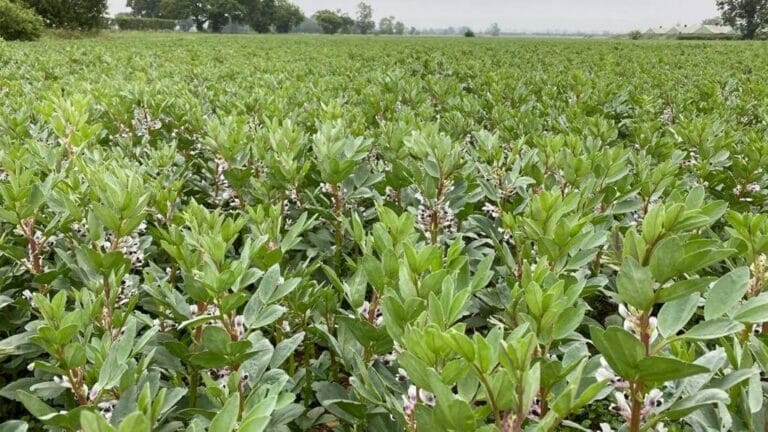
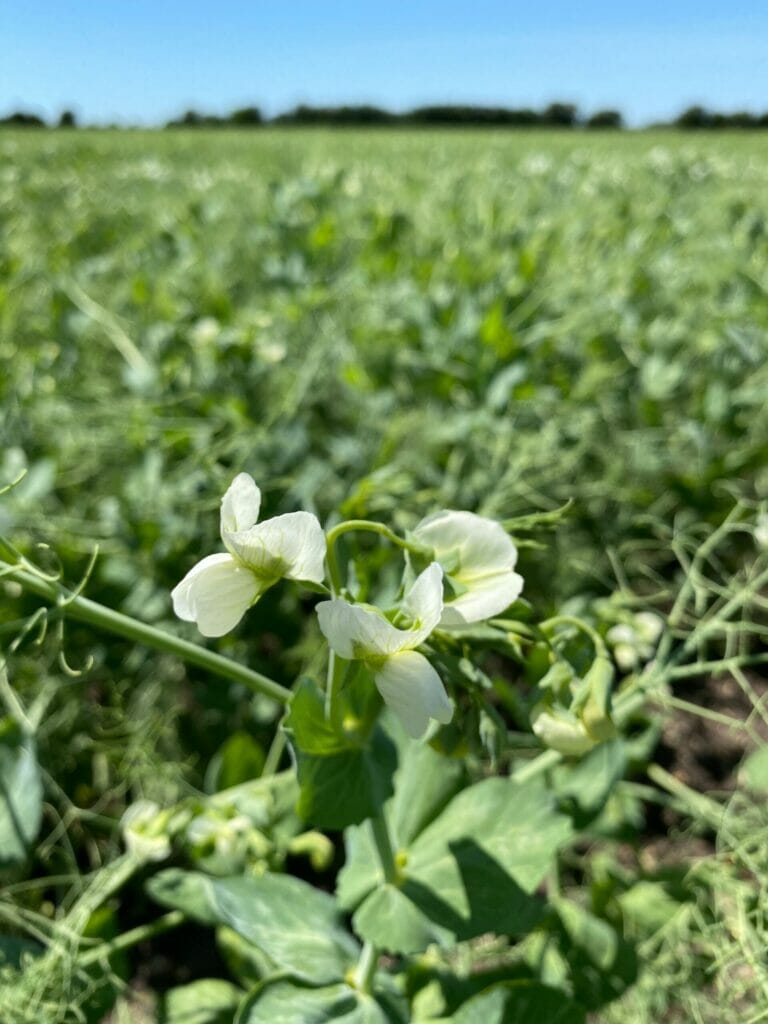
For Rob Atkin of Field Farm, Field, Uttoxeter, it is the perfect opportunity for him to exploit a new market for his bean crop.
“We have grown beans since 2010, and have alternated between springs and winters depending on the rotation. However, with the opportunity to grow for Frontier’s processing plant which is fairly local, it made sense to opt back into spring beans.”
“As an alternative break crop, they have a valuable place in the rotation and if you get beans right, they can be a profitable crop, as they don’t really require high inputs.”
Mr Atkin has chosen to grow the variety; LG Cartouche, as it offers the highest protein content available on the spring bean PGRO Recommended List 2019, sitting 1.3% ahead of any other pale hilum variety at 29.1%.
“To meet the 29% protein target needed by Frontier, it made sense to start at the highest genetic protein base level.” LG Cartouche is also high yielding with very good standing ability and is early to mature. It’s a pale hilum bean, that’s also suitable for the premium human consumption market. “Rob will be following our bespoke agronomy advice, using dedicated yield and protein boosting products to ensure the crop
fulfils this potential,” explains Richard Plant, Frontier agronomist.
“Initial results from trials indicate that some of the new bio-stimulants have a positive effect on yield and protein. When used early in the growing crop, they have improved rooting and nutrient utilisation which helps in pushing for that extra quality.”
“LG Cartouche responds particularly well to this, with its higher base level protein content.” Mr Plant points out that should the beans reach human consumption quality, there is still an option to trade them for the more lucrative human consumption market.
Growing beans for a protein premium
Frontier is offering an attractive price of £40/tonne* for beans above November wheat futures, with an additional £10/t premium for growers who opt for Frontier’s specialist bean agronomy package and achieve the required 29% protein targets.
This comes about with the opening of a new de-hulling plant near Nottingham in July of this year, where beans are processed to produce a protein-rich binding agent that’s attractive to the fish farming industry.
* Contract premium correct as of 18th February 2019. Premiums can go up or down depending on market movement.





















 “However the crop was left in the ground over winter and in the spring, Mr Lamyman walked the field with Ron Granger of Limagrain UK. They both believed that there would be learnings to be had from what had gone wrong, so the OSR was entered into the


 “We really like


